







Amazon has officially expanded its smart home ecosystem with a fresh generation of Alexa-powered hardware, headlined by significant capability upgrades to two of its most popular smart speakers. The tech giant introduced an overhauled Echo Dot and an innovative, vision-enabled Echo Studio, alongside devices like the Echo Show 16, the Echo Time smart clock, and the Alexa Photo Frame.
This hardware refresh arrives at a fiercely competitive moment for the consumer smart home market. Just weeks after Apple announced the HomePod mini 2 and its new HomeView smart home hub, Amazon is aggressively leaning into universal connectivity, local processing, and spatial awareness to maintain its footprint in modern households.

Main Facts and Hardware Overview
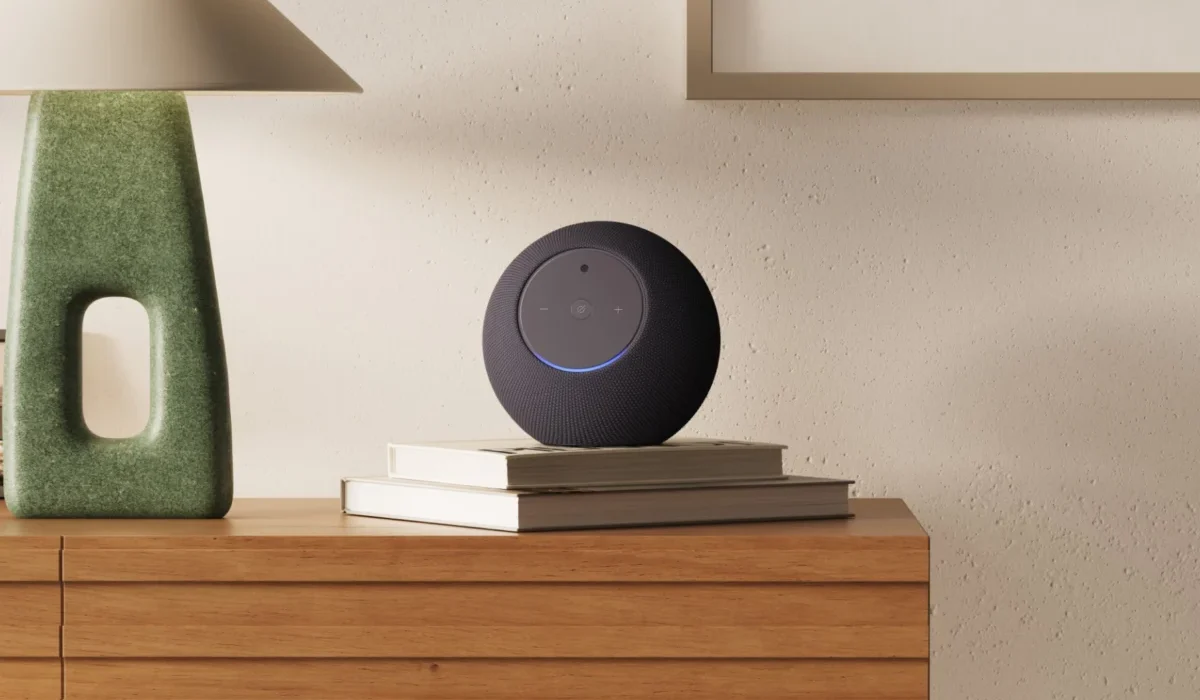
The redesigned Echo Dot retains its familiar fabric-wrapped spherical silhouette, but beneath the exterior lies a complete architectural overhaul. Priced at $99.99, the new Dot now features a built-in smart home hub supporting Zigbee, Matter, and Thread protocols. This inclusion allows users to directly pair and control compatible third-party smart lights, door locks, and thermostats without requiring an intermediary bridge or separate hub.
Audio performance has also been heavily revised. Amazon reports that the new Echo Dot delivers 50% more bass than its predecessor, driven by an improved acoustic architecture. Processing power sees a substantial leap thanks to the integration of the AZ3 chip, which is specifically optimized to handle advanced voice models and the upgraded capabilities of Alexa+. Furthermore, the device incorporates a fourth microphone array to dramatically improve voice command accuracy in noisy environments, alongside Omnisense technology capable of tracking room temperature and human presence.
Complementing these features is a built-in eero Wi-Fi extender capable of expanding an existing eero network’s coverage by up to 1,000 square feet. For younger demographics, Amazon also rolled out an Echo Dot Kids edition, priced at $109.99.

Meanwhile, the flagship Echo Studio has received a much more radical and controversial upgrade. Available now for $249.99—with the legacy camera-free variant remaining available at $219.99—the new Echo Studio incorporates an integrated optical camera. This addition is designed to give Alexa+ computer vision capabilities, allowing the speaker to visually recognize physical objects held up to it. Users can present a board game box to ask for rule clarifications or hold up household products to trigger automated reordering through Amazon’s retail pipeline.
Despite the addition of visual sensors, the speaker preserves its high-end acoustic pedigree, featuring a high-excursion woofer, three mid-range drivers, and spatial audio support via Dolby Atmos, complemented by automatic room-calibration tools.
Chronology and Market Context
The rollout of these devices represents the culmination of Amazon’s multi-year strategy to transition Alexa from a reactive voice assistant into a proactive, context-aware ambient intelligence platform. Over the past two decades, smart speakers evolved from novelty music players into the central nerve centers of connected households. However, fragmentation across connectivity protocols—such as Zigbee, Z-Wave, and Wi-Fi—historically created friction for consumers attempting to unify disparate device ecosystems.

The adoption of the Matter standard by major tech conglomerates, including Amazon, Apple, and Google, marked a turning point in interoperability. By embedding native Matter, Thread, and Zigbee controllers directly into entry-level hardware like the Echo Dot, Amazon is systematically removing financial and technical barriers to smart home adoption. Consumers no longer need to purchase expensive standalone hubs to build a responsive, multi-brand automated home network.
Simultaneously, the integration of cameras into room-filling audio gear like the Echo Studio mirrors an industry-wide push toward multimodal artificial intelligence. By allowing voice assistants to "see" as well as "hear," tech companies are attempting to bridge the gap between digital queries and physical inventory management, home security, and interactive entertainment.
Supporting Data and Technical Specifications
A closer examination of the internal architecture highlights the technological leap between this generation and older iterations:

- Echo Dot (New Generation):
- Price: $99.99 (Kids Edition: $109.99)
- Connectivity: Built-in Zigbee, Matter, and Thread hub; integrated eero Wi-Fi extender (adds up to 1,000 sq. ft. of coverage).
- Audio & Processing: AZ3 silicon chip optimized for Alexa+, 50% increase in low-end bass output, four-microphone array.
- Sensors: Omnisense presence and temperature detection.
- Echo Studio with Home Camera:
- Price: $249.99 (Camera-free model remains at $219.99)
- Optics & Vision: Integrated camera supporting visual object recognition via Alexa+, Live View through the mobile app, and upcoming Fire TV video-calling integration.
- Acoustics: High-excursion woofer, three full-range drivers, Dolby Atmos audio processing, and automatic spatial tuning.
- Privacy Controls: Hardware kill-switch button to physically disconnect the camera and microphones, paired with an active indicator LED during cloud data streaming.
Privacy Safeguards and Official Responses
The inclusion of an active camera inside a stationary living room speaker naturally raises data privacy questions. Industry analysts have frequently noted consumer reluctance toward ambient optical monitoring devices inside private living spaces.
To address these concerns, Amazon has implemented explicit hardware-level safeguards. The new Echo Studio features a dedicated physical button that completely severs power to both the camera sensor and the microphone array. Additionally, the device is engineered with a hardwired indicator LED that illuminates brightly whenever image or video feeds are actively processed or streamed to cloud servers.
While advanced features like object recognition and Live View rely heavily on cloud-based AI processing through Alexa+, Amazon continues to emphasize user control permissions within the centralized Alexa mobile application, allowing households to restrict or permit camera access on a room-by-room basis.

Broader Industry Impact and Implications
The simultaneous launch of these two distinct smart speakers underscores a widening bifurcation in the smart home market. On one end, affordable, utility-driven hubs like the Echo Dot are becoming invisible infrastructure—embedded with routers, temperature sensors, and universal protocols to manage daily routines quietly in the background. On the other end, premium devices like the Echo Studio are pushing into experimental territory, combining high-fidelity audiophile hardware with advanced computer vision.
As competition intensifies between Amazon’s Alexa ecosystem, Apple’s expanding HomeKit and HomeView infrastructure, and Google’s Nest lineup, the battleground has shifted from simple voice recognition to ambient contextual awareness. Devices that can dynamically adjust indoor climates based on occupancy, expand wireless network ranges, and visually interact with physical household objects are setting a new baseline for consumer expectations.
Whether mainstream consumers will embrace camera-equipped audio equipment in private spaces remains to be seen, but Amazon’s latest hardware lineup clearly signals that the era of the passive smart speaker has officially come to an end.