Tesla has officially signaled that its long-awaited next-generation Roadster is finally stepping out of the shadows of conceptual vaporware, issuing a firm date for a live demonstration. Following years of repeated delays, shifting timelines, and extraordinary performance promises, the electric vehicle manufacturer published a cryptic tease on social media, showcasing a vehicle positioned on a launch pad under the banner "Go for launch" alongside the date "10.01."
Subsequent updates and formal digital invitations dispatched to reservation holders have confirmed that the high-profile reveal event will take place on the evening of October 1 in Waco, Texas, situated roughly 90 minutes north of Tesla’s primary corporate headquarters in Austin. This announcement brings a definitive checkpoint to a development cycle that has spanned nearly a decade, reigniting consumer and industry interest in what was originally unveiled as a radical redefinition of automotive performance.
A Decadelong Chronicle of High Expectations and Slips
The genesis of the second-generation Tesla Roadster traces back to a surprise unveiling in November 2017, when Elon Musk rolled out the supercar at the conclusion of the Tesla Semi launch event. At the time, the specifications outlined by the company were nothing short of astronomical: a blistering 0 to 60 mph acceleration time of under two seconds, a top speed exceeding 250 mph, and an unprecedented 620 miles of range enabled by a massive 200 kWh battery pack. Initial targets pointed toward a full commercial market rollout by 2020.
However, the path from concept to manufacturing reality has been fraught with delays. As Tesla prioritized the scaling of higher-volume vehicles like the Model Y and the structural demands of establishing new gigafactories, the Roadster was repeatedly pushed down the corporate roadmap. At a shareholder meeting, Musk openly joked about setting a specific demo timeline to afford himself procedural "deniability" if the schedule slipped once more—an admission that underscored the engineering hurdles of bringing such a niche, high-performance vehicle to production. Despite these setbacks, vehicle engineering leadership has maintained that production will eventually take place at Gigafactory Texas, with a projected timeline targeting late 2027 or 2028.
The SpaceX Package and Sub-Second Physics
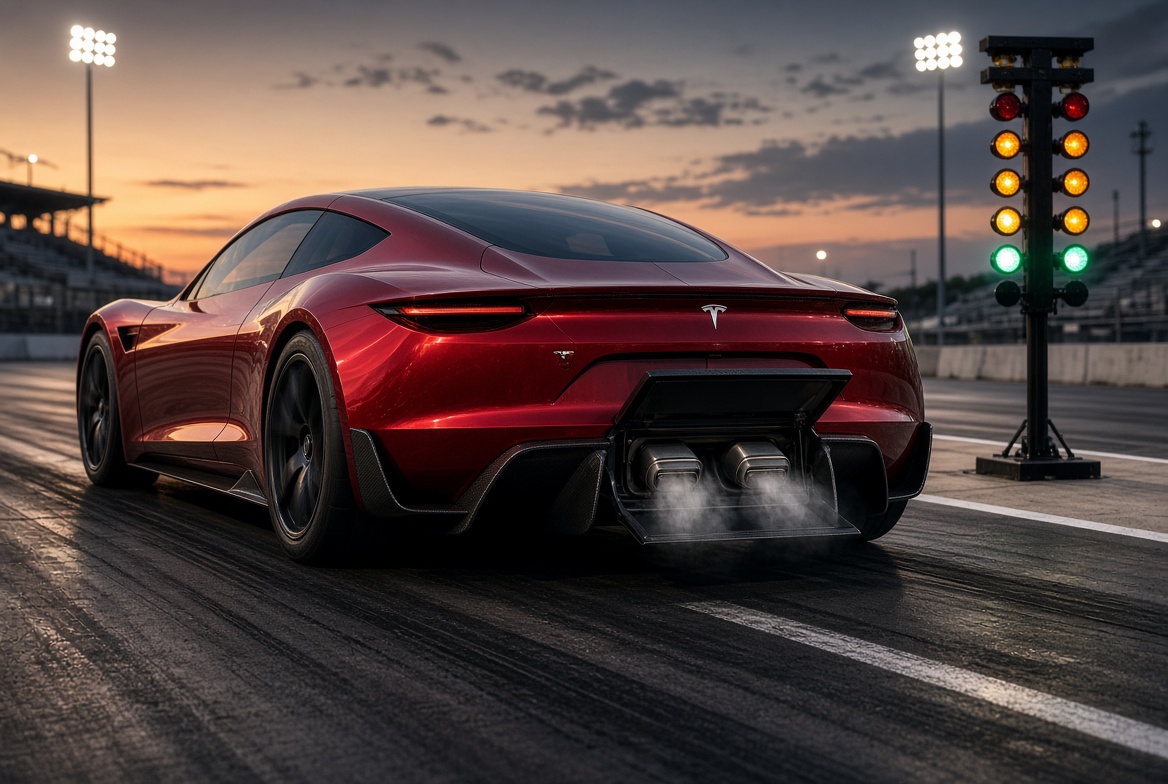
Central to the upcoming October 1 demonstration is the long-discussed SpaceX package, a feature set that elevates the Roadster from an exceptionally fast electric vehicle into something bordering on aerospace engineering. First teased in 2018, the system—internally designated with the code name A71 as a tribute to the legendary Lockheed SR-71 Blackbird—is designed to utilize cold gas thrusters powered by composite overwrapped pressure vessels, mirroring the tank architecture employed by SpaceX on its Falcon 9 rocket boosters.
According to statements made by Musk over the years, a Roadster equipped with the thruster system could theoretically achieve a 0 to 60 mph acceleration time of approximately 1.1 seconds, subjecting occupants to roughly 2.75 g of force during launch. Industry analysts note that such performance metrics would far surpass standard friction-limited tire traction, pushing the boundaries of what a consumer vehicle can physically achieve. Because of these extreme forces and the physical modifications required, this specific iteration is anticipated to be non-street-legal, likely distributed through a strictly limited track-only program.
Meanwhile, the standard variant of the Roadster is expected to retain its baseline pricing structure from 2017: a $200,000 base price alongside a $250,000 Founders Series tier, for which early adopters placed substantial reservations years ago.

Navigating Media Scrutiny and Public Perception
As Tesla prepares for its upcoming showcase, the company continues to navigate a turbulent media landscape regarding the safety and public framing of its driver-assistance software. This friction was recently highlighted when Musk publicly pushed back against mainstream media coverage of a fatal collision in Midtown Manhattan.
The incident, which occurred in the early morning hours, involved a 2024 Tesla Model Y striking street furniture before coming to rest several blocks away. Local law enforcement charged the driver with vehicular manslaughter, driving while ability impaired, and leaving the scene of an accident. Despite police charging documents attributing the crash to driver impairment rather than vehicle autonomy, early media reports drew intense scrutiny. Musk took to social media to criticize the reporting, asserting that the vehicle’s Autopilot system was not engaged and reiterating that engaged automated systems consistently demonstrate safety statistics superior to human-only driving.
This event mirrors previous high-profile incidents, such as a fatal crash in Katy, Texas, where initial headlines prematurely blamed vehicle automation before internal vehicle telemetry and prosecutorial investigations revealed full human override—specifically, the driver pressing the accelerator pedal to 100% in a residential zone. Figures across the political and industrial spectrum have increasingly pointed out a systemic media bias wherein Tesla is explicitly named in crash headlines even when human error or impairment is proven to be the sole root cause.
Integrating Space-Age Connectivity Into Autonomous Fleets
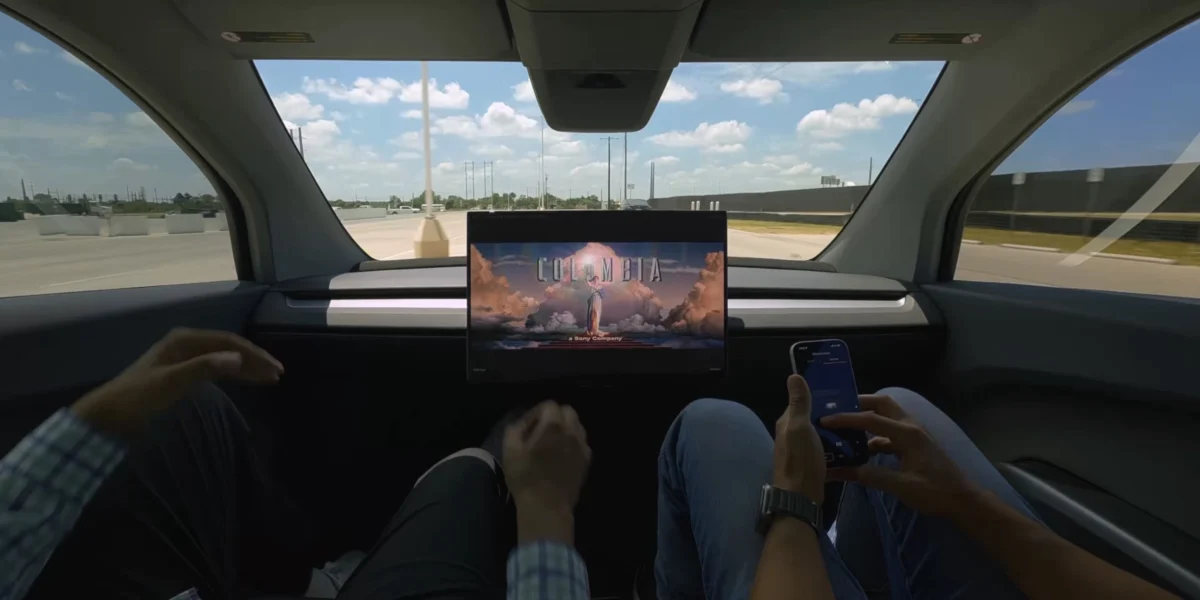
Beyond high-performance supercars and public safety discourse, Tesla is concurrently accelerating technological integration across its commercial autonomous lineup. Recent drone flyover footage from Giga Texas has revealed that the company’s newly minted Cybercabs are now rolling off the production lines with SpaceX Starlink hardware integrated directly into the rear hatch as standard factory equipment rather than as post-production retrofits.
The integration of satellite connectivity into the Cybercab fleet addresses a critical logistical challenge for autonomous ride-hailing networks: uninterrupted data flow. While Tesla’s artificial intelligence software and local computing power allow the vehicles to navigate independently without a persistent cloud connection, Musk has emphasized during quarterly earnings calls that the company cannot risk its robotaxis losing telemetry in rural dead zones or dense urban infrastructure environments characterized by cellular congestion. Furthermore, the inclusion of high-bandwidth satellite connectivity opens up expansive in-cabin entertainment possibilities for future passengers, including uninterrupted 4K video streaming and high-latency gaming during transit.
With the commercial rollout of autonomous services expanding across major metropolitan areas in Texas and Florida, the convergence of satellite hardware, advanced neural networks, and next-generation vehicle platforms underscores Tesla’s broader pivot toward autonomy and robotics.
Implications for the Broader Automotive Industry
The impending October 1 Roadster demonstration holds significant weight not just for Tesla enthusiasts, but for the luxury and supercar markets as a whole. By attempting to merge terrestrial electric vehicle dynamics with aerospace thruster technology, Tesla is setting a new benchmark for extreme performance engineering.
If the demonstration successfully showcases the promised sub-second acceleration and operational reliability of the SpaceX package, it will validate years of unconventional engineering claims and reassert Tesla’s technical dominance in the high-end EV space. However, the true test will lie in the transition from a specialized track demonstration to scalable manufacturing at Gigafactory Texas. As reservation holders prepare to converge on Waco, Texas, for the reveal, the automotive world watches closely to see whether the futuristic promises made nearly a decade ago will finally translate into a tangible, production-ready reality.