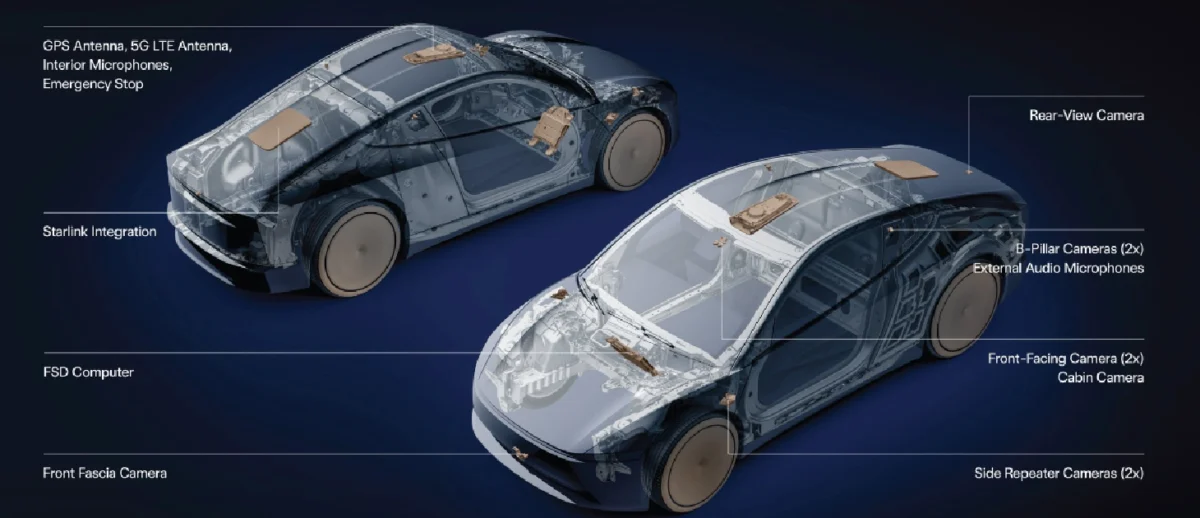
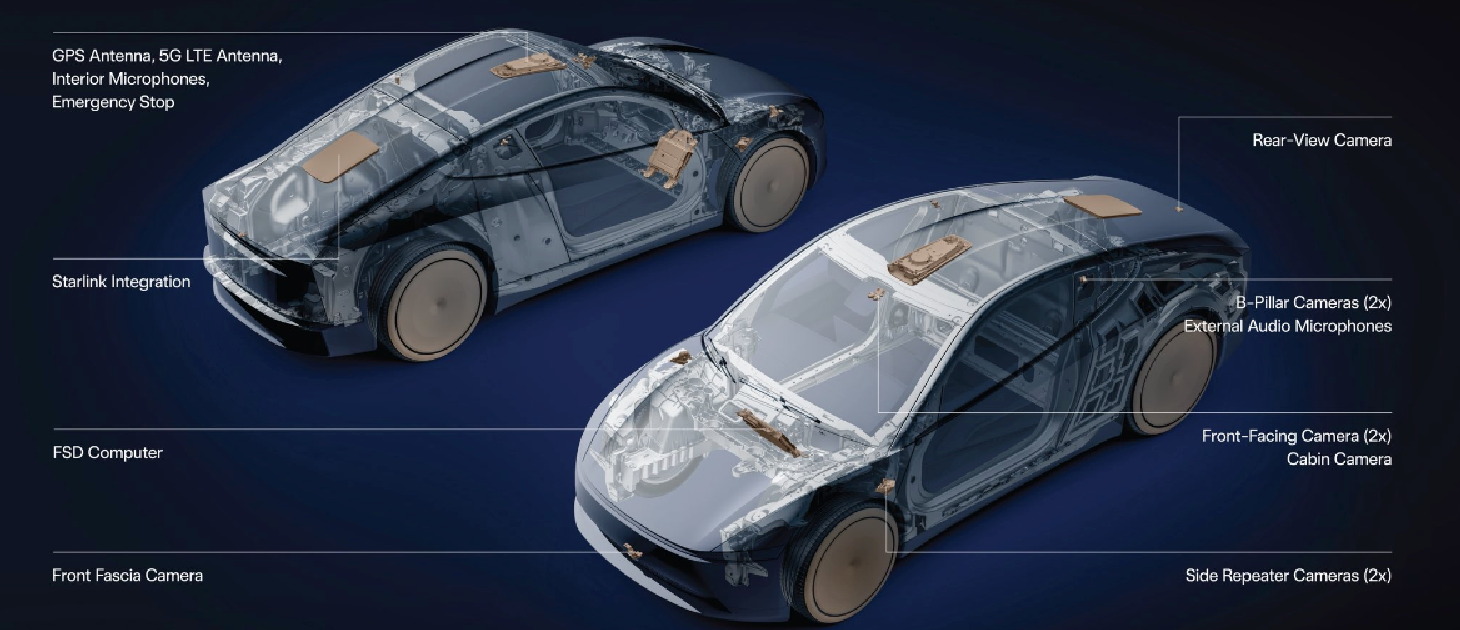
The future of autonomous transportation has taken an unexpected turn with the recent announcement from Tesla and SpaceX’s Starlink regarding the direct integration of satellite internet into Tesla’s highly anticipated Cybercab robotaxi. This development, revealed through a series of posts on the social media platform X, introduces a new layer of connectivity to the autonomous vehicle landscape, sparking both curiosity and questions about its immediate necessity and long-term implications. The integration features a Starlink antenna embedded within the Cybercab’s roof, as depicted in a detailed cutaway diagram released by the companies. While the companies have confirmed the integration, the precise rationale behind equipping a self-driving vehicle, designed to operate on its own sophisticated onboard computing, with internet access from space remains a subject of considerable discussion and analysis.
The Unveiling and Ambiguity of the Announcement
The initial reveal came in the form of two distinct but complementary posts. Starlink, a division of Elon Musk’s SpaceX, shared a graphic accompanied by the statement, "High-speed internet from space for the future of autonomous vehicles." This broadly framed the technological advancement as a cornerstone for next-generation self-driving technology. Tesla’s contribution was more concise, stating, "Starlink V5 directly integrated in Cybercab." The accompanying visual clearly delineates a dedicated "Starlink Integration" module within the vehicle’s roof structure, positioned alongside callouts for its advanced camera and sensor arrays.
However, the brevity of these announcements has left many details unspecified. Notably absent are concrete figures on performance metrics, a clear timeline for when this integrated system will be operational in production vehicles, or a comprehensive explanation detailing the specific benefits this satellite connectivity will provide to the Cybercab’s autonomous driving capabilities. This lack of granular information has led to a surge of inquiries, including pertinent questions posed on X by industry observers such as Fred Lambert, who directly asked for clarification on whether this integration is currently in production and, crucially, for the underlying reasons behind its implementation.

The Paradox of Onboard Autonomy vs. External Connectivity
A central point of contention and intrigue surrounding the Starlink integration is its apparent redundancy with Tesla’s established autonomous driving philosophy. Tesla’s Full Self-Driving (FSD) system, which is expected to power the Cybercab, is engineered to operate primarily on the vehicle’s onboard hardware. In the case of the Cybercab, this refers to the advanced AI4 computing platform. This system is designed to perceive its environment, make driving decisions, and execute maneuvers entirely without reliance on an external data connection. The core tenet of Tesla’s approach to autonomous driving has always been its self-sufficiency, meaning that even if the vehicle loses all external network connectivity, it should theoretically continue to operate safely and effectively.
While the primary driving functions are independent of connectivity, external data links are undeniably valuable for a range of supplementary services. These include real-time traffic updates and dynamic routing for optimized navigation, efficient fleet dispatch and management systems, remote diagnostics and support for vehicles experiencing technical difficulties, seamless over-the-air software updates that enhance performance and introduce new features, and in-cabin entertainment and connectivity for passengers. All these are crucial aspects of a modern transportation service. However, the argument against the immediate necessity of satellite internet for these functions in the Cybercab’s current operational context is strong.
Geographic Limitations and Current Operational Scope
The primary operational zones for Tesla’s robotaxi service, which is currently in a limited rollout phase, are concentrated in densely populated urban and suburban areas. These include specific geofenced regions within Austin, Houston, and Dallas, Texas, as well as a restricted service area in Miami, Florida. These locations are characterized by robust and widespread cellular network coverage. Starlink’s primary advantage lies in its ability to provide internet connectivity in remote, rural, or underserved areas where terrestrial cellular networks are sparse or non-existent. By integrating Starlink into the Cybercab, Tesla appears to be addressing a connectivity challenge that its current robotaxi fleet does not encounter.
In every location where the Cybercab is presently authorized to operate, the existing cellular infrastructure provides a reliable and high-speed data connection, rendering the satellite backup seemingly superfluous for the immediate operational needs of the robotaxi. This has led to speculation that the integration may be driven by factors beyond the immediate operational requirements of the current robotaxi deployment.
Potential Strategic and Financial Underpinnings
The announcement has also fueled discussions about broader strategic alignments within Elon Musk’s business empire. A prevailing theory suggests that the integration of Starlink into Tesla’s Cybercab fleet serves as a strategic business move to generate recurring revenue for SpaceX. By embedding Starlink terminals into a large fleet of Tesla robotaxis, Tesla would essentially be subscribing to Starlink’s services, thereby providing a consistent and substantial income stream for SpaceX.
This perspective aligns with a broader pattern observed in Musk’s business dealings, where capital and resources have been seen to flow between his various ventures. Notably, Tesla’s significant investment of $2 billion in xAI, an artificial intelligence company founded by Musk, was followed by SpaceX’s absorption of xAI in a major financial transaction. Analysts have previously highlighted potential conflicts of interest and self-dealing in proposed mergers and financial arrangements between Tesla and SpaceX. From this viewpoint, the Starlink integration can be seen as another instance of a business decision that benefits one Musk-controlled entity through the financial resources of another.
Expert Analysis and Future Implications
While the immediate practical need for Starlink in the Cybercab’s current operational environment is debatable, the long-term vision for autonomous vehicles, particularly those operating on a global scale, may necessitate such robust connectivity solutions. As robotaxi services expand into less urbanized regions, or as autonomous vehicles are tasked with longer-haul or more remote routes, the limitations of terrestrial cellular networks will become more pronounced. In such scenarios, a satellite fallback system like Starlink would be crucial for maintaining operational continuity.
The concept of redundancy for critical systems is a fundamental principle in engineering and operations. For a fully autonomous vehicle, especially one without a human safety driver, ensuring uninterrupted communication for fleet management, emergency services, and essential operational data is paramount. A satellite backup could provide a vital safety net, preventing a loss of connectivity from rendering a vehicle stranded or unable to communicate its status, thereby enhancing overall safety and reliability.

However, the timing of this announcement raises questions about prioritization. Tesla is reportedly in the process of manufacturing Cybercabs ahead of their widespread commercial deployment and the full realization of their autonomous driving capabilities. This suggests that the integration of Starlink might be a forward-looking feature, designed for a future operational landscape rather than an immediate necessity.
The Evolving Landscape of Autonomous Mobility
The integration of Starlink into the Cybercab represents a significant technological step, even if its immediate practical utility is limited. It underscores the increasing reliance on robust connectivity for advanced technological systems. As autonomous vehicle technology matures and its operational scope expands, the challenges of maintaining seamless connectivity in diverse environments will undoubtedly grow. Solutions like Starlink, designed to overcome the limitations of traditional infrastructure, are likely to play an increasingly important role in the future of transportation.
The partnership between Tesla and Starlink highlights the growing interdependence between the automotive industry and satellite communication providers. As the autonomous vehicle sector continues to evolve, collaborations of this nature will likely become more common, shaping the infrastructure and capabilities of the next generation of mobility. The ultimate impact of this integration will depend on Tesla’s future deployment strategies, the expansion of its robotaxi service into new territories, and the continued development and cost-effectiveness of satellite internet technology. For now, it stands as a bold statement of intent and a glimpse into the multifaceted technological ecosystem envisioned for autonomous transportation.