The Open Home Foundation has officially announced that Community Day 2026 will take place worldwide on Saturday, November 7, 2026. Building on the foundational success of the inaugural event held in May 2025, this year’s gathering introduces significant structural expansions, including a broader organizational scope that encompasses all major Open Home Foundation projects rather than focusing exclusively on Home Assistant. Organizers have released early details nearly a year in advance to provide local meetup coordinators with extended planning windows, updated logistical frameworks, and comprehensive support systems.
Background and Context of the Open Home Initiative
The genesis of Community Day traces back to May 2025, when the inaugural global gathering was organized primarily around the Home Assistant ecosystem. The event exceeded expectations, drawing packed rooms of smart home enthusiasts, developers, and local contributors across multiple continents. A post-event review published in June 2025 highlighted numerous operational insights, chief among them being the critical need for extended lead times. Local organizers noted that regional venues, sponsorships, and promotional schedules required months of advance preparation to achieve maximum local impact.
By shifting the announcement timeline significantly earlier for the 2026 iteration, foundation leadership aims to mitigate logistical bottlenecks. Furthermore, the selection of Saturday, November 7, was determined following careful analysis of international calendars to minimize conflicts with major regional holidays, religious observances, and overlapping tech industry conferences.
Broadening the Horizon: Beyond Home Assistant
The most consequential change for the 2026 event is its institutional transition. While the 2025 event was spearheaded under the Home Assistant banner, Community Day 2026 is officially hosted under the broader umbrella of the Open Home Foundation.
This pivot opens the doors for communities centered around other foundational projects—such as ESPHome and Music Assistant—to host official, calendar-backed meetups without feeling structurally disconnected from the primary event. Foundation representatives noted that this unified approach reflects the growing diversity of the open-source smart home ecosystem. By integrating all major sub-projects under a single banner, the foundation encourages cross-pollination among developers and users of disparate protocols, hardware integrations, and audio frameworks, fostering a more cohesive open-source hardware and software movement.
Visual Identity and Core Principles
Alongside structural updates, the visual presentation of Community Day 2026 has been redesigned to align with the overarching identity of the Open Home Foundation. Graphic design teams have overhauled the event’s visual assets, adopting a color palette derived directly from the foundation’s core operational principles.
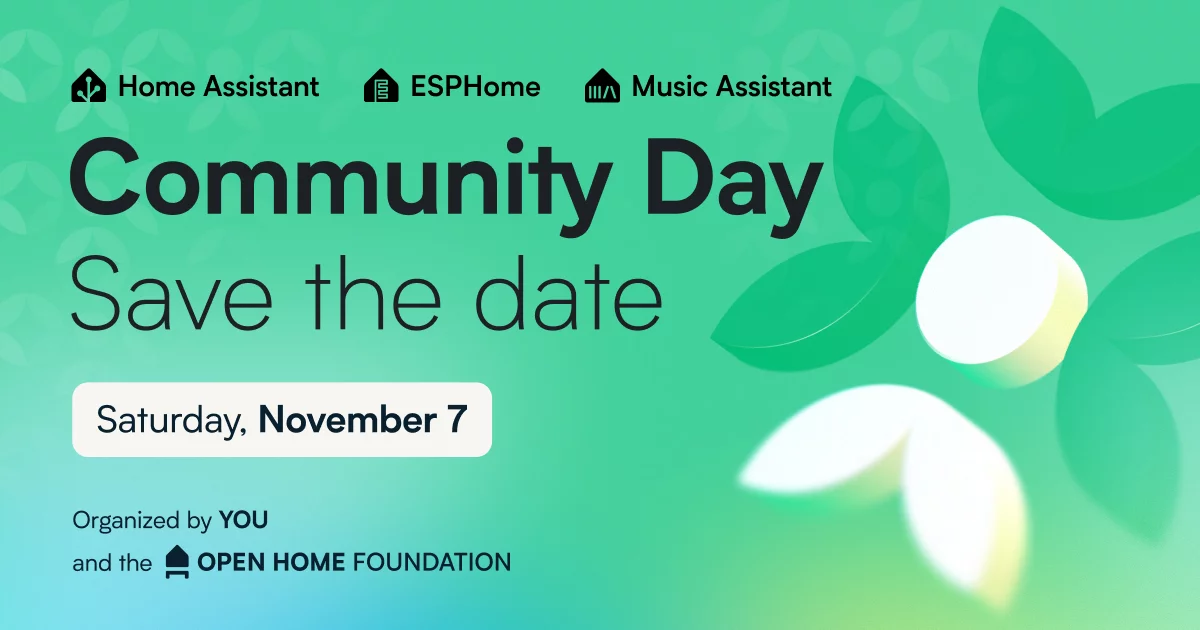
Specifically, the chosen color scheme mirrors the foundation’s visual branding for sustainability. Organizers utilized this palette as a symbolic nod to the symbiotic relationship between the open-source platform developers and the global user community, whose active contributions continuously sustain the ecosystem. This aesthetic refresh ensures that promotional materials, local banners, and digital assets present a unified front across disparate geographic regions.
Logistical Support, Host Playbooks, and Digital Infrastructure
Recognizing that decentralized global events require robust administrative backing, the Open Home Foundation has rolled out a comprehensive suite of tools for event hosts. Because privacy regulations and platform policies (such as contact preferences enforced by event management tools like Luma) restrict automated outreach to past organizers, the foundation has initiated direct communication channels. Previous hosts have been urged to establish contact through dedicated Discord channels to secure verified host roles and gain access to internal planning networks.
To streamline local execution, the foundation is deploying several new administrative resources:
- Dynamic Central Website: A dedicated portal will automatically update in real-time as new local chapters and meetups are registered on the global calendar.
- Updated Reimbursement Guidelines: Clearer financial policies will assist local organizers in covering venue rentals, basic refreshments, and logistical necessities.
- Merchandise Request Forms: Standardized procurement pathways will allow localized groups to acquire official Community Day swag and promotional items.
- The Host Playbook: A comprehensive operational guide detailing best practices for venue selection, safety protocols, accessibility standards, and community engagement.
Chronology and Upcoming Milestones
The rollout of Community Day 2026 follows a structured timeline designed to balance global tech industry events with grassroots community mobilization.
- May 2025: Inaugural Home Assistant Community Day concludes, prompting internal reviews and calls for extended planning cycles.
- Late 2025 / Early 2026: Foundation leadership reviews feedback, expands the event scope to include all Open Home Foundation projects, and selects November 7, 2026, as the target date.
- Early September 2026: Following major international technology showcases—including IFA Berlin—the foundation will officially open Luma calendar submissions, release the complete suite of graphic assets, and launch the dedicated Community Day website.
- November 7, 2026: Global execution of Community Day 2026 local meetups worldwide.
Industry Implications and Broader Impact
The evolution of Community Day from a single-project meetup into a unified foundation-wide event underscores the maturation of the open-source smart home sector. As commercial ecosystems increasingly fragment through proprietary lock-ins and cloud dependencies, open-source alternatives managed by entities like the Open Home Foundation have experienced accelerated adoption.
By formalizing decentralized, community-led gatherings on a global scale, the foundation strengthens its social infrastructure. Local meetups serve not only as educational hubs for privacy-conscious automation enthusiasts and developers but also as critical onboarding points for non-technical users seeking alternatives to mainstream commercial smart home assistants. The structured support systems implemented for 2026 indicate a long-term commitment to scaling grassroots engagement, ensuring that local chapters receive the institutional stability required to sustain rapid growth in the years ahead.