










In the evolving landscape of management simulation games, Minerva Rising has emerged as a title that blends high-stakes resource logistics with sociopolitical instability. Developed by solo creator Jonny Strellman, the game challenges players to assume the role of an omniscient Artificial Intelligence tasked with governing a sprawling, multi-tiered underground city. Unlike traditional city builders that focus on surface expansion, Minerva Rising mandates a vertical approach to survival, where the physical structure of the cave system dictates the limitations and potential of the civilization within.
Core Mechanics and Gameplay Philosophy
The fundamental premise of Minerva Rising centers on the precarious balance between industrial efficiency and the needs of the subterranean population. Players are responsible for the management of distinct levels, each functioning as a semi-autonomous district with specific resource requirements, industrial output, and cultural dynamics. The AI interface provides the player with real-time surveillance and administrative controls. However, this power is not absolute. If the AI fails to provide essential life support—such as oxygen, heat, or food—the populace may turn toward subversion.
A unique feature of the game is the potential for the population to engage in systemic rebellion. Should the citizens lose faith in their digital overseer, they possess the capability to sabotage the AI’s infrastructure, effectively cutting the video feed and blinding the player to the activities occurring within that specific level. This mechanic introduces a layer of psychological tension, as the player must maintain control without resorting to authoritarian measures that could trigger an insurrection.
Comparative Context and Industry Influence
Industry observers have drawn direct comparisons between Minerva Rising and established titles such as 11 bit studios’ Frostpunk. The thematic parallels are evident; both games emphasize the brutal realities of survival in hostile environments and the moral weight of leadership decisions. Where Frostpunk explores the freezing surface of a dying world, Minerva Rising turns the gaze downward, echoing the narrative structure of the Apple TV+ series Silo, which examines the rigid social strata and hidden histories of an underground bunker society.
Despite these thematic similarities, the developer has integrated unique aesthetic and cultural elements into the game’s world-building. Among the notable features are in-game propaganda screens. Players can utilize these tools to broadcast media—including historical artifacts such as the early animation Steamboat Willy—to boost morale or reinforce the ideological foundations of the subterranean colony. This inclusion of cultural "remnants" serves as a bridge between the lost world above and the claustrophobic reality of the caves.
Procedural Generation and Replayability
According to documentation provided on the official Steam store page, the developer has prioritized high levels of replayability through procedural generation. The game utilizes a randomized system to generate new strata of earth for every playthrough, ensuring that environmental challenges fluctuate significantly. One campaign may force the player to contend with a localized blight or food shortages, while another might focus on the scarcity of coal necessary for the power grid.
The strategic depth is further enhanced by the lack of a singular path to victory. While the ultimate goal is to facilitate the survival of the population and potentially reach the surface again, the methods by which a player achieves this vary. Decisions regarding labor allocation, resource distribution, and civil management create a cascading series of consequences that define the trajectory of the civilization.
Technical Challenges and Development Timeline
While the project has generated interest within the strategy gaming community, it currently remains in active development without a finalized release date. Solo development presents unique hurdles in balancing complex AI systems with intuitive user interfaces. The development cycle for Minerva Rising highlights the increasing trend of solo-led projects attempting to match the scope of larger studio productions through clever mechanical design rather than brute-force asset production.
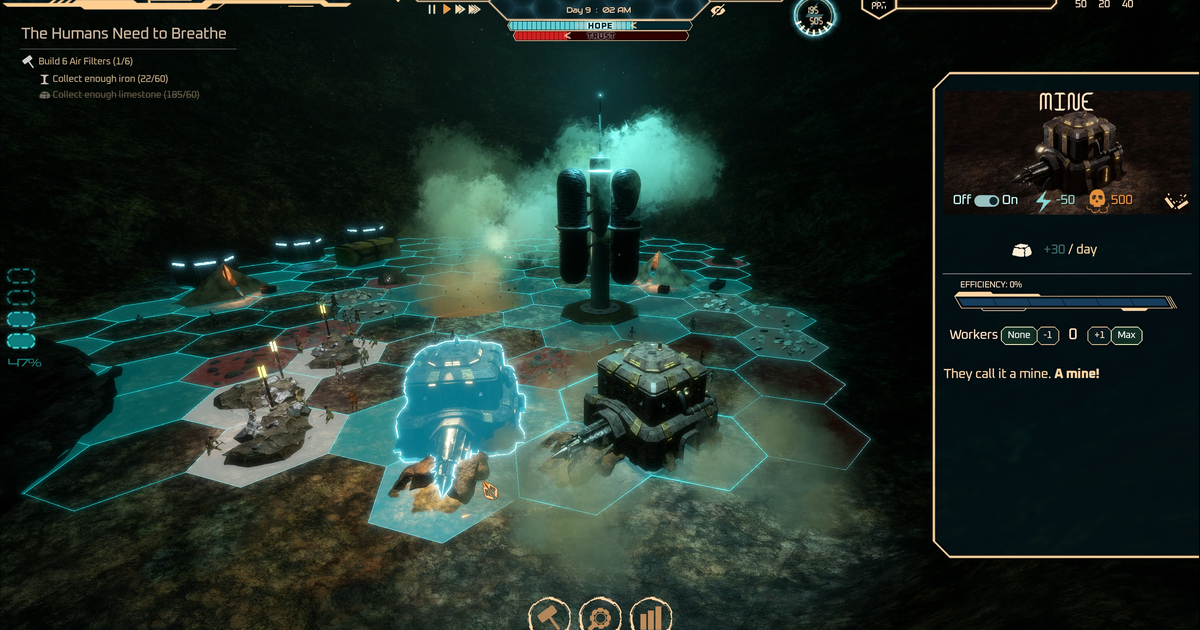
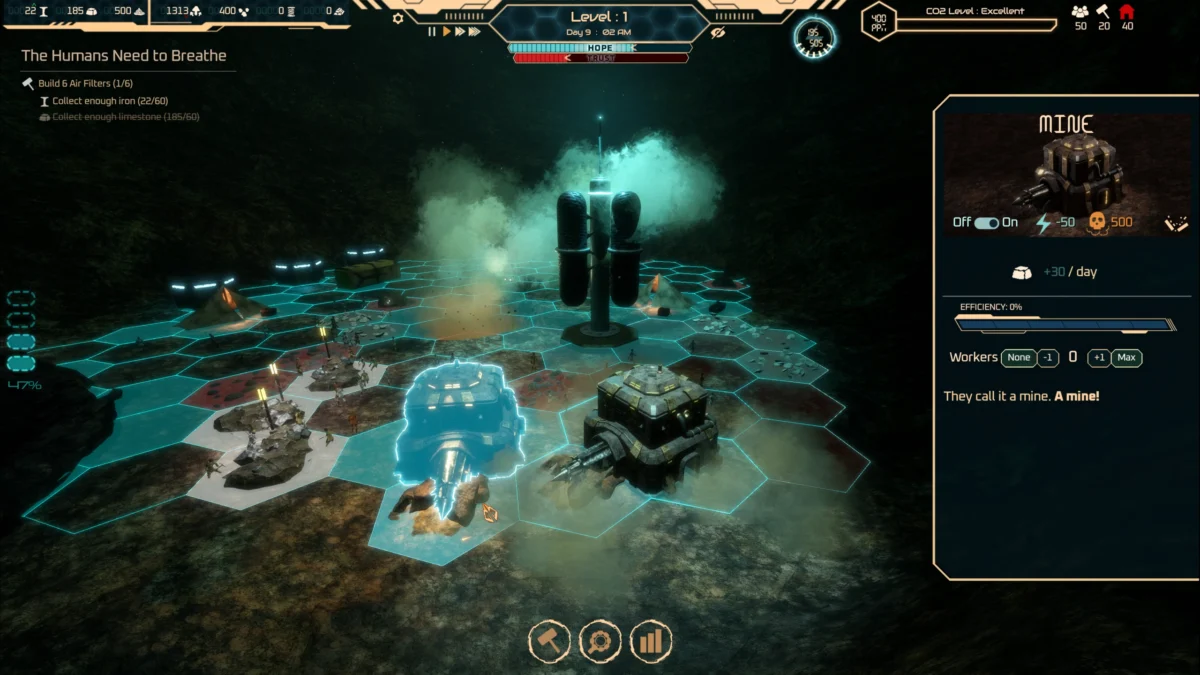
The game’s visual design relies on a hexagonal building layout, a common trope in logistics-heavy strategy games that allows for efficient space utilization. The transition between the high-tech interface of the AI and the organic, often damp, environment of the caves creates a striking visual contrast. As of late 2024, the developer has been focused on refining the feedback loops between player action and AI response, ensuring that the "rebellion" mechanics feel earned rather than arbitrary.
Broader Implications for the Simulation Genre
The simulation genre has seen a resurgence in recent years, with players gravitating toward games that offer moral complexity alongside technical challenge. Minerva Rising fits into a growing sub-genre of "dystopian management," where the player is not necessarily the hero, but a cog in a machine that is either saving or condemning its subjects.
From a design perspective, the implementation of "blind spots" in the player’s vision—caused by player failure—is a significant evolution of the "fog of war" mechanic. By making the loss of vision a consequence of poor governance rather than an exploration-based limitation, the game creates a narrative justification for the lack of information. This encourages a more proactive style of management, where the player must anticipate the needs of the population before they reach a boiling point.
Socio-Economic Dynamics within the Game
The simulation extends beyond simple resource gathering to include the management of the population’s psychological state. The game’s environment—often populated by bioluminescent fungi and subterranean water features—offers a contrast to the utilitarian factories and power plants the player must build. Balancing the aesthetic needs of the citizens with the hard-line requirements of industrial output is a core tension point.
The ability to designate areas for different purposes, including the potential for recycling or waste management, suggests a deep economic loop. If a player mismanages a level, the game does not simply offer a "Game Over" screen; it instead forces the player to contend with a fractured empire. This complexity is intended to ensure that no two sessions feel identical, as the AI must adapt its strategy to the specific resource constraints generated at the start of the game.
Future Outlook and Community Reception
The community reaction to the early trailers and development logs has been largely positive, with players expressing interest in the game’s unique "AI-as-a-character" perspective. By placing the player in the role of the system itself, rather than a human leader, the developer has effectively removed the traditional "avatar" barrier. This perspective shift allows for a more detached, analytical approach to decision-making, which the game then complicates by forcing the player to deal with the messy, unpredictable nature of human resistance.
While there is no confirmed release date, the anticipation surrounding Minerva Rising points to a continued market demand for strategy games that prioritize system-level depth. As the industry moves forward, the success of titles like this will likely depend on the developer’s ability to maintain the delicate balance between the game’s "hard" simulation elements—resource counts, power grids, and population metrics—and the "soft" elements—morale, rebellion, and cultural propaganda.
In summary, Minerva Rising stands as an ambitious attempt to synthesize the claustrophobic tension of subterranean survival with the analytical rigor of AI-managed city building. As development continues, the game serves as an interesting case study in how small-scale development can push the boundaries of established genres through focused, thematic, and mechanical innovation. Whether players will eventually lead their subterranean charges to the surface or find themselves locked out of their own systems by a disgruntled populace remains the central question that the final release will address.