






Self-taught Chinese wildlife photographer Xiaoping Lin has added another remarkable accolade to his distinguished career, securing the Gold Category win in the Professional Wildlife division at the prestigious 1839 Awards. Lin earned the top honor for his visually arresting and impeccably timed image titled Pass By, a photograph that encapsulates both the fierce unpredictability and the delicate poetry of the natural world. Known internationally for his mastery of high-speed avian photography—particularly his ability to freeze birds capturing prey mid-air—Lin’s latest triumph reinforces his standing among the world’s elite nature photographers.
The 1839 Awards, a globally recognized competition and creative platform named in honor of the birth year of photography, annually seeks to elevate exceptional artists who push the technical and conceptual boundaries of the medium. Lin’s victory places him among an elite group of contemporary image-makers who document the unvarnished realities of wildlife with extraordinary artistic vision.
The Anatomy of an Award-Winning Shot: Pass By
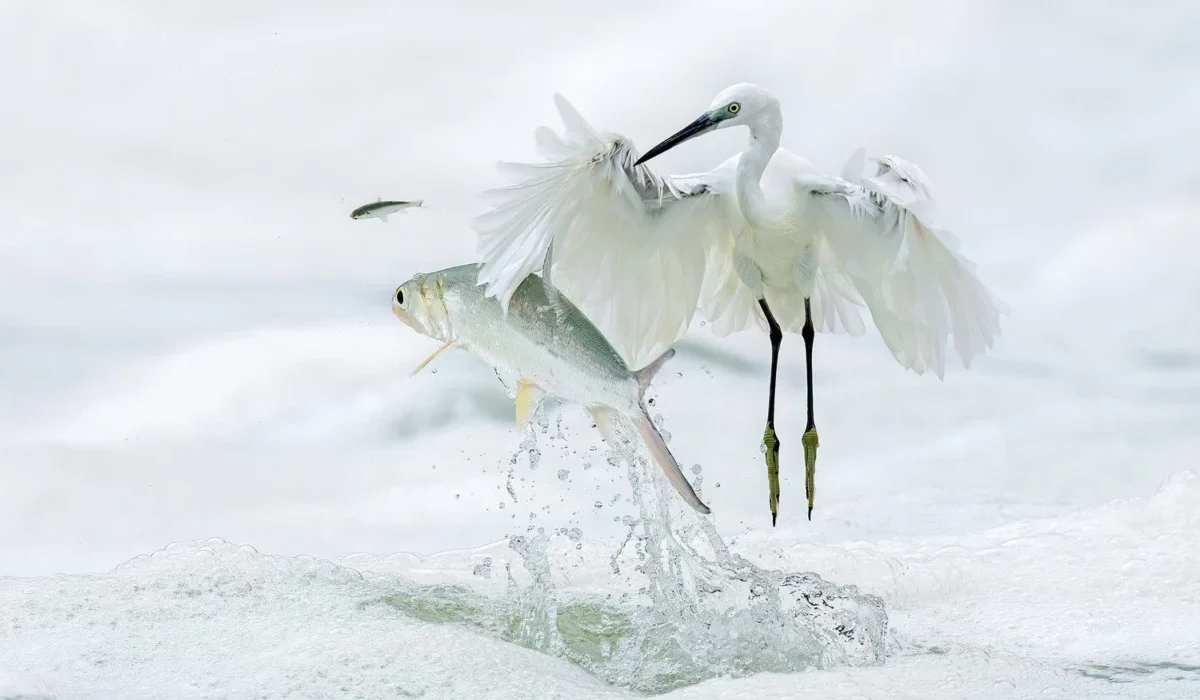
At the center of Lin’s success is Pass By, an extraordinary white-on-white wildlife composition that immediately captivated the competition’s international judging panel. The photograph depicts a majestic white heron, or egret, with its wings dramatically unfurled above churning, splashing water. The bird appears suspended in an instant of intense focus and confusion as it attempts to secure a meal.
Adding an extraordinary layer of dynamic tension to the frame, a tiny fish leaps out of the water alongside a larger aquatic predator, creating a fleeting narrative of survival that unfolds in fractions of a second. The monochromatic, ethereal palette of the white bird against the shimmering, reflective surface of the water gives the image a timeless, almost painterly quality while maintaining absolute documentary authenticity.
Detailing the split-second encounter to the 1839 Awards organizers, Lin described the chaotic and poetic sequence that led to the capture. "The big fish chased the small fish and rushed out of the water together, passing the egret," Lin explained. "The egret looked surprised and did not know where the small fish would go. Just like a poem: I passed you by. You hurried here. Before I noticed, you had gone far away, leaving me a regretful back."
This ability to translate complex ecological interactions into evocative visual poetry has become the hallmark of Lin’s career. By freezing the invisible kinetics of predator-prey dynamics, his work invites viewers to look beyond static representations of wildlife and confront the raw, unfiltered pulse of ecosystems.
A Self-Taught Master of High-Speed Avian Photography
Lin’s journey into the upper echelons of professional photography is as remarkable as his portfolio. Unlike many of his contemporaries who received formal artistic training or pursued careers in photojournalism from a young age, Lin taught himself the craft beginning in 1992. Over more than three decades behind the lens, he has cultivated an encyclopedic understanding of animal behavior, lighting conditions, and the mechanical limits of camera equipment.
Specializing primarily in avian subjects, Lin has dedicated thousands of hours to observing the habits of wetland and predatory birds. Capturing animals mid-hunt requires an exceptional blend of patience, technical preparedness, and intuitive timing. High-speed action photography of this caliber demands advanced camera bodies capable of lightning-fast autofocus tracking, rapid continuous shooting frame rates, and telephoto lenses with wide maximum apertures to isolate subjects against complex natural backgrounds.
Throughout his career, Lin’s dedication has yielded numerous international accolades, widespread gallery exhibitions, and a dedicated global following. His images consistently serve as visual documentation of biodiversity, shedding light on the behavioral intricacies of species that often go unnoticed by the casual observer.
The Significance of the 1839 Awards in Modern Photography
The 1839 Awards occupy a unique space in the contemporary photography landscape. By deliberately invoking the historical milestone of 1839—the year Louis Daguerre and William Henry Fox Talbot introduced their pioneering photographic processes to the world—the organization honors the enduring legacy of visual storytelling while aggressively championing modern innovation.
The competition is structured to encompass a vast array of genres, ranging from fine art and portraiture to architecture, landscape, and professional wildlife photography. Winning the Gold Category in the Professional Wildlife division is a rigorous feat, requiring creators to demonstrate not only flawless technical execution—such as sharpness, dynamic range, and exposure control—but also a profound conceptual understanding of their subject matter.
Judges for the 1839 Awards typically comprise a diverse panel of renowned curators, gallerists, editors, and master photographers from around the globe. Entries are evaluated blindly to ensure absolute impartiality, focusing solely on the emotional resonance, originality, and narrative power of the images. Lin’s Pass By emerged from a massive global pool of submissions, underscoring the universal appeal and technical mastery of his work.
Broader Implications and the Role of Wildlife Photography in Conservation
While competitions like the 1839 Awards celebrate the aesthetic and technical achievements of photographers, images like Pass By carry significant functional weight in the broader spheres of environmental education and wildlife conservation.
In an era defined by rapid habitat loss, climate change, and declining global biodiversity, powerful visual media plays an indispensable role in shaping public perception. High-impact wildlife photography bridges the gap between scientific data and human empathy. When viewers are confronted with the intimate, high-stakes realities of animal survival—such as the fleeting interaction between the egret and the leaping fish captured by Lin—they are more likely to develop a personal investment in ecological preservation.
Conservationists and environmental scientists increasingly rely on the visual arts to communicate the urgency of protecting fragile wetland ecosystems, where birds like the white egret play crucial regulatory roles in aquatic food webs. By highlighting the delicate balance between predator and prey, Lin’s photography implicitly reminds audiences of the interconnected vulnerability of all natural systems.
Equipment and Technical Considerations for Aspiring Wildlife Photographers
For photographers inspired by Lin’s achievements, capturing comparable imagery requires specialized gear and a rigorous methodological approach. Professional wildlife and bird photography heavily relies on high-performance equipment capable of enduring harsh environmental conditions while delivering uncompromising optical clarity.
Industry standards for wildlife documentation typically include full-frame mirrorless camera bodies featuring advanced subject-recognition algorithms—particularly AI-driven animal eye AF—and high-speed electronic shutters capable of capturing 20 to 30 frames per second. Paired with super-telephoto prime or zoom lenses, such as 500mm or 600mm focal lengths, photographers can maintain a respectful distance from sensitive wildlife while isolating intricate details like water droplets, feather textures, and sudden behavioral shifts.
Beyond hardware, mastery of fieldcraft remains paramount. Anticipating animal behavior, understanding seasonal migration and feeding patterns, and recognizing the subtle environmental cues that precede high-action moments are skills that cannot be replaced by automation. As Lin’s career demonstrates, technical proficiency is merely the vehicle; the true catalyst for extraordinary imagery is patience, observation, and an artistic vision capable of finding poetry in the wild.
As the photography community looks toward the remainder of the exhibition and publishing cycle for the 2026 award winners, Xiaoping Lin’s Pass By stands as a defining achievement in contemporary nature documentation—a testament to what can be accomplished when technical precision meets a profound reverence for the natural world.