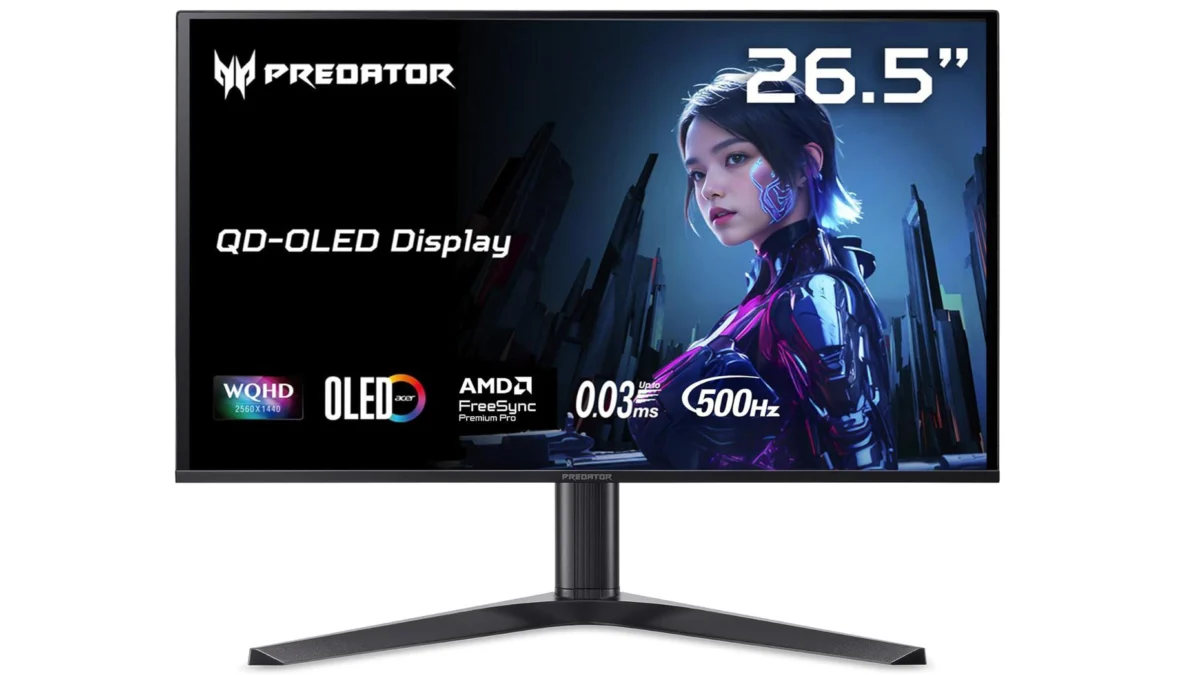
In an era where the PC hardware market is frequently dominated by distressing headlines regarding soaring costs for random-access memory, solid-state drives, and traditional mechanical hard drives, consumers are occasionally granted a brief reprieve in the form of aggressive retail discounts. The latest such price correction arrives from Newegg, which has slashed the cost of the Acer Predator X27U—officially designated by the model number F5bmiippruzx—down to $509.99. This substantial price cut brings a high-end, enthusiast-grade peripheral into a much more competitive tier for gamers and media professionals alike who have been hesitant to upgrade their desktop setups due to inflating component expenses across the broader technology sector.
Main Facts of the Promotion
The Acer Predator X27U is a 27-inch desktop monitor that utilizes Quantum Dot Organic Light Emitting Diode technology, commonly referred to as QD-OLED. Designed explicitly to target high-end competitive gamers and visual purists, the display boasts a native resolution of 2560 by 1440 pixels, frequently categorized as 1440p or QHD. This resolution strikes a widely recognized balance, offering significantly sharper image fidelity than standard 1080p displays while avoiding the severe graphics processing unit taxation imposed by full 4K panels.
Perhaps the most notable specification of this specific variant is its staggering refresh rate, which reaches up to 500 Hz. Such a high refresh rate provides ultra-smooth motion handling and drastically reduced input latency, catering directly to fast-paced esports titles where milliseconds can determine the outcome of a competitive match. Furthermore, the display carries a DisplayHDR True Black 500 certification. This accreditation guarantees that the panel can achieve deep, ink-like black levels characteristic of OLED technology while maintaining consistent peak brightness levels for high-dynamic-range content, ensuring that highlights pop without crushing shadow detail.
By dropping the retail price to $509.99, Newegg has positioned the Predator X27U aggressively against competing monitors from manufacturers such as ASUS, MSI, Dell Alienware, and Samsung, all of which vie for dominance in the fiercely contested high-refresh-rate OLED monitor segment.
The Evolution of OLED in PC Gaming
To understand the significance of this price point, it is necessary to examine the rapid evolution and adoption of OLED technology within the desktop PC monitor ecosystem. For many years, organic light-emitting diode panels were largely confined to high-end television sets and premium mobile devices. The primary barriers to entry for desktop monitors included manufacturing yields, high production costs, and legitimate industry concerns regarding image retention—commonly known as burn-in—resulting from the static user interfaces inherent to desktop operating systems like Windows and macOS.
Around 2022 and 2023, major panel manufacturers began producing dedicated monitor-sized OLED and QD-OLED panels in commercially viable quantities. These early adopters commanded astronomical prices, often exceeding $1,000 to $1,200 upon initial release. Consumers who desired the infinite contrast ratios, near-instantaneous pixel response times of approximately 0.03 milliseconds, and vibrant color reproduction of OLED were forced to pay a substantial early-adopter tax.
Over the subsequent 24 months, manufacturing efficiencies improved markedly. The introduction of Quantum Dot layers by companies like Samsung Display helped bridge the gap between pure OLED black levels and high perceived color luminance. Consequently, prices began a gradual downward trajectory. The arrival of a 500 Hz QD-OLED monitor at approximately the $510 mark illustrates just how rapidly panel costs have compressed, transforming what was once an ultra-luxury niche into an increasingly accessible option for mainstream enthusiasts.
Broader Hardware Market Context
The timing of this discount is particularly notable against the backdrop of widespread consumer frustration regarding component pricing. While display panels are seeing downward price corrections driven by intense manufacturer competition, other crucial sectors of the PC building market tell a very different story.
Throughout the past year, memory manufacturers have faced tightening supply constraints driven by surging demand for high-bandwidth memory utilized in enterprise-grade artificial intelligence accelerators. This shift in foundry allocation has precipitated noticeable price increases for both desktop DDR5 and DDR4 memory modules. Similarly, NAND flash memory and controller components have experienced fluctuating supply chains, leading to elevated retail prices for high-capacity solid-state drives.
Because building or upgrading a modern personal computer requires a balanced investment across processors, graphics cards, memory, storage, and displays, unexpected discounts on major peripherals like the Acer Predator X27U serve as a welcome counterbalance. Consumers attempting to assemble a high-performance rig within a strict budget can redirect savings from the display category toward securing adequate RAM and storage without necessarily compromising their overall performance goals.
Analysis of Specifications and Performance Implications
From a technical standpoint, a 27-inch 1440p display running at 500 Hz places unique demands on the rest of the host computer system. While achieving 500 frames per second in less demanding competitive titles such as Counter-Strike 2, Valorant, or League of Legends is entirely feasible for modern mid-to-high-tier graphics cards, doing so requires a robust central processing unit with strong single-core performance.
The inclusion of QD-OLED technology fundamentally alters the visual experience compared to traditional In-Plane Switching or Vertical Alignment liquid-crystal displays. Because each individual subpixel emits its own light and can be turned completely off, the monitor produces absolute blacks without the distracting backlight bleeding or blooming common in edge-lit or local-dimming LED monitors. This characteristic makes the Acer Predator X27U exceptionally well-suited not only for fast-paced gaming but also for media consumption, digital photography editing, and HDR video production where accurate color grading is paramount.
Industry experts note that while ultra-high refresh rates above 360 Hz yield diminishing returns for the average human eye in terms of motion clarity, professional esports athletes and dedicated enthusiasts frequently report perceptible improvements in target tracking and responsiveness. The combination of this extreme refresh rate with the instantaneous pixel response time inherent to OLED panels eliminates the motion blur that typically plagues LCD technology, rendering fast-moving objects crisp and legible even during rapid camera pans.
Market Impact and Consumer Guidance
Retail promotions of this magnitude frequently operate on limited-time availability or restricted stock allocations. Analysts observing the retail landscape point out that aggressive discounting by major electronics vendors like Newegg is often utilized to clear out warehouse inventory ahead of new product refreshes or to stimulate sales volume during traditionally slower retail periods.
For prospective buyers considering the Acer Predator X27U at the $509.99 price point, industry analysts recommend evaluating their current hardware stack to ensure their graphics processing unit and central processing unit can adequately capitalize on the monitor’s high refresh rate capabilities. Additionally, consumers utilizing OLED displays for productivity work involving static user interfaces are advised to utilize built-in maintenance features—such as pixel orbiting, screen savers, and automatic dimming—to maximize the long-term lifespan of the organic emissive compounds.
Ultimately, the availability of a top-tier 500 Hz QD-OLED display at nearly half its historical introductory valuation underscores a broader maturation of the display market. While components such as memory and storage continue to grapple with macroeconomic and industry-specific supply pressures, the display segment is currently experiencing a period of fierce competition and technological democratization, to the direct benefit of the consumer base.