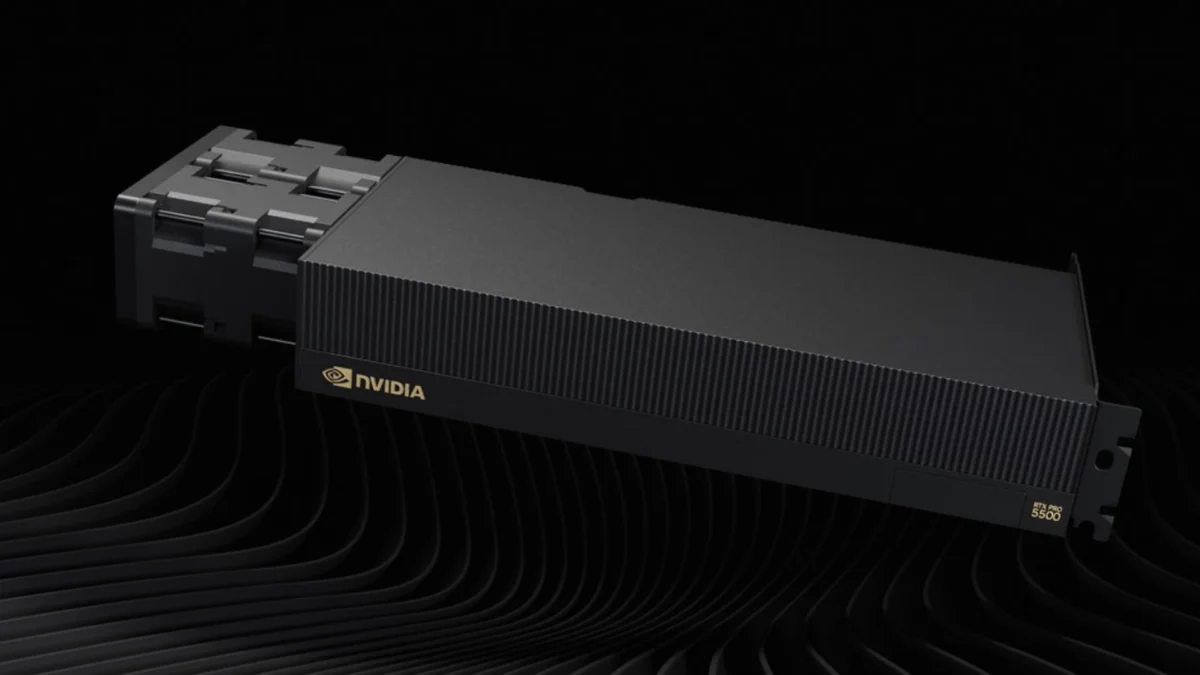
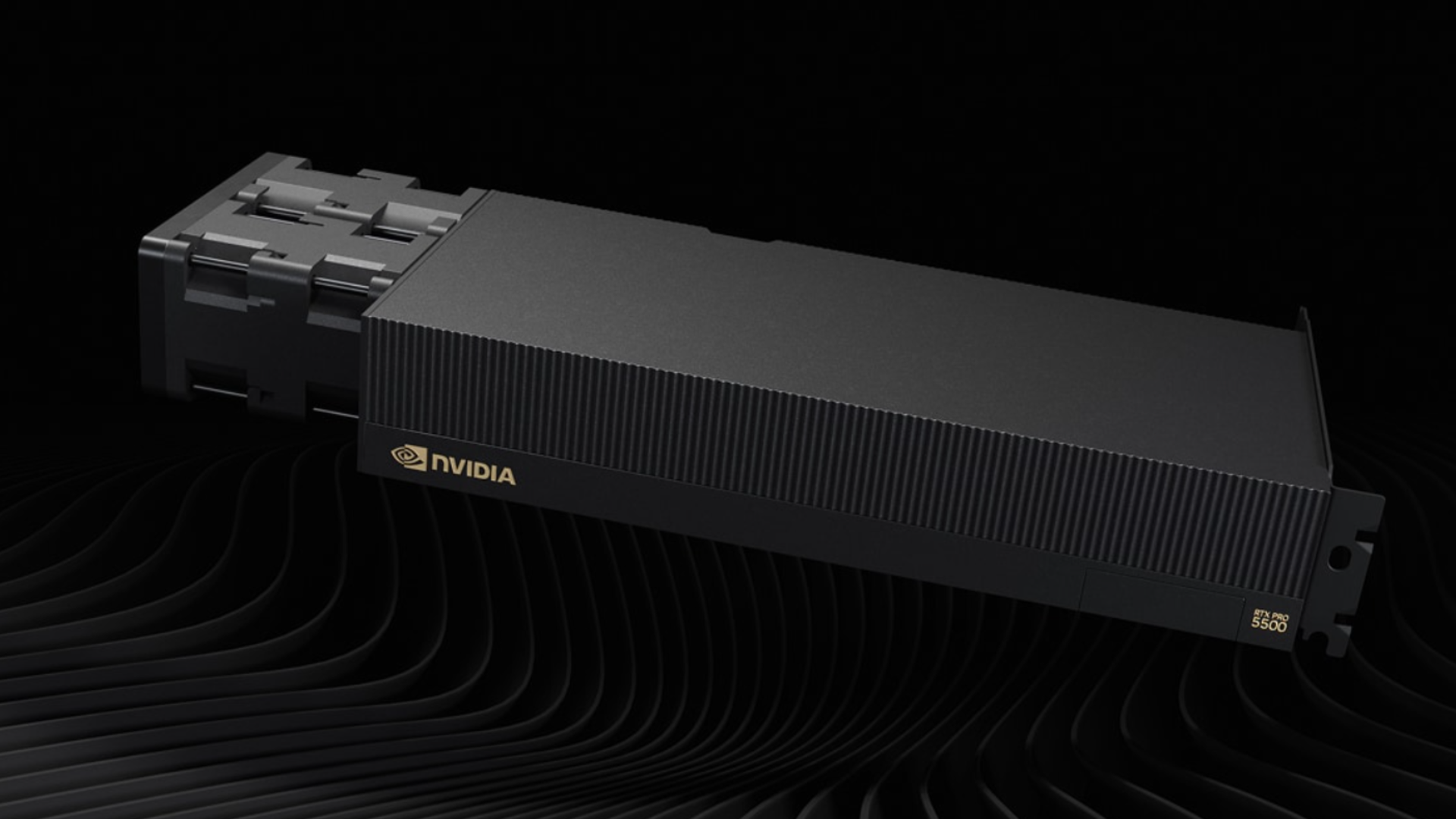
Nvidia has officially expanded its enterprise-grade hardware lineup with the introduction of the RTX Pro 5500 workstation graphics card, a specialized computing solution designed specifically for heavy-duty professional environments. Built upon Nvidia’s cutting-edge Blackwell architecture, the newly announced hardware features an extraordinarily generous allotment of 84 GB of GDDR7 memory. Unlike consumer-facing graphics cards aimed at gaming and media consumption, the RTX Pro 5500 is engineered strictly for high-performance computing (HPC), artificial intelligence model training, complex data analysis, and professional rendering pipelines deployed in enterprise data centers and rack-mounted server environments.
The core of the RTX Pro 5500 is driven by the GB202 processor, housing a formidable 21,760 CUDA cores. Interestingly, this exact core count mirrors the specifications found in Nvidia’s flagship consumer-grade GeForce RTX 5090. However, the architectural implementation, thermal design, memory subsystem, and intended use cases diverge sharply from consumer hardware. Rather than prioritizing consumer-level frame rates and real-time ray tracing for interactive entertainment, the RTX Pro 5500 is optimized for massive dataset ingestion, multi-instance virtualization, and sustained computational workloads that demand absolute stability and vast frame buffer capacities.
Engineering an 84 GB GDDR7 Footprint
Accommodating 84 GB of high-speed GDDR7 memory on a single physical circuit board required an unconventional engineering approach. Memory manufacturers typically design graphics cards with balanced, power-of-two capacities aligned with symmetrical memory controllers. To circumvent physical space limitations while achieving this capacity, Nvidia engineers adopted a dense double-sided board layout, frequently referred to in the industry as a sandwich configuration.
The physical arrangement places 14 GDDR7 memory modules on the front side of the printed circuit board (PCB) immediately adjacent to the GB202 processor. A matching set of another 14 modules is mounted directly on the rear of the board. This compact packaging crams a total of 28 memory chips onto a single enterprise card. Each individual memory chip operates at approximately 27 Gbps per pin, representing a robust yet standard operational speed for the GDDR7 generation rather than pushing bleeding-edge overclocking frequencies.
This complex configuration results in a 416-bit memory interface, yielding an aggregate bandwidth of roughly 1,398 GB/s. The 416-bit bus width is notably unusual in modern GPU design, as memory controllers traditionally operate in even pairs to form standard widths such as 256-bit, 384-bit, or 512-bit. A 416-bit architecture implies the presence of 13 separate 32-bit memory channels, a mathematically asymmetrical configuration that highlights Nvidia’s prioritization of massive capacity over traditional bus symmetry.
To maximize utility in virtualized corporate environments, the RTX Pro 5500 supports multi-instance partitioning. Enterprise administrators can configure the card to operate either as one massive, unified 84 GB block or divide the resources into two independent 42 GB segments. This flexibility allows multiple users or distinct computational tasks to share the same physical hardware efficiently.
Thermal Management and Power Delivery
Operating a processor containing over 21,000 CUDA cores alongside 28 high-density memory modules generates substantial thermal energy. Nvidia has rated the RTX Pro 5500 at a formidable 600 W Total Board Power (TBP). Because of this high energy draw and the intended deployment environment, the card is manufactured strictly for rack-mounted enterprise servers and professional workstation towers rather than standard consumer desktop chassis.
To maintain optimal operating temperatures under continuous, high-load conditions, Nvidia offers the RTX Pro 5500 in both air-cooled and liquid-cooled variants. The air-cooled version departs from traditional blower or axial consumer designs, instead utilizing high-speed server-grade fans bolted directly to a massive, high-density heatsink. This configuration ensures consistent airflow through dense server racks where ambient temperatures can be elevated. Liquid-cooled variants cater to data centers equipped with specialized closed-loop or facility-wide liquid cooling infrastructure, allowing for quieter operation and superior thermal dissipation during sustained computational tasks.
Positioning Within Nvidia’s RTX Pro Family
Within the broader hierarchy of Nvidia’s professional workstation graphics lineup, the RTX Pro 5500 occupies a strategic position just below the absolute flagship. The apex of the family remains the RTX Pro 6000, which boasts an even larger 96 GB of dedicated video memory paired with 24,064 CUDA cores. Conversely, the RTX Pro 5500 comfortably outclasses the step-down RTX Pro 5000, a model that is restricted to a maximum of 72 GB of memory and 14,080 CUDA cores.
By placing the core count of the RTX Pro 5500 much closer to the top-tier RTX Pro 6000 than to its lower-numbered sibling, Nvidia has signaled a clear product strategy. The company is leaning heavily into massive memory volume to handle increasingly bloated AI datasets and complex digital simulations, rather than focusing purely on raw compute efficiency or bandwidth optimization. Industry analysts note that as large language models (LLMs), generative AI training parameters, and photorealistic 3D rendering assets grow exponentially in size, memory capacity has become the primary bottleneck for enterprise professionals.
Background Context and Technological Evolution
The rollout of the RTX Pro 5500 arrives during a period of transformative demand for high-end professional hardware. Over the past several years, the explosive growth of artificial intelligence, machine learning, and cloud-based rendering has strained existing data center infrastructure. Enterprises are constantly searching for hardware that can process larger models locally without requiring multi-node clusters for routine operations.
The transition to Blackwell architecture represents a major generational leap over the preceding Hopper and Ada Lovelace designs, incorporating advanced transformer engines, enhanced tensor cores, and improved energy efficiency metrics. By bringing GDDR7 memory technology into the professional workstation sphere, Nvidia is bridging the gap between high-speed consumer standards and enterprise-grade reliability. GDDR7 offers significant bandwidth and power-efficiency improvements over older GDDR6 and GDDR6X standards, making it an ideal medium for memory-intensive enterprise tasks.
Market Implications and Enterprise Impact
While Nvidia has not yet disclosed official pricing or a firm commercial release date for the RTX Pro 5500, industry insiders anticipate a steep price tag commensurate with its enterprise positioning and complex manufacturing process. The double-sided PCB layout, combined with 28 individual GDDR7 chips and the massive GB202 silicon die, ensures high production costs.
Consequently, the target demographic for the RTX Pro 5500 will consist almost exclusively of enterprise buyers, research institutions, animation studios, and cloud service providers. Everyday consumers and traditional PC enthusiasts will find little practical application for the card, given its specialized rack-mounted form factor, 600 W power requirement, and professional driver certification.
As corporations continue to integrate artificial intelligence into their core operational workflows, the demand for hardware capable of handling oversized datasets will only accelerate. The introduction of the RTX Pro 5500 provides enterprise architects with a powerful intermediate option between standard workstation cards and ultra-expensive server accelerators. Whether the unique memory configuration and massive frame buffer will deliver the anticipated productivity gains across diverse industrial applications will become clearer once production units land in corporate data centers later this year.