Pelican Products, a brand universally recognized for its heavy-duty resin transport cases and crushproof protective housings, has taken a definitive step into lifestyle and travel soft goods with its latest television advertising campaign. For decades, the company built its reputation serving military personnel, industrial technicians, and globe-trotting photojournalists who required absolute defense against the elements. However, the introduction of the Aegis camera bag series—highlighted by products such as the PX25 Travel Pack and the SX5 Padded Sling—prompted a strategic pivot toward cinematic commercial storytelling. To spearhead this unprecedented marketing initiative, Pelican tapped Global Ambassador, veteran photographer, and documentary filmmaker Chris Burkard.
The resulting campaign, anchored by a short film titled The Detour, offers a rare glimpse into the unpredictable nature of extreme outdoor production. Recently, industry analyst Dave Murphy sat down with Burkard to discuss the two-decade evolution of his career, the conceptualization of the Pelican commercial, the rigorous demands of shooting at high altitudes, and the engineering philosophy behind modern camera transport.
From Action Sports to Environmental Advocacy
Chris Burkard’s career in professional photography spans two decades, beginning when he was just 18 or 19 years old. Initially carving out a niche in the hyper-competitive world of action sports, Burkard established himself as a premier surf photographer, shooting for numerous editorial titles and print magazines. Over time, his portfolio expanded to encompass high-end commercial projects, branded content, and large-scale environmental and adventure documentaries.
Rather than viewing photography as an isolated discipline, Burkard regards the camera as a foundational tool within a broader storytelling apparatus. His assignments frequently take him to remote, climactically volatile regions of the globe, where visual media serves as a medium to communicate narratives larger than himself. This extensive field experience ultimately laid the groundwork for his long-standing relationship with Pelican Products.
A Twenty-Year Partnership Forged in Extreme Environments
Burkard’s history with Pelican predates any formal corporate partnership by nearly twenty years. Early in his career as a coastal photographer operating out of boats and near oceanic hazards, essential equipment lists invariably included two items: a reliable water housing and a Pelican hard case. Over the course of numerous international expeditions, Burkard’s gear endured extreme operational hazards, ranging from capsized watercraft to administrative detentions in international facilities. While countless camera bodies failed under these harsh conditions, his Pelican hard cases consistently preserved his primary assets.
When Pelican leadership approached Burkard to test their nascent soft-goods line, the collaboration felt organic. Entrusting upwards of $30,000 to $40,000 worth of camera equipment to carry-on luggage requires uncompromised structural integrity. Burkard’s initial involvement focused on field-testing the Aegis four-wheel roller and related travel packs in demanding real-world scenarios. Recognizing the authenticity of his endorsement, Pelican elected to move beyond traditional product specifications and commission a narrative-driven television campaign—a departure from the brand’s historically utilitarian marketing approach.
The Conceptualization and Production of The Detour
The Detour—initially conceived under the working title The Side Quest—was developed as a collaborative effort between director Will Kutscher, known for his work with outdoor apparel brand Filson, Pelican’s internal marketing division, and Burkard himself. The core philosophy of the campaign centers on the premise that the most rewarding expeditions are often unscripted, rewarding those who embrace spontaneity and maintain a willingness to accept unexpected opportunities.
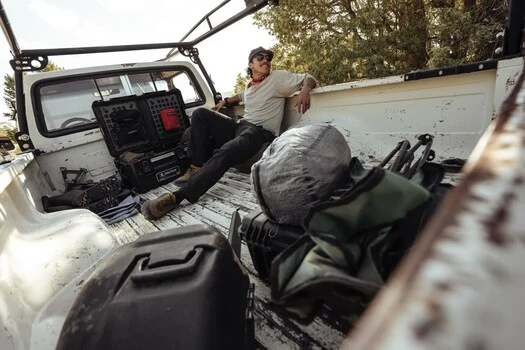
Production for the commercial took place in the rugged terrain of the Great Sand Dunes National Park within Colorado’s San Luis Valley. Choosing this location was driven by Burkard’s familiarity with the area’s stark aerial textures and his desire to reflect the raw, untamed spirit of the American Southwest. The production featured local characters, including equestrian packers and experimental trike pilots, who exemplify human ingenuity and harmonious coexistence with formidable landscapes.
The shoot presented significant logistical and environmental hurdles. Operating at an elevation of approximately 8,000 feet, the production team faced severe thermal updrafts during the summer months. These atmospheric conditions restricted aerial filming windows to a narrow 40-minute window immediately following sunrise. Crew members initiated daily operations at 4:00 a.m., departing from the local airfield in Alamosa to capture low-altitude aerial passes over the dune fields before intense winds rendered experimental aircraft operation unviable.
Ground production proved similarly demanding. Transporting cinema-grade RED camera packages, Sony mirrorless stills bodies, and secondary action cameras across shifting sand at elevations exceeding 9,000 feet tested the physical endurance of the entire production crew. Unpredictable weather events, including sudden rainstorms and high-velocity winds, necessitated continuous improvisation—circumstances that frequently yield the most authentic cinematic moments in documentary production.
Engineering Philosophy of the Aegis Series: PX25 and SX5
The Aegis series represents Pelican’s translation of its industrial protection standards into consumer-facing travel gear. Designed around semi-rigid structural panels, the product line—encompassing crossbody slings, backpacks, and rolling luggage—aims to bridge the gap between heavy-duty hard cases and traditional soft luggage.
According to field evaluations, the PX25 Travel Pack and SX5 Padded Sling are engineered for photographers and travelers who require elevated impact resistance without the bulk of a traditional resin case. While extreme, multi-day wilderness expeditions may still necessitate specialized backcountry packs or submersible hard containers, the Aegis series targets short-to-medium-term travel. The design emphasizes robust zipper construction, modular exterior attachment points for tripods and hydration vessels, and materials engineered to develop an aesthetically pleasing patina through hard use rather than degrading prematurely.
Burkard notes that the primary advantage of the Aegis lineup lies in its accessibility and balance. When navigating commercial aviation hubs, rental vehicles, and transient locations, the bags offer sufficient shock absorption to protect sensitive optical elements while maintaining the agility required for fast-paced media production.
Field Methodology: Gear Organization and Accessibility
In professional photography, equipment accessibility often dictates production efficiency. Burkard outlines a meticulous packing methodology designed to eliminate unnecessary deployment delays. His standard operational kit typically involves a modular system pairing a primary backpack—often in the 40-liter capacity range—with a dedicated lumbar or waist pack.
When operating in active shooting environments, Burkard relies on a waist-mounted configuration to maintain immediate access to his core optical range: a 16-35mm wide-angle zoom, a 24-70mm standard zoom, and a 70-200mm telephoto zoom. This configuration prevents the need to remove a backpack continuously, thereby increasing shooting velocity in rapidly changing light or weather conditions.
Burkard’s packing philosophy adheres to a strict hierarchy of needs: baseline survival equipment—including hydration, caloric sustenance, meteorological layers, and illumination tools—occupies the foundation of the pack, followed by critical camera infrastructure, leaving remaining volume for specialized accessories. His overarching principle remains pragmatic: "The best camera is the one you are willing to use." Equipment that is difficult to access or overly burdensome to deploy is frequently left behind.
Future Testing Grounds: Volcanic and Glacial Environments
To rigorously evaluate the durability of transport gear, Burkard identifies volatile geological zones as the ultimate proving ground. Drawing on his documentation of volcanic eruptions in Iceland for National Geographic, he emphasizes the unique challenges posed by abrasive volcanic ash, corrosive particulate matter, and extreme thermal gradients. A truly reliable camera bag must withstand particulate infiltration, abrasive contact with sharp basalt formations, and exposure to moisture without compromising internal electronics.
Conversely, polar environments present contrasting operational hazards. During a recent documentary production for Netflix atop the Vatnajökull glacier in Iceland, extreme sub-zero temperatures, high-velocity winds, and persistent moisture tested the material limits of both camera bodies and support infrastructure. Burkard considers the duality of Iceland’s volcanic and glacial topographies to be the definitive benchmark for gear validation, asserting that equipment capable of surviving repeated deployment in these punishing conditions is adequately prepared for professional assignments worldwide.
Industry Implications and Market Shift
Pelican’s strategic pivot toward lifestyle marketing and narrative-driven advertising signals a broader trend within the industrial protective equipment sector. As consumer-grade travel gear faces increasing demand from hybrid creators, adventure vloggers, and mobile professionals, legacy manufacturers are leveraging their engineering pedigree to capture market share outside traditional industrial channels. By partnering with established veterans like Chris Burkard and documenting authentic field failures and successes, brands can substantiate performance claims in a marketplace saturated with superficial aesthetic marketing. The commercial success of The Detour and the reception of the Aegis line indicate that functional durability remains a primary purchasing criterion for creators operating in demanding environments.