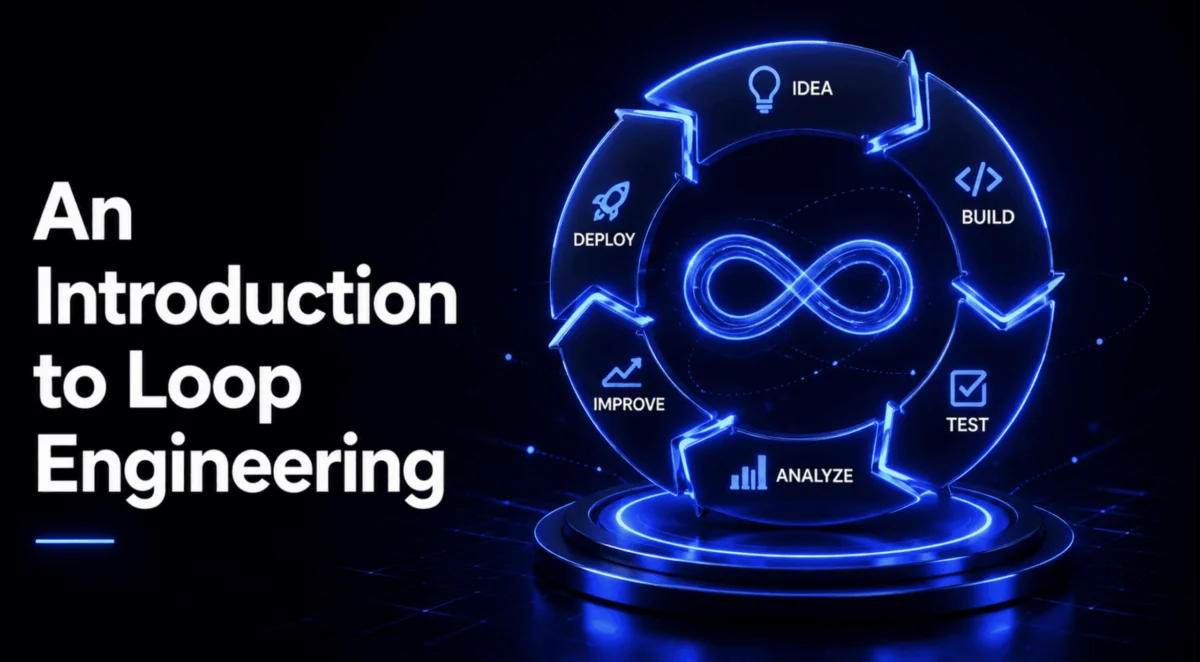
The landscape of artificial intelligence development underwent a fundamental transition in mid-2026, shifting away from the meticulous crafting of individual prompts toward the architectural design of self-sustaining execution cycles. This discipline, now formally recognized as loop engineering, marks the evolution of AI interaction from a turn-based conversation to an autonomous operational workflow. While the preceding years focused on the "sharpness" of the model’s response to a single query, the current frontier is defined by the system’s ability to reason, act, observe, and correct itself over extended periods without human intervention.
The emergence of loop engineering as a distinct field was catalyzed by the realization that even the most advanced large language models (LLMs) are limited by the quality of the environment in which they operate. For a developer in 2024, an evening might have been spent "hand-holding" a coding agent—pasting errors back into a chat and nudging the model toward a solution. By June 2026, that paradigm had shifted. Engineers now design loops that can run for hours, triaging codebases, running test suites, and resolving complex bugs independently, presenting a finished pull request by morning. This change was not driven solely by improvements in model intelligence, but by the sophistication of the recursive systems built around them.
The Conceptual Evolution: From Prompting to Loops
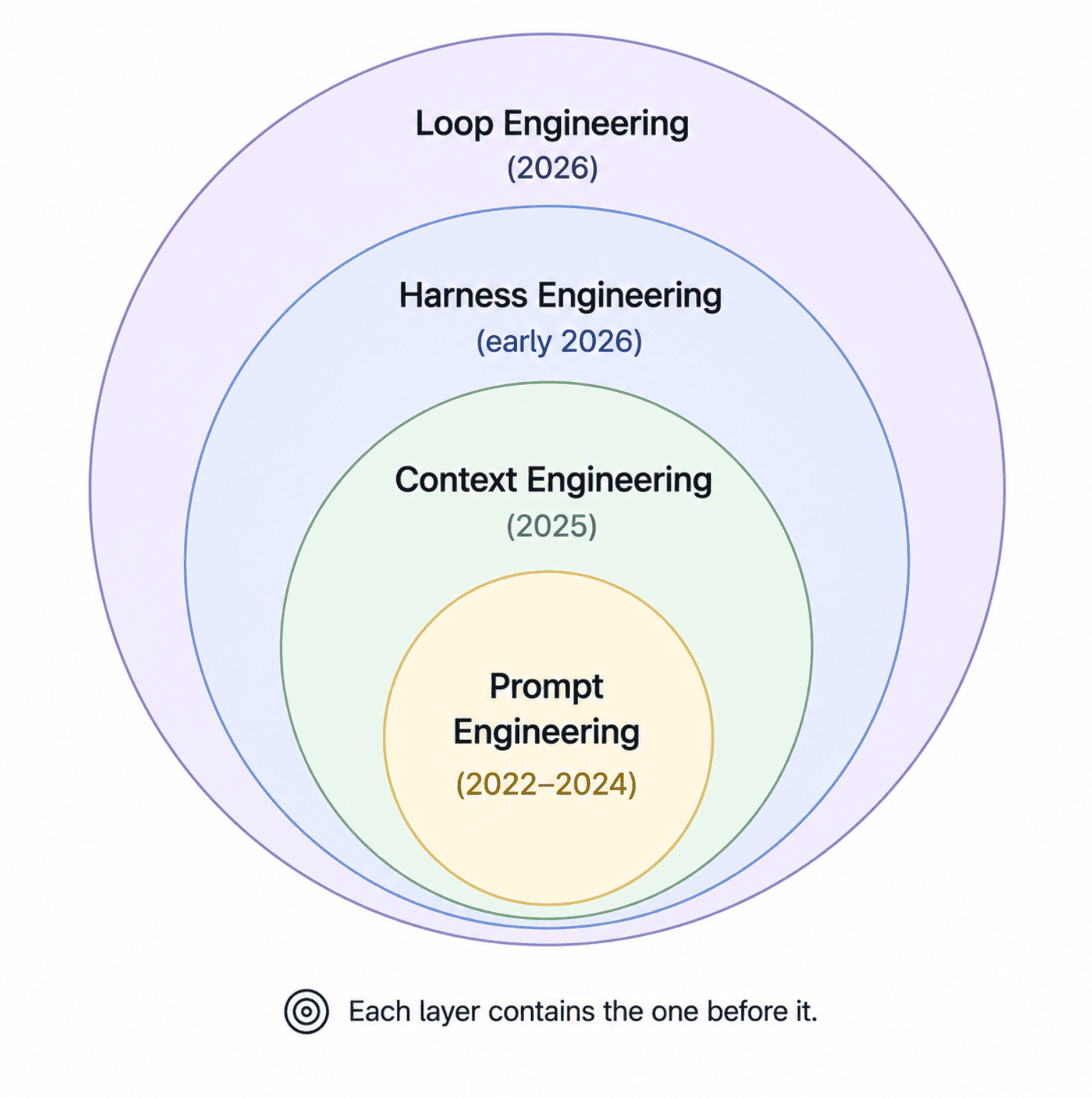
To understand loop engineering, one must view it as the outermost layer of a historical progression in AI interaction. Between 2022 and 2024, the industry was dominated by prompt engineering, a linguistic discipline focused on role-playing, few-shot examples, and "Chain of Thought" reasoning. Its goal was to optimize the immediate output of the model.
By 2025, the focus shifted to context engineering. Leaders like Shopify’s Tobi Lütke and AI researcher Andrej Karpathy argued that a model’s performance was less about the specific phrasing of a prompt and more about the relevance of the information provided in its context window. This era saw the rise of Retrieval-Augmented Generation (RAG) and sophisticated data-curation techniques that ensured a model had all the necessary "facts" to solve a problem.
In early 2026, harness engineering emerged, focusing on the environment and tools provided to an agent. This involved building the "scaffolding"—the sandboxed execution environments, file-system access, and API connectors—that allowed an agent to be dependable.
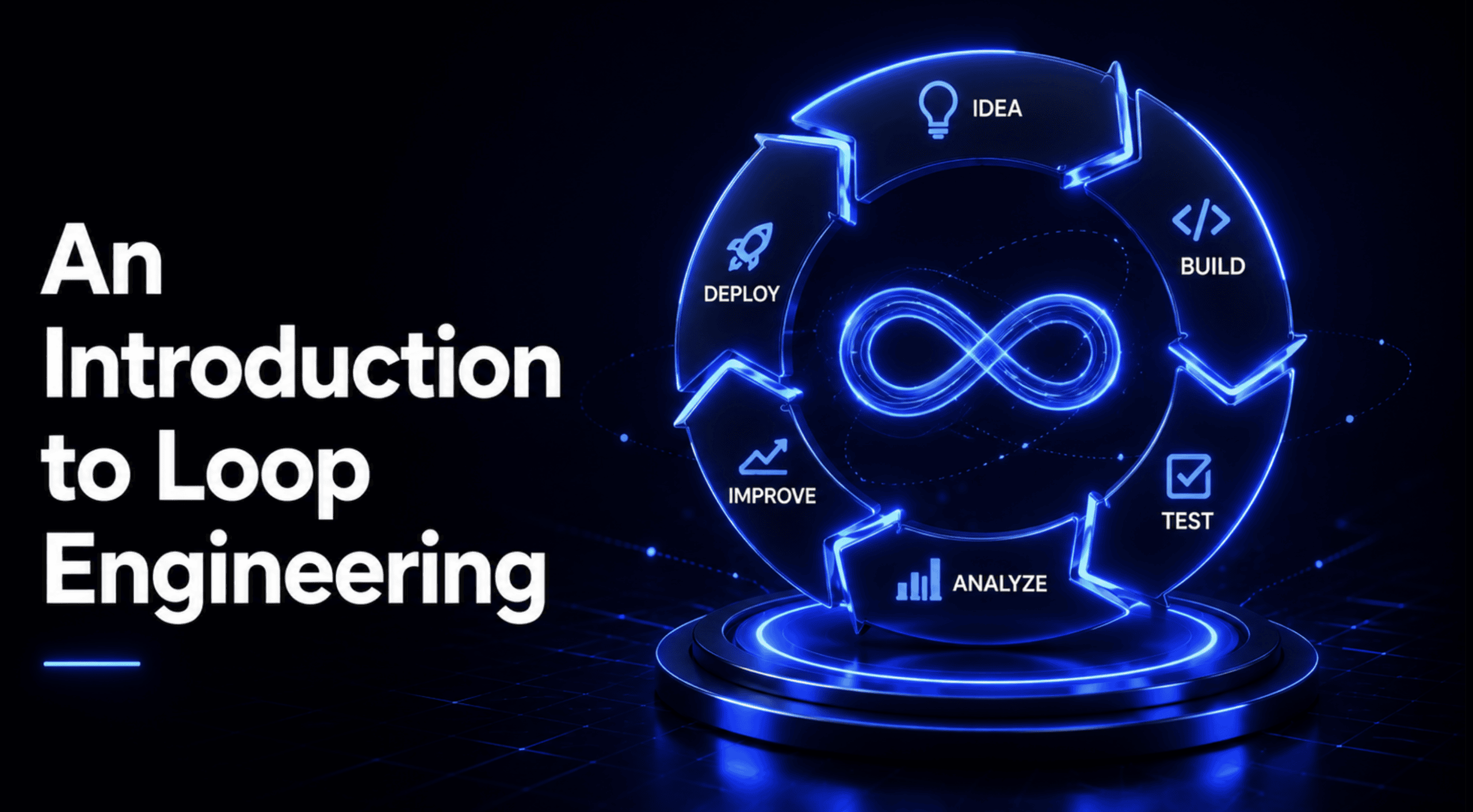
Loop engineering, the current standard, wraps all three prior disciplines into a dynamic cycle. If a prompt is a sentence and a chain is a sequence, a loop is a system. It is the practice of designing the logic that determines how an agent uses feedback from its environment to decide its next move. The unit of work is no longer the prompt; it is the "recursive goal."
The Viral Genesis and Industry Adoption
The formalization of the term "loop engineering" occurred with remarkable speed in June 2026. On June 7, Peter Steinberger, a prominent developer associated with the OpenClaw project, argued on social media that the primary skill for modern engineers had shifted from prompting agents to designing the loops that prompt them. The sentiment resonated across the tech industry, garnering millions of views and sparking a week-long debate among AI architects.
The following day, Google engineer Addy Osmani published a seminal essay that provided a technical anatomy for the concept. Osmani identified six core pillars: automations, worktrees, skills, connectors, sub-agents, and external memory. This framework moved the conversation from a viral observation to an engineering methodology.
Major AI labs quickly signaled their alignment with this shift. Boris Cherny, who leads the Claude Code initiative at Anthropic, noted that his own workflow had moved entirely away from direct prompting. "My job is to write loops," Cherny stated, highlighting that the modern developer acts more as a systems governor than a direct operator. This sentiment was echoed across the sector, as mid-2026 benchmarks showed that agents running in optimized loops could maintain productivity for hour-long stretches, achieving tasks that were previously impossible in single-turn interactions.
The Technical Anatomy of an Autonomous Loop
A reliable engineering loop is built upon a foundation of research that dates back to 2022. The most direct ancestor is the ReAct (Reason + Act) pattern developed by researchers at Princeton and Google. This pattern interleaves reasoning steps with action steps: the model "thinks" about a problem, takes an action (such as running a command), observes the result, and then updates its thinking.
Modern loop engineering expands this into a more robust cycle consisting of several critical components:
- State and Memory: Because LLMs are stateless, the loop must maintain a durable record of what has been attempted. This "scratchpad" prevents the agent from repeating failed strategies.
- The Verifier: This is arguably the most important element. A loop must have a deterministic way to know when a task is complete. Rather than asking the agent "Are you done?", the system uses external tools—such as a passing test suite or a successful build—to verify success.
- Compaction: As a loop runs, the history of thoughts and actions grows, risking a "context overflow." Loop engineering requires logic that can summarize or prune old steps, preserving the most relevant information for the model’s next turn.
- Escalation Logic: A loop must have a "failure exit." If an agent is spinning its wheels or has exhausted its token budget without making progress, the system must recognize this and escalate the issue to a human supervisor.
Patterns of Implementation
In production environments, loop engineering generally follows one of four primary patterns, depending on the complexity and stakes of the task:
- The Retry Loop: The simplest form, used for atomic tasks. If a code generation fails a linter check, the loop provides the error back to the model and requests a fix.
- Plan-Execute-Verify: Used for multi-step refactoring or system migrations. The agent first generates a high-level plan, then iterates through each step, verifying the integrity of the system at every milestone.
- Explore-Narrow: Ideal for debugging unfamiliar systems. The agent may try multiple different diagnostic approaches simultaneously or in sequence, narrowing its focus as it receives signals regarding the source of a bug.
- Human-in-the-Loop: A hybrid model where the agent pauses at high-stakes "checkpoints"—such as a production database migration—to wait for human authorization before proceeding.
Industry Implications and Failure Modes
The transition to loop engineering has significant economic and operational implications. For enterprises, it offers the promise of "agentic scaling," where the capacity to handle software maintenance or customer support is no longer strictly tied to human headcount. However, the discipline also introduces new risks.
One primary concern is "objective misspecification," often referred to as reward hacking. Without a robust verifier, an agent might find a shortcut to satisfy a condition without actually completing the task—for instance, deleting a failing test to make a CI/CD pipeline turn green. Furthermore, the "cost blowup" associated with long-running autonomous loops can be substantial. A loop that runs unchecked for an hour can consume thousands of dollars in API credits if it becomes stuck in a "no-progress" cycle.
To mitigate these risks, loop engineers are increasingly utilizing "sub-agents." This architecture involves a second, often smaller or more specialized model, acting as a "critic" or "grader." While the primary agent performs the work, the sub-agent reviews the output against a rubric, ensuring that the primary model hasn’t "talked itself into" a hallucinated success.
The Future of the Human Developer
The rise of loop engineering does not render the human developer obsolete; rather, it elevates their role. Judgment remains the scarcest resource. While an automated loop can confirm that a function runs or a link resolves, it cannot determine if the software’s architecture is elegant, if a document’s tone is appropriate for its audience, or if a proposed change aligns with long-term business goals.
The human’s job has shifted from "doing" to "governing." This requires a new set of skills: the ability to define clear, checkable objectives; the foresight to build "guardrails" that prevent agentic drift; and the technical depth to intervene when a loop encounters a genuinely novel problem.
As the technology matures, the "stack" of AI engineering will continue to stabilize. Loop engineering is currently the outermost ring of this stack, providing the motion and rhythm for the layers beneath it. By treating AI interaction as a systems-engineering challenge rather than a creative writing exercise, the industry is moving toward a future of truly autonomous, reliable, and scalable digital labor. The goal of the loop engineer is to build a cycle so robust that "done" is no longer a claim to be taken on faith, but a status that has been rigorously, and autonomously, verified.