






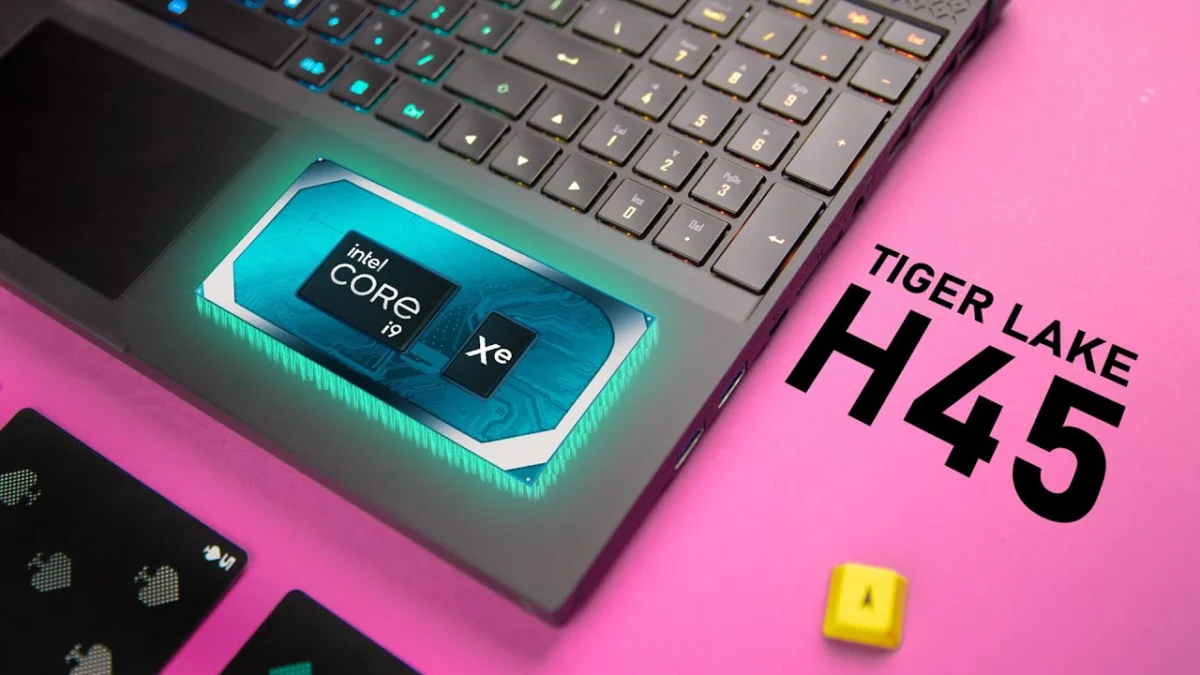
The landscape of the mobile computing and high-performance gaming laptop market has experienced a significant tectonic shift as Intel officially introduces its 11th Generation Core H-series processors, codenamed Tiger Lake-H45. For the past several generations, Advanced Micro Devices (AMD) has steadily asserted its dominance in the laptop sector through its highly efficient and powerful Ryzen 4000 and Ryzen 5000 mobile processor families. While Intel maintained a stronghold in the desktop arena through iterative performance tuning, its mobile offerings largely relied on aging 14nm architectures, such as the Comet Lake-H family, leaving the company heavily vulnerable to relentless competition. The arrival of the 11th Generation H-series represents Intel’s aggressive attempt to reclaim technological leadership, utilizing an entirely overhauled manufacturing node and architecture to challenge AMD’s reigning mobile portfolio.
Background Context and Technological Evolution
To understand the weight of Intel’s 11th Generation launch, one must examine the grueling engineering cycle that preceded it. For years, Intel struggled with the transition from its refined 14-nanometer manufacturing process to a dense, commercially viable 10-nanometer node. While desktop variants like Rocket Lake were met with mixed reviews due to their reliance on older process technology paired with new architectures, the mobile sector required a radically different approach.
The turning point for Intel’s mobile division began with the introduction of its initial Tiger Lake ultrabook processors, followed by the H35 series optimized for ultraportable gaming systems. However, those early iterations were limited in core counts and sustained thermal envelopes. The newly launched H45 lineup scales those previous innovations up to eight cores and sixteen threads, utilizing Intel’s advanced 10nm SuperFin manufacturing process, the Willow Cove microarchitecture, and integrated Intel Xe graphics. This combination marks a comprehensive departure from legacy designs, moving away from infinite process refinements to a ground-up silicon redesign.
Chronology of the Mobile Processor Landscape
The rivalry between Intel and AMD in the laptop space has been heavily defined by supply chain constraints and architectural rollouts over the past twenty-four months:
- Early 2020: AMD launches the Ryzen Mobile 4000 series, instantly capturing critical acclaim for power efficiency and multi-core performance in thin-and-light gaming chassis.
- Late 2020 to Early 2021: Intel attempts to bridge the gap with 10th Gen Comet Lake-H processors, which struggle to maintain efficiency parity against competing architectures. Meanwhile, widespread industry supply chain bottlenecks prevent AMD from fully capitalizing on its performance lead, as notebook manufacturers face severe shortages of Ryzen chips.
- CES 2021: Intel previews its Tiger Lake-H35 platform alongside early teasers for an upcoming 8-core, 5GHz mobile processor line equipped with PCIe Gen4 capabilities.
- Mid-2021: Intel officially launches the 11th Gen Core H-series (H45), bringing 10nm desktop-class performance to the mobile sector and challenging the availability dominance of AMD’s Ryzen 5000 series.
The 11th Gen H-Series Lineup and Specifications
The newly unveiled Tiger Lake-H45 portfolio features both 6-core/12-thread and 8-core/16-thread processors operating at a standard 45-watt thermal design power (TDP), with flagship models configurable up to 65 watts for maximum sustained performance.

At the apex of the stack sits the unlocked Intel Core i9-11980HK, an 8-core, 16-thread processor capable of achieving single-core turbo boosts of up to 5.0 GHz and maintaining a 4.5 GHz frequency across all eight cores simultaneously. On paper, this mobile flagship delivers performance parity with high-end desktop silicon, such as the Rocket Lake Core i7-11700K, despite operating within a constrained mobile power envelope. The processor is fully unlocked, granting enthusiasts manual overclocking capabilities via Intel’s Extreme Tuning Utility (XTU) or automated boosts through the Speed Optimizer feature.
Positioned immediately below the flagship are the Core i9-11900H and the Core i7-11800H. Both chips maintain the 8-core/16-thread architecture, with the i7-11800H emerging as a particularly strong value proposition for mainstream gaming notebooks, offering benchmark performance within a tight 7 to 9 percent margin of the top-tier HK variant. A notable hardware addition across all three top-tier 8-core processors is a generous 24MB of shared L3 cache, exceeding the cache capacity found in comparable desktop configurations and significantly enhancing application responsiveness. Furthermore, native memory support has been upgraded from DDR4-2933 to DDR4-3200 across the entire Tiger Lake-H lineup.
For the mid-range market, Intel introduces two 6-core/12-thread Core i5 variants. While maintaining competitive clock speeds, these processors feature a reduced L3 cache of 12MB to clearly delineate product segmentation between the performance and mainstream tiers.
Platform Innovations: PCIe Gen4 and Connectivity
Beyond raw computing power, the underlying platform architecture of the 11th Gen H-series introduces critical advancements that outpace current competing platforms. Intel has integrated a complete PCIe Gen4 architecture directly into the processor, providing 20 lanes dedicated to system expansion. Of those, eight lanes are allocated for discrete graphics, while the remaining twelve lanes can be leveraged for high-speed NVMe storage solutions, including advanced RAID configurations.
This hardware capability positions Intel platforms to fully harness upcoming software APIs such as Microsoft Direct Storage, which reduces CPU overhead during massive input/output operations. By comparison, competing mobile architectures have frequently restricted storage lanes to PCIe Gen3 standards to manage thermal and electrical power budgets.
In addition to CPU-attached lanes, the Platform Controller Hub (PCH) provides an additional 24 PCIe Gen3 lanes, bringing the platform total to 44 lanes of high-speed connectivity. Real-world internal testing data released by Intel indicates that these architectural changes yield up to an 80 percent increase in storage bandwidth and a 75 percent improvement in access times compared to previous-generation Comet Lake platforms.
Connectivity features have also been modernized through native support for Thunderbolt 4, delivering 40Gbps bidirectional bandwidth capable of driving multiple high-resolution external displays and supporting universal laptop charging protocols. Wireless capabilities are similarly enhanced through integrated Killer Wi-Fi 6E (Gig+) support, expanding network connectivity into the uncluttered 6GHz spectrum to minimize latency and signal congestion in high-density environments.
Integrated Graphics and Market Positioning

While the integrated graphics processors (IGP) included in the H-series retain the "UHD Graphics" nomenclature rather than Iris Xe branding, they utilize the same advanced Xe-LP architecture found in Intel’s lower-wattage mobile processors. However, the execution units (EUs) are scaled down to 32 EUs to accommodate the physical constraints of the larger 8-core silicon die. Industry analysts note that this design choice aligns with original equipment manufacturer (OEM) deployment strategies, as virtually all high-performance 11th Gen H-series laptops will be paired with dedicated discrete graphics cards, such as NVIDIA’s GeForce RTX 30-series mobile GPUs.
Performance Claims and Industry Reactions
According to internal benchmark data provided by Intel, the new mobile processors deliver substantial performance uplifts over both preceding generations and AMD’s Ryzen 5000 mobile lineup. In comparative gaming workloads, the Core i9-11980HK demonstrates competitive advantages against the Ryzen 9 5900HX, even when paired with discrete graphics operating at lower total graphics power (TGP) thresholds. Similarly, Intel positions its mid-range Core i5-11400H to trade blows with higher-tier Ryzen 9 mobile processors in select gaming scenarios, highlighting the strength of its per-core IPC (instructions per cycle) improvements.
Independent industry analysts and hardware reviewers emphasize that while synthetic benchmarks and manufacturer-provided metrics highlight impressive architectural leaps, real-world performance will ultimately depend on system-level implementation. Factors such as laptop chassis thermal design, power delivery tuning, and acoustic profiles vary wildly across different OEM designs, meaning that thermal throttling and power limits will dictate day-to-day user experiences.
Broader Economic and Market Implications
The introduction of Intel’s 11th Generation H-series processors introduces renewed competition into a sector that has faced persistent supply chain vulnerabilities. For consumers, the primary determinants of success for Intel’s latest silicon will not rest solely on architectural specifications, but on retail pricing parity and product availability.
Because AMD’s Ryzen Mobile ecosystem has established a strong foothold in the market—particularly when paired with high-end GPUs in thin-and-light form factors—Intel and its manufacturing partners cannot rely solely on historical brand preference to command price premiums. If OEMs can deliver well-engineered, competitively priced laptops featuring Tiger Lake-H processors ahead of seasonal demand surges, the competitive balance between Intel and AMD will normalize, driving innovation and consumer value across the entire high-performance computing market.