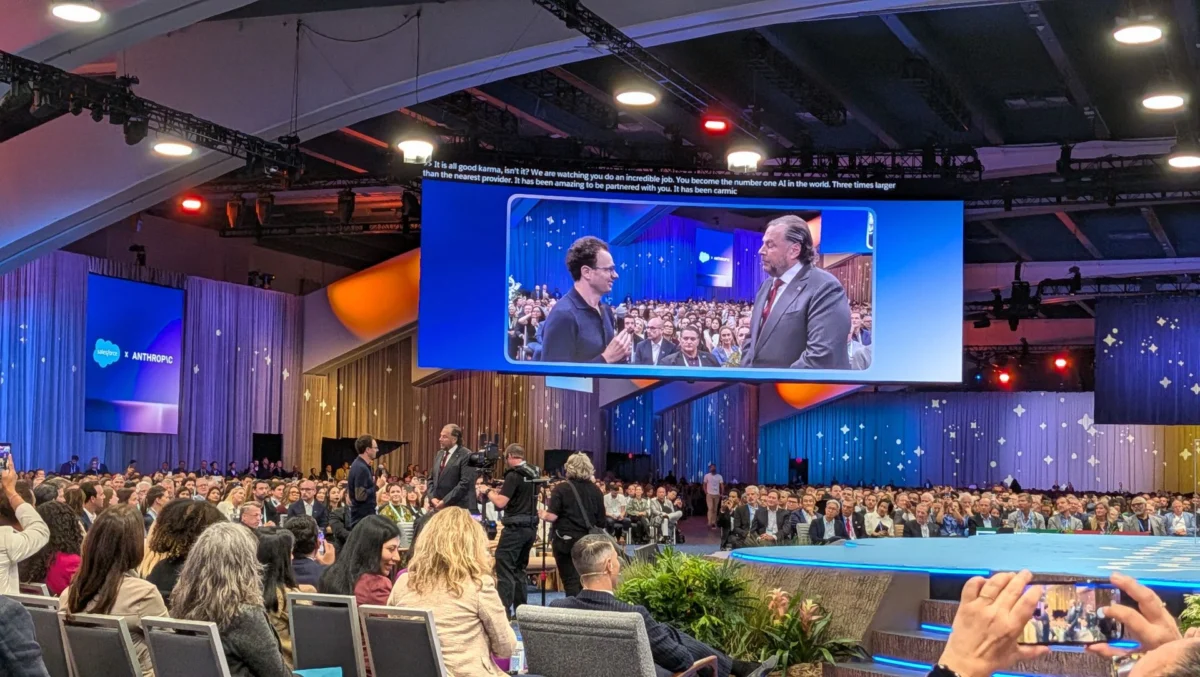
The opening keynote of Dreamforce 2026 in San Francisco became the stage for a compelling contrast of visions as two of the most influential figures in artificial intelligence shared the podium. Nvidia CEO Jensen Huang and Anthropic CEO Dario Amodei addressed a packed auditorium, offering diverging perspectives on the trajectory of the AI industry when questioned by Salesforce CEO Marc Benioff. The discussion highlighted the complex balancing act facing technology leaders, enterprise stakeholders, lawmakers, and regulators as generative AI rapidly reshapes the global economy.
The high-profile appearances underscored the deepening integration of advanced foundational models into enterprise software. Amodei’s company, Anthropic, has seen its Claude platform forge increasingly deep ties with Salesforce in recent months, culminating in the recent launch of Claudeforce. Meanwhile, Huang’s Nvidia continues to supply the foundational hardware driving the global AI buildout, positioning both executives at the epicenter of the current technological shift.
The State of the Market: A New Industrial Revolution
Kicking off the keynote discussions, Dario Amodei reflected on the current state of the artificial intelligence market. Asked by Benioff to evaluate the industry landscape, Amodei drew a parallel to the automotive sector. He noted that while safety records across different companies can sometimes be conflated or difficult to measure uniformly, the industry benefits immensely when developers learn from one another’s milestones. Furthermore, Amodei emphasized the necessity of fostering international standards and cross-border cooperation to elevate the baseline for safety and performance worldwide.
"I think that’s the way to lead the industry forward, to set an example, to say that everyone can always be better," Amodei stated during the session.
Shifting focus to the broader trajectory of the sector, Benioff asked Amodei about the most significant surprises he has encountered during a decade of developing generative AI technologies. Amodei pointed directly to the unprecedented pace of progress. He acknowledged that the sheer velocity of technological breakthroughs caught even industry insiders off guard, particularly regarding the rapid, profound economic impact and how quickly specific AI firms would scale to become central fixtures of daily commercial and consumer life.
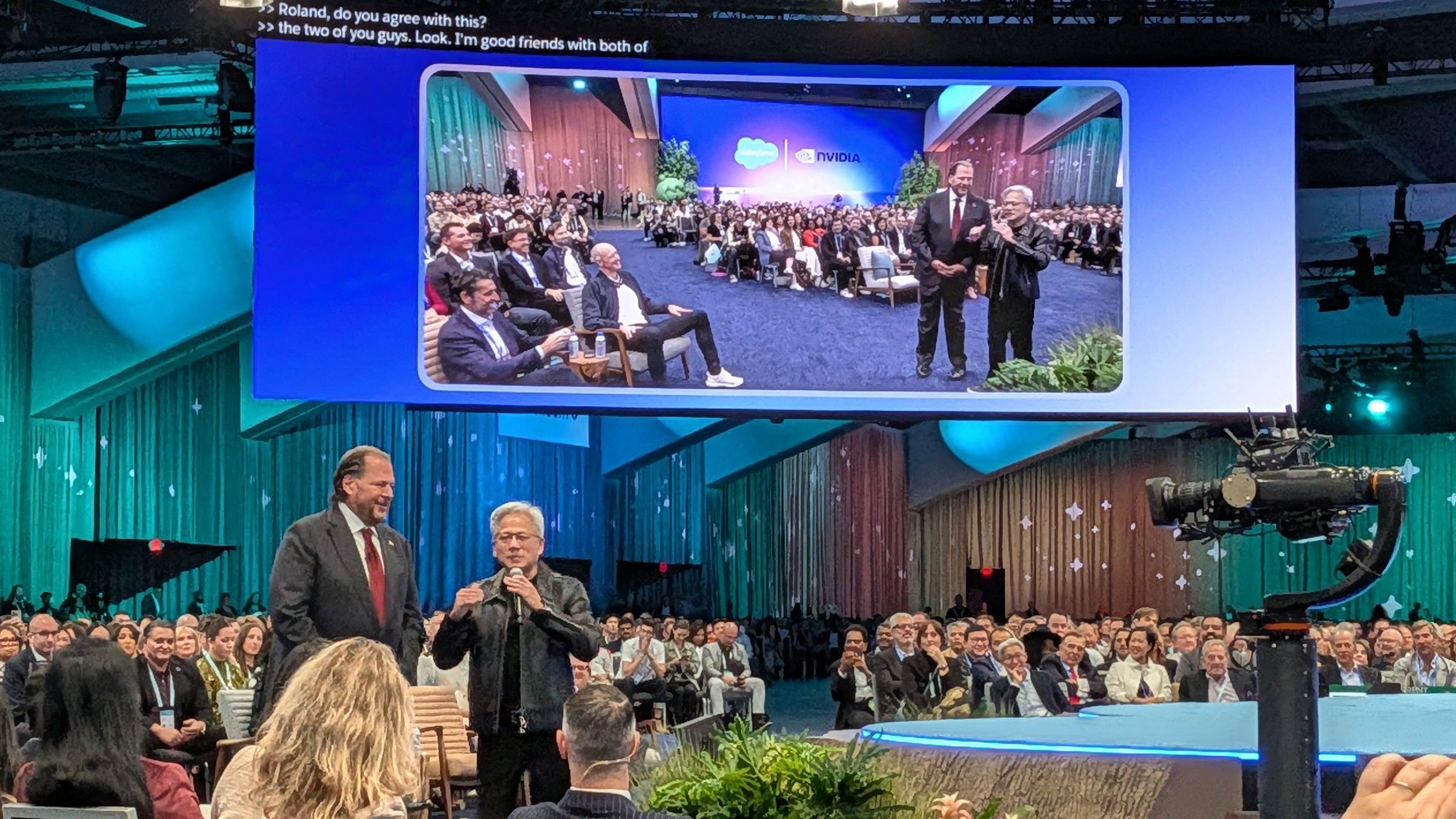
Conversely, Nvidia CEO Jensen Huang framed the current era in sweeping historical terms, leading Benioff on an interactive walkabout across the keynote stage to illustrate his points. "We’re going through a new industrial revolution," Huang declared, emphasizing that computing infrastructure is undergoing a fundamental structural transformation reminiscent of electrification or the rise of the internet.
Navigating the Dilemma of Speed Versus Safety
A central theme of the Dreamforce 2026 keynote panels was the ongoing debate surrounding safety protocols and the speed of deployment. While both executives agreed on the necessity of secure development, their methodologies and framing of the issue revealed distinct philosophies.
Amodei’s approach leans toward methodical oversight and international standardization, reflecting the cautious posture often adopted by frontier lab researchers navigating unpredictable capability jumps.
Huang, however, adopted a more pragmatic, engineering-focused stance on the matter. While conceding that safety remains an absolute priority, Huang challenged the premise that velocity and security are mutually exclusive goals.
"Safety is paramount in a lot of ways. It’s job one," Huang acknowledged. "However, safety is an engineering problem."
Describing the trade-off as a false choice, Huang argued that companies can successfully pursue aggressive innovation while simultaneously maintaining rigorous safety checks. He advised industry peers to run as fast as possible in their product development cycles, but inserted a critical caveat: if a company senses that a product is slipping out of control or failing to meet safety thresholds, leadership must be willing to take a strategic pause to get the engineering right.
Unlocking Enterprise Value and the Road Ahead
As the discussions turned toward practical application and future horizons, both leaders offered advice for businesses and the general public seeking to harness artificial intelligence effectively.
Amodei addressed the question of public and corporate utilization by suggesting that the world has barely scratched the surface of AI’s potential utility. According to Amodei, even if the global development of artificial intelligence models were to be completely frozen at today’s capabilities, society is currently utilizing only an estimated 5% to 10% of the maximum theoretical value those models can provide. He emphasized that widespread diffusion—deepening the integration of existing platforms like Claude into standard business workflows—remains the primary frontier for economic growth. "There’s so much diffusion left," he noted.
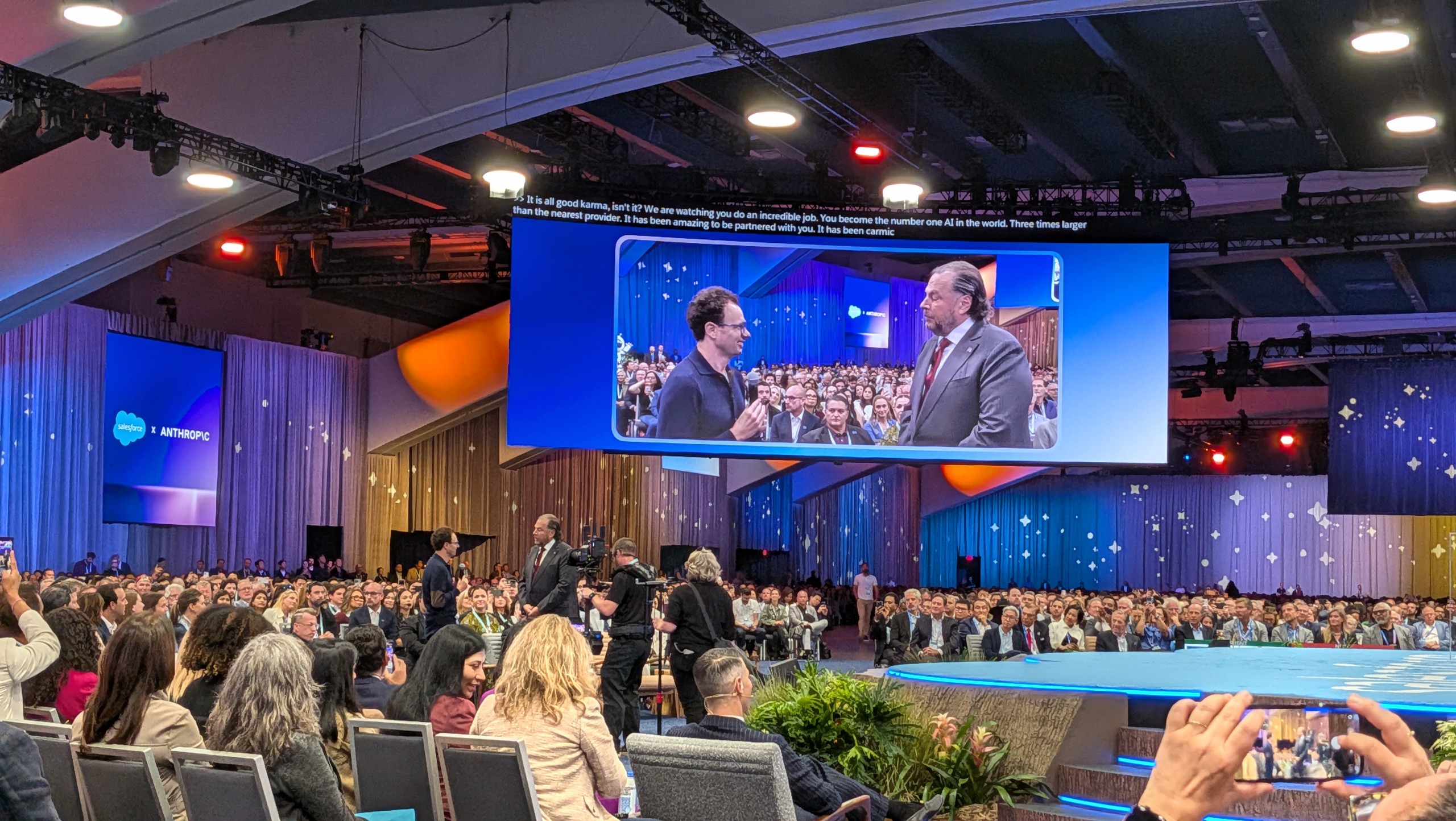
Huang echoed the urgency of integration from an enterprise perspective, outlining a clear mandate for the business community. Detailing his vision for the coming years, Huang stated his desire to "Agentforce every company," underscoring an objective to seamlessly embed autonomous AI agents across the corporate landscape.
Addressing business leaders hesitant to adopt nascent technologies, Huang issued a stark warning against complacency. "You don’t want to be left behind, this is too important of a technology revolution," Huang said. "If it doesn’t work for you straight away, don’t give up on it." He concluded with an optimistic rallying cry for the sector: "The most important thing—don’t get left behind… the sky’s the limit for us."
Implications for Regulators and Enterprise Strategy
The contrasting viewpoints presented by Huang and Amodei at Dreamforce 2026 underscore the broader strategic dilemma confronting enterprise leaders and policymakers. On one side, the hardware and infrastructure perspective championed by Nvidia advocates for relentless momentum, treating risk mitigation as a manageable engineering hurdle that can be solved alongside rapid market expansion. On the other side, the frontier model developer perspective represented by Anthropic emphasizes structural caution, economic disruption metrics, and the imperative for standardized global guardrails.
For corporate decision-makers, navigating this duality requires a balanced approach. Organizations are increasingly pressured to adopt agentic workflows and advanced AI integrations to maintain competitive parity—aligning with Huang’s warning against stagnation. Simultaneously, enterprises must institute robust internal governance, data privacy protocols, and validation frameworks, reflecting Amodei’s emphasis on maximizing the actual, safe utility of deployed systems rather than merely chasing raw model capability.
As regulatory bodies around the world watch how enterprise ecosystems absorb technologies like Claudeforce and Nvidia-powered infrastructure, the dialogue at Dreamforce 2026 serves as a bellwether for the software and hardware industries. The debate confirms that while the destination—a fully automated, AI-driven industrial economy—is widely agreed upon, the exact velocity and steering mechanisms required to reach it remain a subject of intense negotiation among the architects of the digital age.