The integration of advanced satellite technology into terrestrial automotive fleets marks a significant evolution in modern transportation, blending high-speed connectivity with autonomous vehicle engineering. Recent observations from Tesla’s Gigafactory Texas reveal that newly manufactured Cybercabs are rolling off the production lines equipped with integrated Starlink hardware as a standard factory feature. This development underscores a broader corporate strategy by Tesla Chief Executive Officer Elon Musk to ensure continuous, high-bandwidth digital access for autonomous vehicles, transcending the traditional limitations of cellular networks and terrestrial infrastructure.
Factory-Floor Evidence and Production Scaling
Production momentum at Gigafactory Texas accelerated following the Labor Day weekend, bringing forth new logistical insights into Tesla’s manufacturing output. Drone footage captured by local aerospace observer Joe Tegtmeyer highlighted a notable shift in the facility’s outbound logistics yard. Alongside rows of Model Y Long Wheelbase units, hundreds of gold-colored Cybercabs were spotted featuring the distinctive Starlink satellite module neatly integrated into the rear hatch above the taillights.
This sighting represents a critical transition from previous months. Earlier iterations of Starlink-equipped Cybercabs were predominantly treated as bespoke test units or low-volume prototypes. The appearance of the hardware across a broad volume of outbound vehicles indicates that the satellite antenna has been successfully incorporated into the standard bill of materials for the robotaxi line.
The physical manifestation of this integration follows a series of public disclosures. On August 10, Tesla’s official Robotaxi social media account showcased a single gold Cybercab featuring the roofline-mounted antenna. This followed a July collaborative reveal by Tesla and Starlink, which published detailed cutaway diagrams illustrating the precise placement of the low-profile phased-array antenna designed to maintain continuous communication without disrupting the vehicle’s aerodynamic profile or aesthetic design.
Engineering Rationale Versus Consumer Experience
The decision to equip autonomous vehicles with direct-to-satellite communication capabilities has prompted considerable discussion among industry analysts regarding its primary utility. Ashok Elluswamy, Tesla’s Vice President of AI Software, addressed the functional necessity of the hardware during public briefings, clarifying that the Starlink connection is not fundamentally required for the vehicle’s core autonomous driving systems. The unsupervised Full Self-Driving (FSD) architecture relies on onboard neural networks, localized mapping data, and immediate sensor suites to navigate complex urban environments.
Instead, Elluswamy noted that the primary purpose of the satellite downlink centers on fleet management, high-precision navigation updates, diagnostic telemetry, and responsive customer service interactions. In densely populated urban zones where robotaxi services initially launch, cellular infrastructure is typically robust. However, Musk has emphasized a different operational vulnerability during financial earnings calls. He has frequently warned against the risks of autonomous vehicles becoming stranded in rural or remote pockets devoid of reliable cellular coverage—phenomena he characterizes as connectivity "Bermuda Triangles."
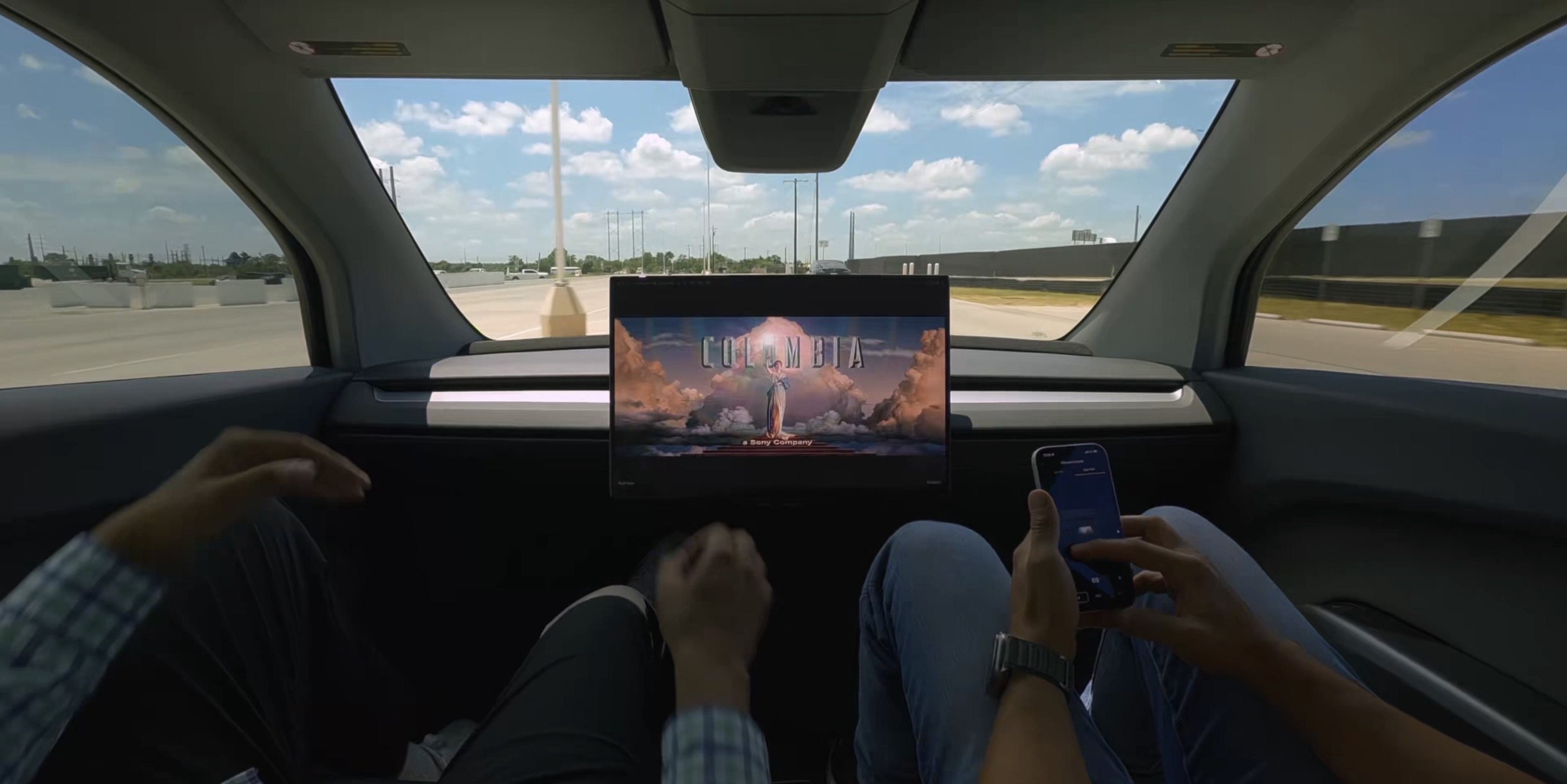
Beyond operational reliability, the hardware serves as a powerful consumer-facing amenity. Musk has publicly stated that the integration of Starlink will eventually extend across the entire Tesla vehicle lineup, establishing the infrastructure necessary to deliver high-bandwidth digital services to millions of vehicles globally. For passengers utilizing the autonomous Cybercab service—which features an interior devoid of traditional steering wheels and pedals—the high-speed connection facilitates advanced in-cabin entertainment options, including seamless 4K video streaming and high-latency-sensitive cloud gaming during transit.

Regulatory Scrutiny and Deployment Context
The scaling of Starlink-equipped Cybercabs coincides with a pivotal expansion phase for Tesla’s autonomous ride-hailing network. Public-facing robotaxi operations officially commenced in Austin, Texas, on September 3, quickly followed by sightings of Starlink-enabled test units operating in metropolitan areas such as Houston, Texas, and near Miami International Airport in Florida.
This rapid geographic expansion occurs under intense regulatory observation. The National Highway Traffic Safety Administration (NHTSA) recently initiated an audit examining the certification pathways utilized by Tesla to ensure the Cybercab complies with federal motor vehicle safety standards, specifically scrutinizing the complete omission of manual driver controls. While this federal inquiry focuses on mechanical and structural compliance, the concurrent rollout of satellite hardware adds another layer of technological complexity to a vehicle already disrupting traditional regulatory frameworks.
The Intersect of Autonomous Fleets and Unforeseen Crises
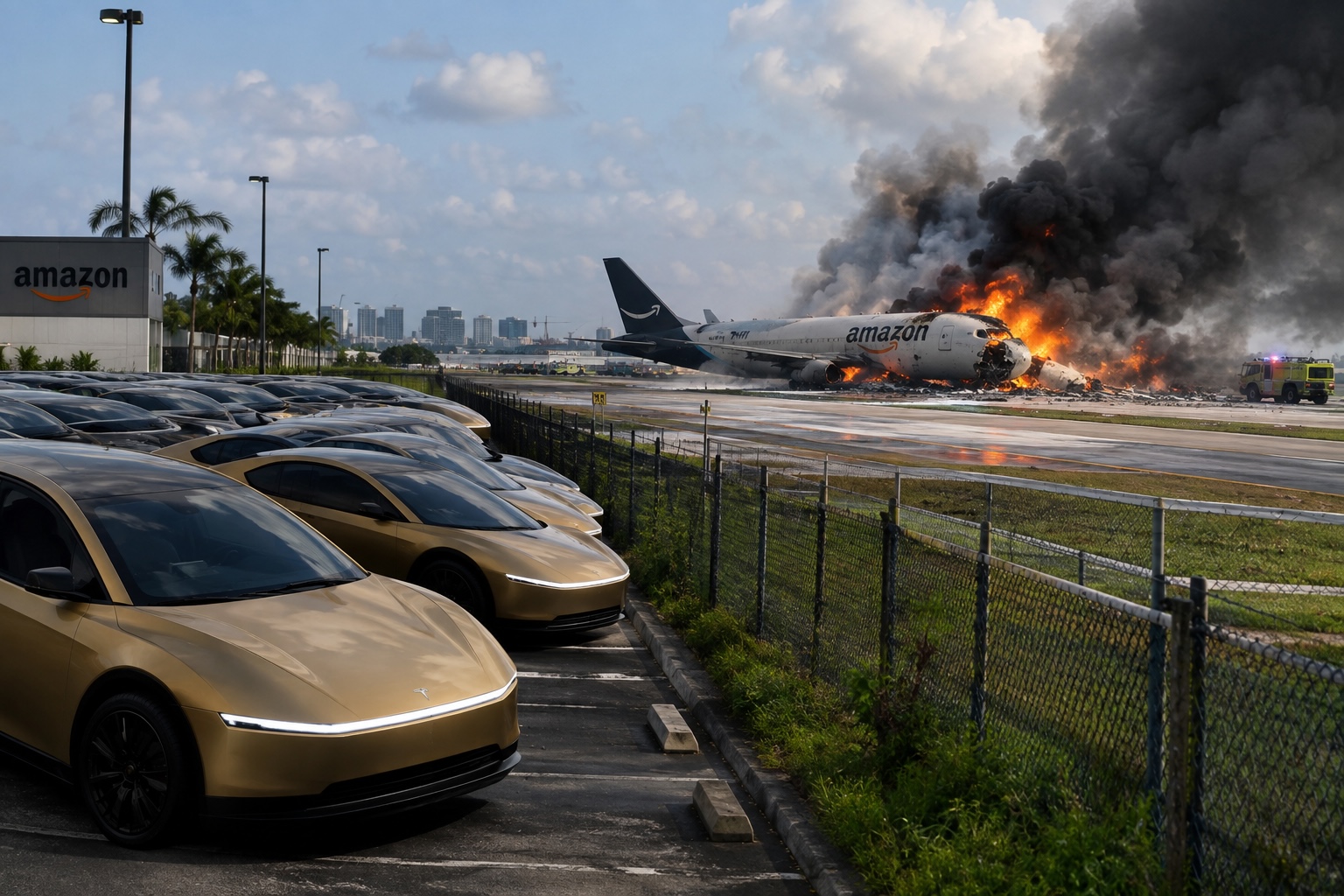
The complex operational landscape of modern transit networks was starkly highlighted during the initial rollout phase when an unexpected aviation incident unfolded near Tesla’s staging infrastructure in Miami. An Amazon Prime Air Boeing 767 cargo aircraft, operating as Flight 7598 by carrier 21 Air, overran the runway at Miami International Airport on Sunday afternoon, September 6. The aircraft crossed the airport’s perimeter barrier, traversed a public roadway, and collided with multiple vehicles before erupting into a fire, resulting in five fatalities and five injuries.
Photographic and video documentation from the immediate aftermath revealed that the aircraft’s nose came to a rest within meters of a secured staging lot containing a fleet of gold-colored Tesla Cybercabs. Emergency response teams from Miami-Dade Fire Rescue confirmed that the aircraft impacted multiple motor vehicles in its path, though official statements from municipal authorities, airport administration, and Tesla have not explicitly confirmed whether individual Cybercabs sustained physical damage.
Musk offered a characteristically sparse public reaction to the proximity of the wreckage, acknowledging the surreal juxtaposition on social media with a single-word post: "Weird." Federal investigators from the National Transportation Safety Board (NTSB) and the Federal Aviation Administration (FAA) immediately launched a comprehensive probe into the aviation accident, examining flight data indicating the aircraft touched down at an elevated speed well above standard operational parameters. The incident served as a dramatic reminder of the unpredictable variables that commercial transport fleets must navigate within densely developed urban environments.
Historical Parallels: The Existential Margins of Innovation
While Tesla navigates the intricate challenges of scaling autonomous vehicle production and satellite integration, the company’s leadership continues to draw parallels to historical milestones that defined sister company SpaceX. The precarious nature of technological pioneering was underscored recently when Musk reflected on the formative years of SpaceX’s Falcon 1 rocket development.
In late 2008, the private aerospace firm faced an existential financial crisis following three consecutive launch failures. Industry observers frequently overlook how close the company came to complete dissolution. When aerospace entrepreneur Peter Diamandis publicly recalled the company’s tumultuous beginnings, noting that SpaceX possessed sufficient capital for precisely one final attempt, Musk confirmed the ultimate stakes: "If the 4th launch had failed, SpaceX would not exist."
A Chronology of Resilience: The Falcon 1 Campaign
The trajectory of commercial spaceflight was forged through a punishing sequence of engineering trials and near-misses on Omelek Island in the Pacific Atoll of Kwajalein:
- March 24, 2006 (Flight 1): Thirty-three seconds after liftoff, a corroded aluminum fitting on a fuel line leaked, causing a kerosene fire that severed control and destroyed the vehicle. The primary payload, a DARPA satellite, survived the fall to land on a nearby storage shed.
- March 21, 2007 (Flight 2): The first stage performed nominally, but unbaffled liquid slosh in the second-stage oxidizer and fuel tanks induced a circular coning motion, leading to premature engine shutdown and preventing orbital insertion.
- August 2, 2008 (Flight 3): Powered by the newly designed regeneratively cooled Merlin 1C engine, the first stage performed well. However, residual thrust lingering in the engine’s cooling channels after main-engine cutoff caused the spent first stage to bump into the second stage in the vacuum of space, destroying the vehicle.
- September 28, 2008 (Flight 4): With capital entirely exhausted, the engineering team assembled a final rocket from spare components. Staging timing was adjusted to allow residual thrust to fully decay before separation. The vehicle successfully placed a 165-kilogram mass simulator into Earth orbit, making Falcon 1 the first privately developed liquid-fueled rocket to achieve orbital insertion.
Broader Implications for Global Infrastructure
The successful realization of that fourth flight fundamentally reshaped the global economy, unlocking crucial NASA Commercial Resupply Services contracts that catalyzed the development of the Falcon 9, Dragon spacecraft, and the Starship architecture. Furthermore, it laid the foundational economic and logistical architecture required to deploy the Starlink satellite constellation.
The convergence of these technologies—autonomous terrestrial vehicles governed by artificial intelligence, direct-to-cell and direct-to-vehicle satellite constellations, and high-cadence commercial rocketry—represents a unified industrial vision. By embedding Starlink terminals directly into the production lines of vehicles like the Cybercab, Tesla is attempting to decouple its service ecosystem from terrestrial telecom limitations.

As these fleets expand across major metropolitan markets and face the realities of real-world deployment, the success of these integrated systems will depend not only on the precision of their neural networks and the resilience of their satellite downlinks, but also on their ability to safely navigate an increasingly complex and unpredictable physical world.