The landscape of digital photography is undergoing a seismic shift as artificial intelligence increasingly blurs the boundary between traditional editing and generative content creation. In its latest move to integrate cutting-edge machine learning into standard creative workflows, Adobe has introduced an experimental beta feature to Lightroom called "Prompt to Edit." Powered by Google’s viral generative AI platform, Nano Banana 2, this new addition allows photographers to completely transform their images using simple text prompts directly from their desktop applications. Released as an early public access beta on September 29, the tool represents a major evolution in how software handles photographic manipulation, sparking both excitement and intense industry debate regarding the future of authenticity in visual media.
Understanding Prompt to Edit and How It Works
Unlike conventional Lightroom tools that manipulate exposure sliders, contrast curves, or local masking brushes, Prompt to Edit approaches image alteration from an entirely different perspective. Instead of fine-tuning existing pixels through mathematical adjustments, the tool relies on generative AI to interpret written instructions and entirely regenerate the photo based on the user’s commands.
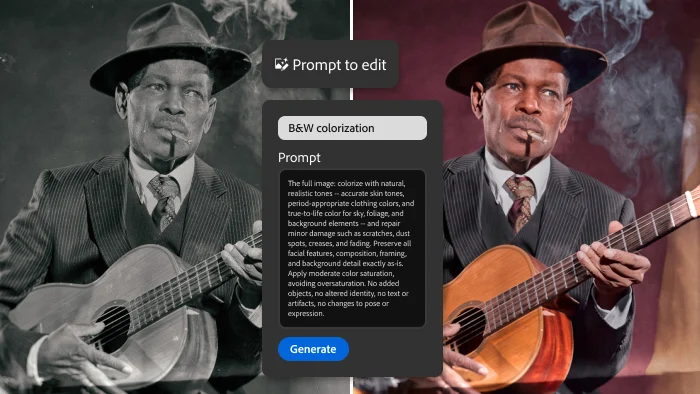
Positioned within a dedicated workspace inside the Lightroom desktop sidebar, the feature presents users with an intuitive text box accompanied by sample prompts designed to guide prompt engineering. When a user selects a sample suggestion, the text box automatically populates, demonstrating the syntax and descriptive language required to achieve specific results. According to Adobe’s demonstration materials, the capability extends far beyond basic touch-ups. Photographers can use the tool to remove complex dust and scratches from vintage photographs, restore missing details in historical archives, seamlessly transition a black-and-white portrait into full color, or perform dramatic environmental alterations such as swapping out an overcast sky or introducing atmospheric fog into a clear landscape.
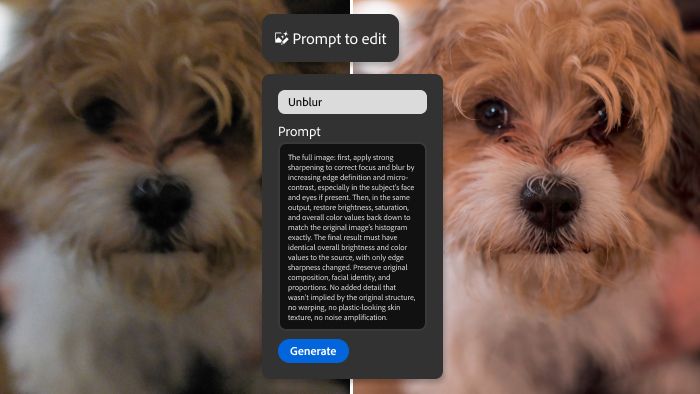
Once a prompt is executed and the image is generated, Lightroom automatically saves the newly created asset in a stack directly alongside the original photograph. This non-destructive stacking approach ensures that users never lose their starting point. Furthermore, photographers can apply Lightroom’s traditional adjustment tools to further refine the AI-generated output. Users are also able to save their successful text prompts as custom presets, allowing for consistent application across large batches of images—a workflow familiar to professional editors managing high-volume shoots. While Adobe has confirmed that utilizing the feature consumes generative credits from a user’s monthly subscription allowance, the company has not yet disclosed the exact credit consumption rate per generation.
Chronology and the Broader Integration of AI in Adobe Ecosystems
The rollout of Prompt to Edit follows closely on the heels of other major artificial intelligence deployments across Adobe’s creative suite, most notably the introduction of Photoshop’s AI Assistant. However, a close examination of the two tools reveals distinct architectural and philosophical differences in how Adobe approaches generative technology across its flagship products.
While Photoshop’s AI Assistant is capable of executing both traditional editing commands and advanced generative adjustments, it operates primarily on Adobe Firefly. Firefly is a proprietary generative model trained exclusively on licensed stock imagery, public domain content, and open-licensed data where copyright has expired. This design choice was intentionally made to provide commercial safety and legal indemnity for professional designers and commercial photographers concerned about copyright infringement.
In contrast, the new Lightroom integration leverages Google’s Nano Banana 2 architecture. Unlike Adobe Firefly, Google’s training methodology for Nano Banana has faced scrutiny regarding data sources, with the company maintaining less restrictive transparency policies. Notably, Nano Banana 2 possesses the capability to pull and reference live images from a Google Search during the generation process. This technical distinction highlights Adobe’s willingness to look outside its proprietary ecosystem, incorporating third-party AI models to meet evolving consumer demands for speed, versatility, and advanced creative control.
The September update containing the Prompt to Edit beta also introduces several other practical enhancements to Lightroom. Among these are significant improvements to the software’s Reflection Removal tool—a popular feature designed to eliminate unwanted glare from glass and water surfaces without requiring physical polarizing filters—alongside routine updates to expand camera and lens compatibility for newly launched hardware.
Industry Implications and the Debate Over Authenticity
The integration of third-party generative AI into a cornerstone professional photography application like Lightroom carries profound implications for the industry. For decades, Lightroom has served as the digital darkroom—a place for developing, balancing, and enhancing images captured through a camera lens, with a strict ethical boundary separating photography from digital illustration or graphic design.
Proponents of tools like Prompt to Edit argue that generative AI represents a natural extension of darkroom manipulation techniques long practiced by master photographers, such as dodging, burning, and composite printing. For commercial creators, advertising agencies, and hobbyists alike, the ability to rapidly prototype backgrounds, fix damaged archival files, or introduce environmental moods via text prompt can dramatically accelerate production timelines and reduce the cost of complex reshoots.
Conversely, documentary, photojournalistic, and fine-art communities have expressed growing apprehension regarding the normalization of generative image regeneration. Critics point out that when an AI tool "regenerates the entire photo" based on a text description, the resulting file ceases to be a capture of a real-world moment and instead becomes a hybrid creation born of machine hallucination and text interpretation. This blurs the line between recording history and fabricating visual fiction, presenting severe challenges for news organizations, evidentiary standards, and audiences seeking truthful representations of events.
As the software remains in an early public access beta phase exclusively for desktop users, Adobe has a critical window to gather telemetry data, user feedback, and ethical considerations from the global creative community. Whether Prompt to Edit becomes an indispensable standard tool for all digital workflows or remains a specialized niche feature will largely depend on how software developers implement provenance tracking, metadata labeling, and content credentials to verify the origin of AI-altered imagery in an increasingly synthetic visual world.