




The modern television market has long been defined by a constant pursuit of absolute picture fidelity, razor-thin bezels, and increasingly complex panel technologies. Yet, manufacturers frequently struggle to deliver compelling innovations that resonate beyond technical benchmark testing. For over two decades, European consumers have enjoyed a distinct alternative known as Philips Ambilight—a technology designed to extend the on-screen visual experience directly onto the wall behind the display via an integrated array of rear-facing LEDs. Following its North American introduction via Roku-powered displays manufactured by Skyworth under license, the launch of the 2026 Philips 7985 Series marks the debut of a quantum dot layer combined with this signature ambient lighting system. Retailing at an aggressive MSRP of $389.00 for the 55-inch model (55PUL7985/F7), the 7985 Series presents a fascinating paradox in the budget television sector: an average performing 4K display coupled with a high-end atmospheric lighting experience.
Background Context and Evolution of Ambilight Technology
Developed originally by Philips in the early 2000s, Ambilight technology was engineered to reduce eye strain and enhance immersion by matching ambient room lighting to the dominant colors displayed on the screen. While consumers in North America have historically relied on aftermarket bias-lighting solutions—such as third-party sync boxes, external cameras, and adhesive LED strips from brands like Govee or Philips Hue—these workarounds demand tedious calibration, cable management, and application setup.

The integration of Ambilight directly into a manufactured television chassis eliminates these friction points entirely. The 2026 7985 Series represents a significant milestone for the North American market by pairing this lighting system with a Quantum Dot (QLED) vertical alignment (VA) panel for the first time at this price point. Manufactured and supported in North America by Skyworth under a long-term licensing agreement, these sets aim to capture budget-conscious consumers who prioritize home theater atmosphere and out-of-the-box convenience over professional-grade color grading.
Design, Hardware, and Connectivity Specifications
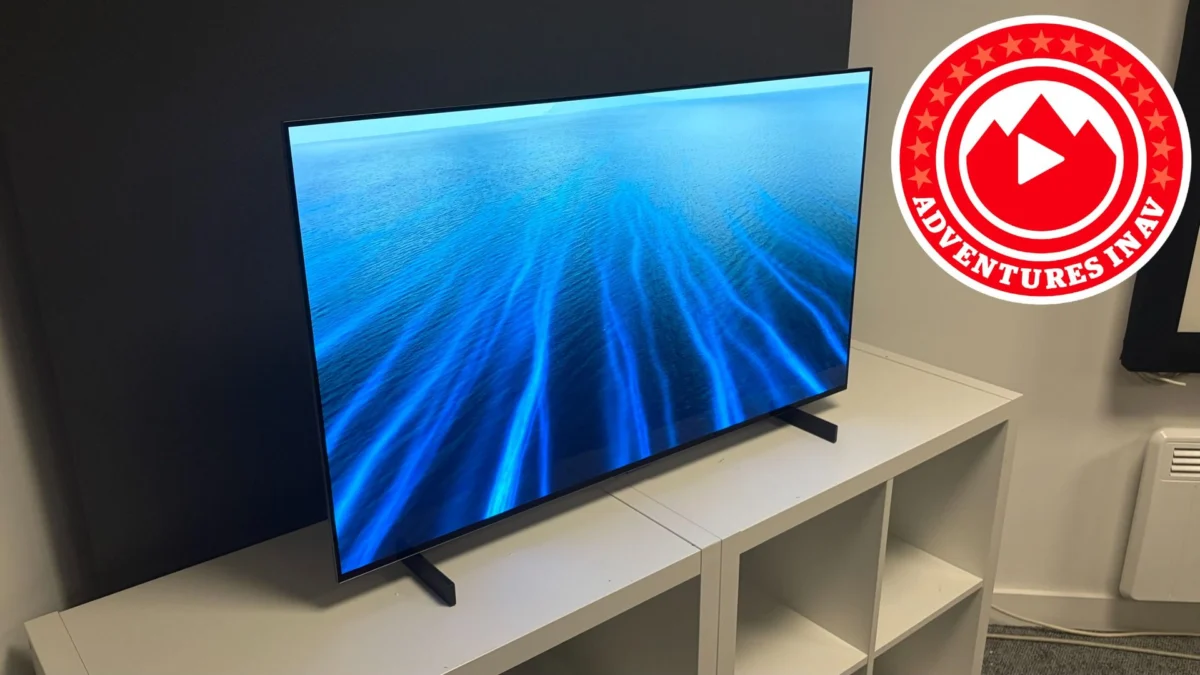
Out of the box, the 55-inch Philips 7985 Series presents a familiar aesthetic common to budget-tier televisions. The chassis features slim black bezels framing a VA-panel LCD, supported by two wide-set plastic feet that screw into the bottom edge. Weighing a modest 22.2 pounds without the stand (and 22.9 pounds with it), the television is exceptionally light, allowing for straightforward, single-person unboxing and placement. However, the absence of a central pedestal may present placement challenges for consumers with narrow media consoles.
Turning the television around reveals the hardware justification for its unique market positioning: LED strips embedded along the left, right, and top edges of the rear panel. Unlike multi-sided installations that wrap around the bottom, the three-sided configuration assumes the television will rest on a piece of furniture, meaning wall-mounted installations will not project light downward. For optimal performance, manufacturers and product reviewers recommend mounting the display a few inches away from a light-colored or white wall, allowing the LEDs to accurately reflect and disperse color data.

The connectivity suite is surprisingly robust for a television priced under $400. The hardware layout includes:
- Four HDMI 2.0 inputs, featuring eARC/ARC on HDMI 1, ALLM (Auto Low Latency Mode), and HDCP 2.3 compliance.
- Maximum video input capabilities of 4K at 60Hz.
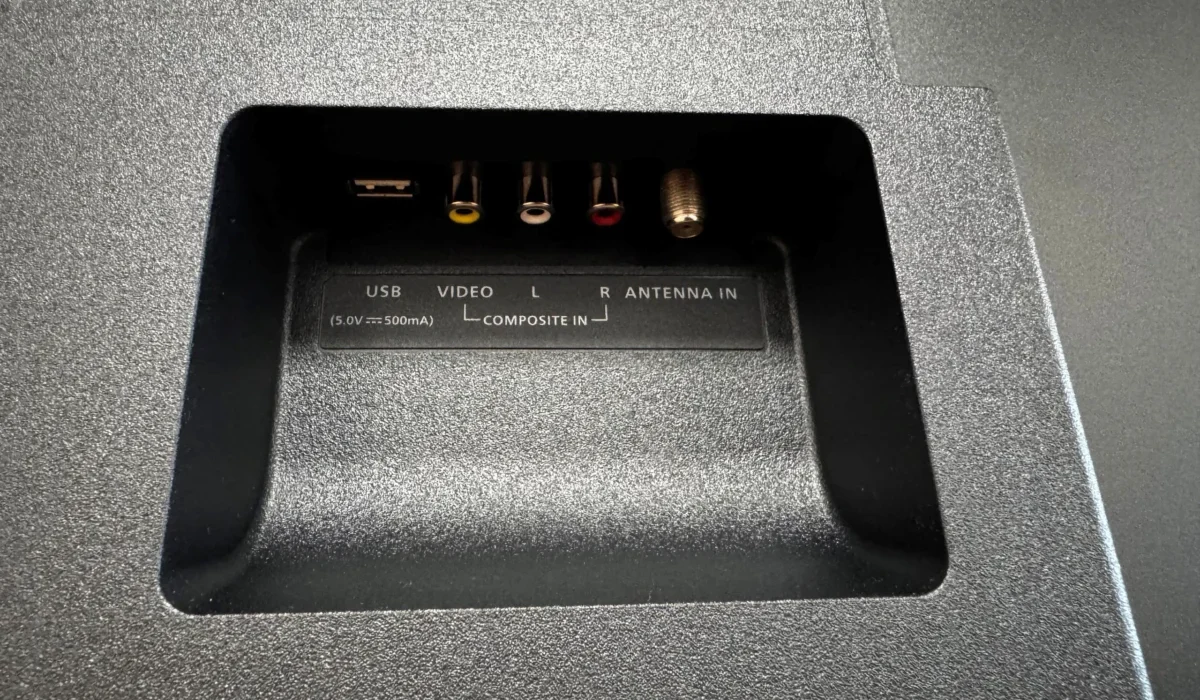
- One USB 2.0 port, an Ethernet port, an optical digital audio output, a headphone output, a composite video input, and an RF coaxial antenna jack.
- Wireless connectivity via Wi-Fi 5 (802.11ac), Bluetooth 5.0, and Apple AirPlay integration.
For physical wall-mounting, the set utilizes a relatively compact 200 x 100 mm VESA pattern, requiring buyers to verify bracket compatibility prior to installation.
Picture Quality Analysis: QLED Color and Budget Contrast Limitations
The visual performance of the Philips 7985 Series is characterized by a distinct compromise between vibrant color reproduction and native contrast limitations. Utilizing a VA-panel LCD enhanced with a quantum dot layer, the television delivers noticeable improvements in red and green saturation compared to its predecessor, the 7875 Series. Animated features and nature documentaries benefit substantially from this expanded color volume, displaying a clean, lively palette during bright-room viewing.

However, the hardware architecture lacks local dimming capabilities. Because the direct LED backlight can only dim globally rather than in localized zones, dark night scenes can occasionally appear charcoal gray rather than deep black. Ironically, the Ambilight system mitigates this perceived limitation in a dark room; the ambient glow raises the overall ambient light level in the viewer’s peripheral vision, effectively tricking the human eye into perceiving deeper contrast and richer blacks than the panel natively produces.
High Dynamic Range (HDR) performance encounters similar hardware boundaries. While the inclusion of Dolby Vision, HDR10, and HLG support is commendable at a $389 price point, the panel’s peak brightness is insufficient to make specular highlights truly pop. Furthermore, the VA panel introduces notable contrast and color shifts when viewed off-axis at 30- and 45-degree angles, necessitating a centered seating position for optimal image accuracy.
Motion handling and upscaling perform reliably within the constraints of a native 60Hz refresh rate. While the 120 PMR (Perfect Motion Rate) designation refers purely to motion processing rather than a 120Hz native panel, standard high-definition upscaling from 1080p cable broadcasts and streaming sources remains clean and free of aggressive, artificial edge sharpening.
The Ambilight Experience and Lighting Modes

The primary differentiator for the 7985 Series remains its integrated lighting framework. Setup requires minimal configuration—typically taking less than five minutes—during which the user selects a target brightness level and specifies the color of the mounting wall to ensure accurate hue projection.
The default setting, "Follow Video," samples the visual data at the edges of the frame and projects corresponding colors onto the wall in real time. Processing speeds are exceptionally responsive, maintaining synchronization during rapid scene transitions without noticeable latency. Additional operational modes include:
- Follow Audio: Pulses the rear LEDs in time with musical rhythms, suited for party environments or music video playback.
- Lounge Light: Emits a static, custom-colored ambient glow while the display panel is powered off, allowing the television to function as a large decorative room lamp.
- Roku Backdrops Integration: Combines static ambient lighting with digital art or photography displayed on-screen.
While performance is generally consistent, minor artifacts—such as brief lighting flickers during high-contrast scene cuts—can occasionally occur.
Software Ecosystem and Roku Integration

Software performance on budget televisions is frequently a primary point of consumer friction, often marred by sluggish proprietary operating systems. Philips bypasses this concern by integrating Roku OS into the 7985 Series. Navigation is swift, responsive, and grants immediate access to all major subscription streaming services alongside free ad-supported streaming television (FAST) channels via the Roku Channel.
The inclusion of Roku OS does introduce standard software advertising monetization, manifested through prominent banner placements on the home screen and sponsored content rows. For Apple device households, built-in AirPlay functionality simplifies casting, while smart home compatibility extends to Amazon Alexa, Google Assistant, and Apple Home (via Siri). The bundled voice remote provides standard navigational controls, though advanced users may rely on HDMI-CEC integration for seamless peripheral control with soundbars and gaming consoles.
Audio Output and Soundbar Recommendations
Acoustic performance is driven by a dual 10-watt speaker configuration paired with Dolby Atmos decoding. While the inclusion of Atmos processing represents an upgrade over previous iterations, physical hardware constraints prevent true overhead spatial audio reproduction. Dialogue clarity remains clean and intelligible during moderate-volume television viewing, but dynamic action sequences expose limitations in low-end frequency response and bass extension.

Given the price point, these acoustic limitations are standard industry expectations. The inclusion of eARC on HDMI 1 ensures straightforward integration with external audio systems, while owners invested in the Roku ecosystem can wirelessly pair proprietary Roku surround speakers and subwoofers natively.
Industry Implications and Market Positioning
The launch of the Philips Ambilight 7985 QLED TV highlights a strategic divergence in the sub-$400 television category. While competing manufacturers such as Hisense and TCL focus heavily on raw panel performance—offering Mini-LED backlighting, local dimming, and 144Hz refresh rates for gamers—Philips leverages atmospheric immersion and brand differentiation as its core value proposition.
For casual evening streamers, families, and consumers seeking an aesthetically engaging home theater environment without the hassle of aftermarket lighting kits, the 7985 Series delivers high functional value. Conversely, hardcore competitive gamers requiring 120Hz or 144Hz input speeds, alongside cinephiles demanding reference-grade HDR contrast, will find better utility in similarly priced or slightly elevated Mini-LED alternatives. Ultimately, the Philips 7985 Series succeeds not as a benchmark display technology, but as a uniquely entertaining visual package tailored for everyday lifestyle integration.