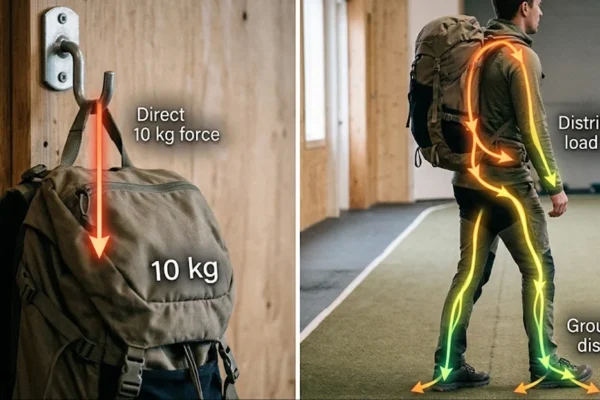






Load up a backpack and wander somewhere for an hour, and you will notice a distinct, cascading sequence of physical feedback. First, your shoulders feel the weight. Then, your hips adjust to the downward pressure. Finally, your trunk leans forward and your stride shifts as your muscles begin, under continuous strain, to negotiate with gravity. Yet, despite the inevitable fatigue and complaints, the human body is remarkably well-engineered for this exact physical task: carrying. While humans may not possess the sheer size, raw strength, or explosive speed of other apex mammals on Earth, give us a load, a pair of functioning feet, and a little time, and we will lug it a surprisingly long distance.
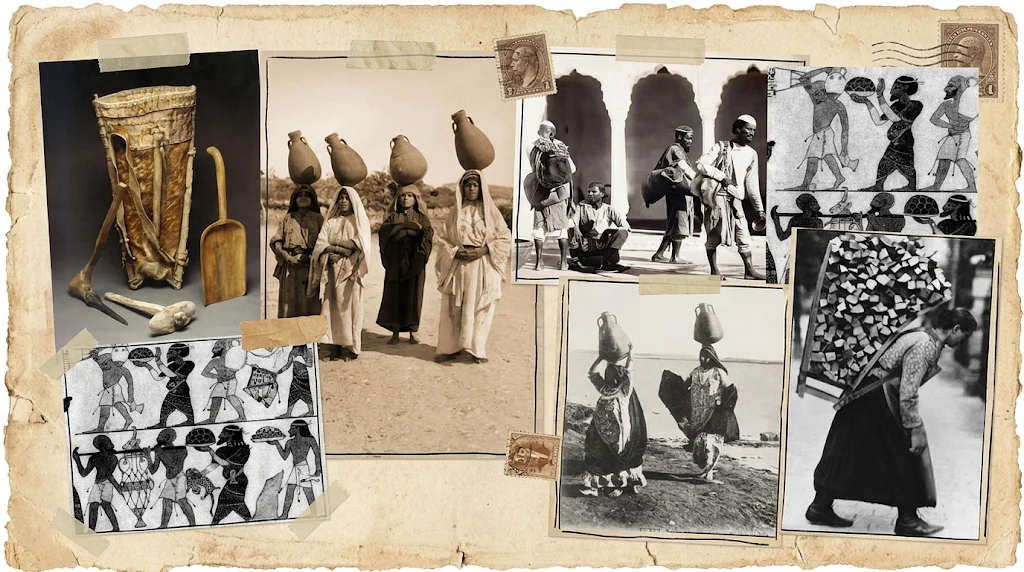
This profound biological capacity is the subject of intense study within evolutionary anthropology and biomechanics. While previous historical and anthropological investigations have focused on ancient carrying systems—examining the baskets, frames, and woven straps that diverse cultures developed long before modern technical packs and load-bearing hardware—modern scientists are now looking deeper inside the machine itself. By analyzing the human skeleton, gait, muscle architecture, metabolism, and locomotion under load, researchers are discovering that humans are fundamentally designed to carry. But why are humans so uniquely adapted to moving while encumbered, and perhaps more importantly, were we truly built by evolution specifically to carry?
The Mechanics of Bipedal Locomotion and the Free Hand
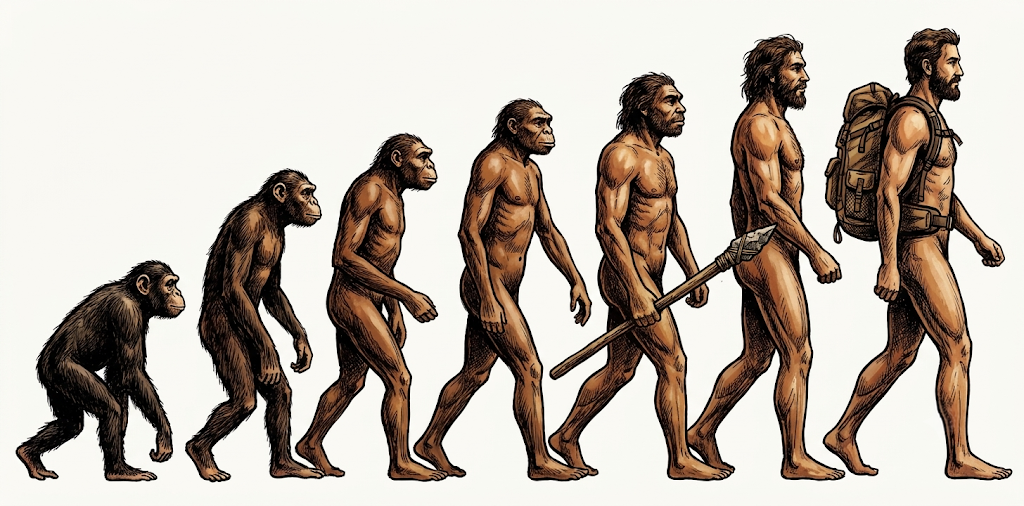
Through millions of years of evolutionary pressure, humans became unusually committed bipeds. Walking upright on two legs full-time left our hands entirely free for secondary tasks, fundamentally altering our ecological niche. Bipedalism describes how human anatomy has been organized around efficient upright locomotion, featuring long legs, relatively short arms, feet with specialized structural arches, vertically aligned lower limbs, a bowl-shaped pelvis, distinctive spinal curves, and highly elastic tendons.
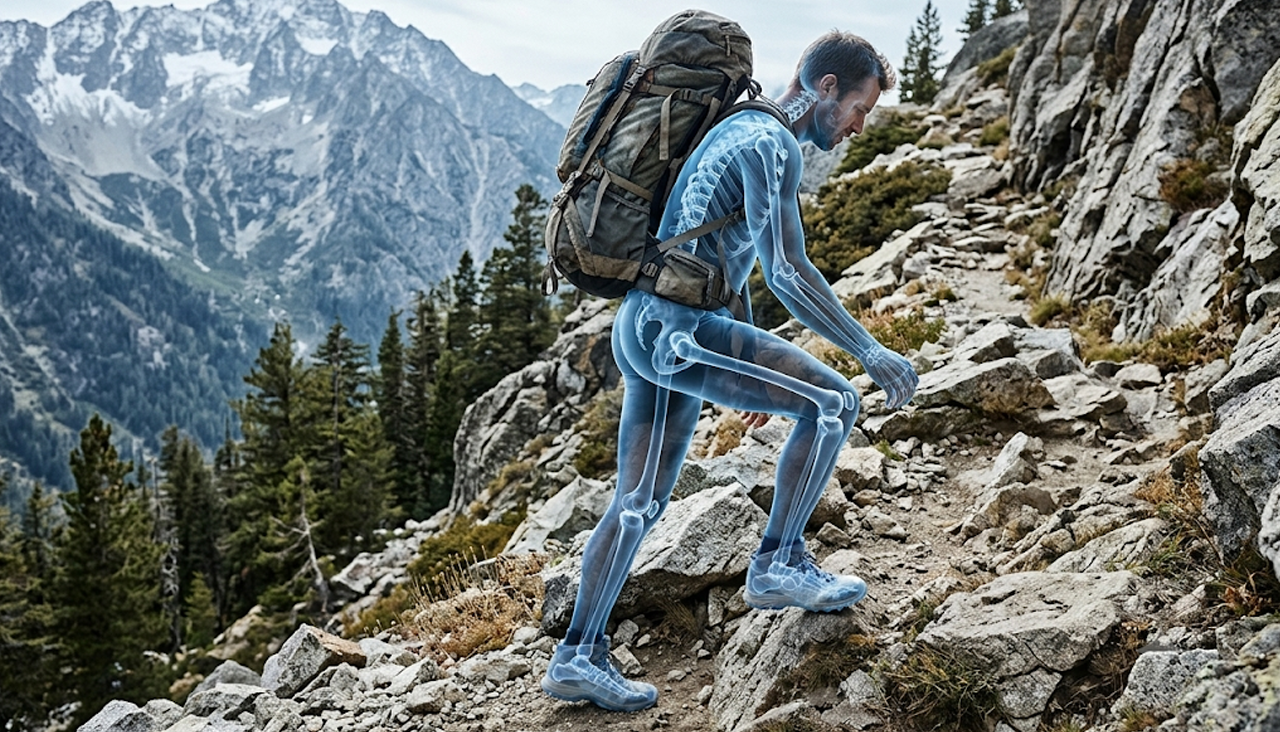
The human foot is an evolutionary marvel, functioning essentially as a biological spring. The Achilles tendon and other elastic structures efficiently store and recycle energy with every step, while the pelvis and trunk dynamically stabilize the body as each leg swings forward. Walking for humans is mechanically economical because our physiology leverages gravity, forward momentum, and elastic tissues to perform a significant portion of the physical work.
This upright posture immediately freed the upper limbs, introducing the capability of carrying. However, while walking itself is an extraordinarily economical form of locomotion, adding external mass significantly increases the metabolic cost of moving from one location to another. Every step requires accelerating and decelerating additional mass, while stabilizing core muscles work overtime to keep the load balanced and controlled. Distance, duration, and terrain critically dictate energy expenditure, alongside how the specific load interacts with an individual’s unique center of gravity.
Endurance Over Brute Strength
When compared across the animal kingdom, humans are not particularly impressive regarding brute strength or raw speed. Countless mammals can carry heavier loads relative to their body size. Humans lack natural claws, heavy fangs, or the dense muscle horsepower that makes other mammals look like they were engineered for combat.
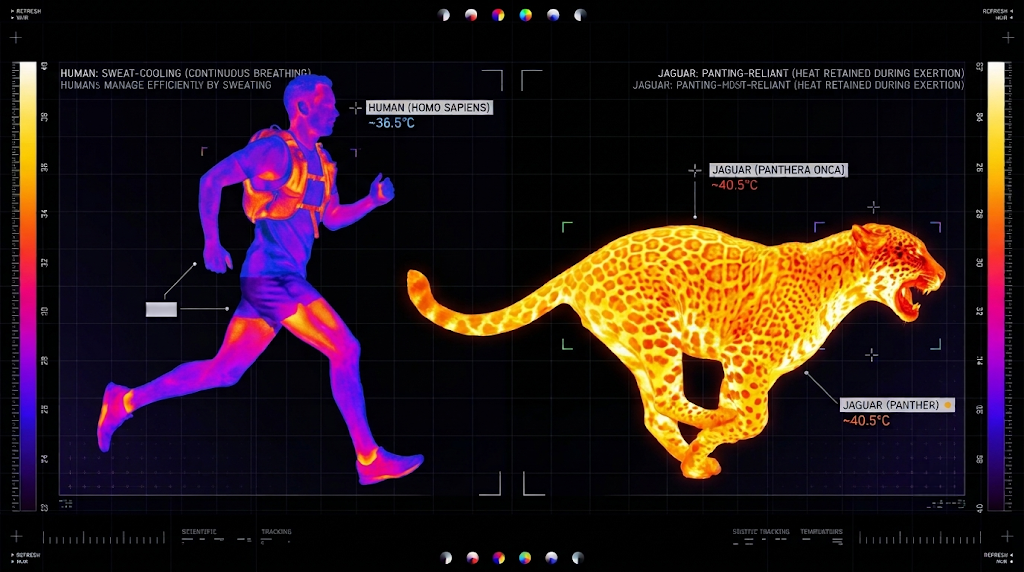
Where the human species demonstrates distinct evolutionary advantages is in endurance—specifically, our capacity to continue moving efficiently over vast distances once locomotion has begun. Anthropologists attribute this endurance capability primarily to advanced thermoregulation. Humans are unusually adept at heat dissipation. We possess the rare ability to produce sweat across large surfaces of our relatively hairless skin, allowing thermal energy to leave the body rapidly as moisture evaporates into the atmosphere.
In contrast, many mammals rely heavily on panting to manage internal body heat, a
mechanism that becomes highly inefficient when an animal simultaneously attempts to breathe deeply while running or traversing difficult terrain. Humans, however, can continue breathing normally while sweating profusely. This allows the respiratory system to remain strictly dedicated to supplying oxygen to working muscles rather than doubling as a thermal cooling system. Combined with long legs, spring-like feet, and stable trunks, humans developed an energetically cheap mode of long-distance transport.
The Evolutionary Timeline of Load-Bearing
The evolutionary story of carrying is complex and cannot be reduced to a simple teleological narrative that humans evolved explicitly to carry objects. Anthropological consensus indicates that carrying was likely not the primary selective driver behind the initial emergence of bipedalism. There was no single moment in prehistory when an hominid stood upright and recognized the utility of transporting miscellaneous goods from one point to another.
Instead, a sequence of adaptations for efficient upright locomotion accidentally created a physiological framework in which carrying became extraordinarily useful. Once upright walking was established as a dominant trait, the secondary advantages multiplied: free hands, an efficient long-distance chassis, advanced heat-shedding capabilities in motion, and the ability to integrate external loads directly into the locomotor system.
Historically, this transition unlocked vast logistical advantages for early human societies. Food no longer needed to be consumed immediately at the exact site of foraging or hunting. Water could be transported away from volatile sources. Tools, weapons, and fuel could be gathered and brought back to a secure home base. Furthermore, for human parents, transporting increasingly dependent offspring safely across dynamic landscapes became vital for infant survival. Carrying effectively transformed from a basic physical action into a profound logistical superpower.
Physiological Analysis and Modern Implications
Modern biomechanical studies utilizing thermal imaging, metabolic gas analysis, and pressure-plate gait tracking continue to reveal the hidden complexities of human load carriage. Data consistently demonstrates that when loads are distributed close to the body’s center of mass—such as with modern ergonomic backpacks—the metabolic penalty of carrying is minimized significantly. Conversely, asymmetric loads or improper weight distribution force secondary stabilizer muscles into overdrive, drastically accelerating fatigue and increasing the risk of musculoskeletal injury.
Industry experts and ergonomists point out that understanding these biological foundations is crucial not only for outdoor recreation and backpacking industries, but also for military applications, emergency response, and occupational health. Designing equipment that aligns with natural human gait and thermoregulation reduces chronic injuries and enhances endurance in high-stakes environments.
Ultimately, the human body represents a finely tuned system optimized for the long haul. The suite of anatomical traits that allowed early humans to forage, provision, and migrate across the globe continues to define our physical limits today. Whether moving across ancient savannahs with primitive tools or traversing modern wilderness with a 70-liter technical pack, humans remain profoundly adapted to the journey, carrying our history literally in our stride.