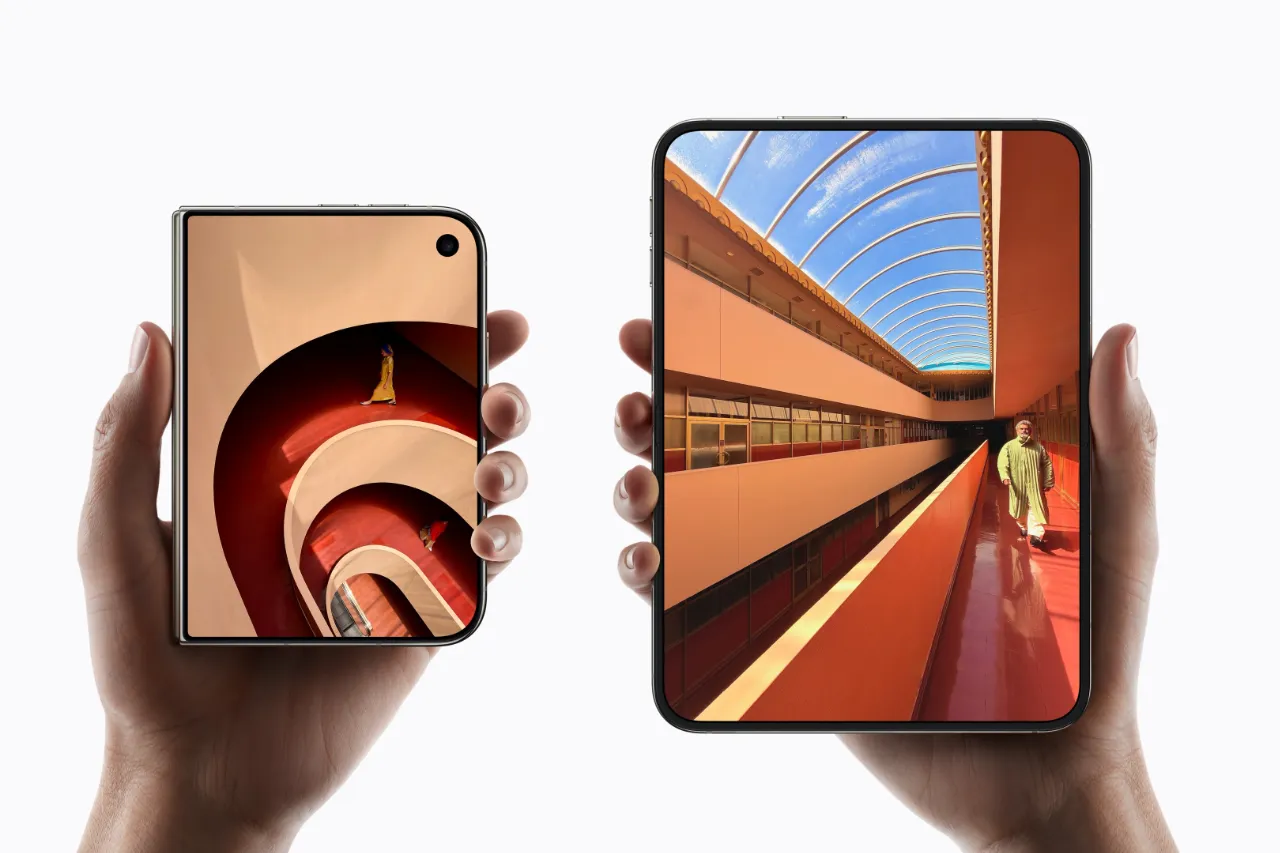
Apple Inc. has officially announced its long-anticipated entry into the foldable device market with the global debut of the iPhone Duo. Representing a radical departure from traditional smartphone formats, the iPhone Duo bridges the gap between pocket-sized portability and tablet-scale productivity. Featuring an innovative dual-screen architecture, cutting-edge hardware specifications, and deep integration with the newly minted iOS 27 operating system, Apple aims to redefine consumer expectations in the ultra-premium mobile segment.
The device features an expansive 7.6-inch internal Super Retina XDR foldable display paired with a convenient 5.4-inch external cover screen. This dual-form factor is designed to offer the familiarity of a standard smartphone when folded, while transforming into a multi-tasking powerhouse upon opening. Running on the custom-engineered Apple A20 Pro processor and equipped with advanced artificial intelligence capabilities through Apple Intelligence, the iPhone Duo sets a new technical benchmark for the industry.
Evolution of the Foldable Form Factor
The launch of the iPhone Duo marks a watershed moment for Apple, a company historically known for taking a measured, patient approach to emerging technology categories while competitors rush to early adoption. Years of research and development have culminated in a device engineered to address the persistent pain points plaguing early-generation foldables, such as crease visibility, mechanical durability, and thermal management.

The structural integrity of the iPhone Duo is anchored by an advanced hinge mechanism crafted from liquid-metal alloys, promising exceptional longevity across hundreds of thousands of fold cycles. Protecting the internal canvas is an all-new iteration of Apple’s proprietary Ceramic Shield technology—dubbed Ceramic Shield 2—which significantly increases scratch resistance and drop survivability over standard glass solutions.
Furthermore, the device boasts an IP68 rating for water and dust resistance, providing peace of mind against accidental submersion up to six meters for 30 minutes. Ergonomically, Apple has integrated a biometric Touch ID sensor embedded directly into the side power button, operating alongside the facial recognition capabilities of Face ID. The inclusion of the customizable Camera Control button, first seen on the iPhone 18 Pro series, brings physical shutter controls and intuitive zoom adjustments to the foldable layout.
Display Technology and Visual Fidelity
At the heart of the iPhone Duo experience are its two distinct Super Retina XDR displays. The external cover screen measures 5.4 inches diagonally, offering approximately 90 percent of the surface area usability found on the standard iPhone 18 Pro. When opened, the device reveals its primary 7.6-inch internal display, which provides roughly 50 percent more screen real estate than the iPhone 18 Pro Max, effectively positioning it as a compact productivity workstation.
Both panels support ProMotion technology with an adaptive refresh rate scaling from 1Hz to 120Hz, ensuring buttery-smooth scrolling alongside power efficiency via an Always-On display mode. Peak outdoor brightness reaches an impressive 3,000 nits, ensuring legibility under direct sunlight.

The internal display incorporates an ultra-thin polarizing layer and an optimized anti-reflective coating that drastically minimizes crease visibility, a common critique of competing foldable devices. Additionally, the iPhone Duo extends stylus compatibility by supporting the Apple Pencil USB-C, opening new creative avenues for digital artists, note-takers, and enterprise professionals who require precision input on a canvas-sized screen.
Processing Power and Thermal Engineering
Driving the iPhone Duo is the formidable Apple A20 Pro system-on-chip, built on an advanced 2-nanometer manufacturing node. The processor architecture features a 6-core CPU delivering up to a 20 percent performance increase over the preceding A19 Pro, while the 7-core GPU achieves up to a 40 percent leap in graphical computing power. A redesigned 16-core Neural Engine underpins the device’s localized machine learning tasks, empowering complex on-device generative AI operations with enhanced privacy and speed.
To sustain peak performance under heavy workloads—such as multi-window multitasking, high-framerate gaming, and AI processing—Apple has engineered a sophisticated internal cooling system utilizing a custom Vapor Chamber. This thermal architecture dissipates heat efficiently across both halves of the device, resulting in sustained performance levels that surpass traditional slab phones by up to 50 percent during extended use.
Connectivity has also received a generational upgrade. The iPhone Duo integrates Apple’s proprietary N1 wireless chip, supporting Wi-Fi 7, Bluetooth 6, and Thread protocol, alongside a second-generation C2 modem optimized for ultra-fast mmWave and sub-6GHz cellular connectivity. Notably, the iPhone Duo is strictly an eSIM-only device in select global markets, further streamlining internal space for larger battery cells and thermal components.

Battery Efficiency and Rapid Charging Capabilities
Power management in a dual-screen device presents significant engineering challenges, which Apple has tackled through intelligent power-partitioning algorithms in iOS 27. Despite powering dual displays, the iPhone Duo delivers up to 44 hours of local video playback on the external screen, up to 31 hours of local video playback on the internal screen, and up to 24 hours of continuous mixed-usage workflows.
When it comes to replenishment, the device supports wired fast charging up to 60W via USB-C, capable of restoring a 50 percent charge in approximately 20 minutes. Wireless charging capabilities have also been enhanced, with MagSafe and Qi2 support delivering up to 25W of power, reaching a 50 percent charge in roughly 30 minutes.
Advanced Camera System and Computational Imaging
The photographic capabilities of the iPhone Duo leverage a versatile triple-sensor array tailored to both folded and unfolded usage. The primary camera system features a 48-megapixel Fusion sensor equipped with second-generation sensor-shift optical image stabilization (OIS) and a 24-megapixel default output mode. A secondary 48-megapixel ultra-wide sensor doubles as a macro lens, while offering a high-resolution canvas for landscape and architectural photography.
For video conferencing and selfies, the device incorporates dual FaceTime cameras: a 12-megapixel sensor on the outer cover and an under-display 12-megapixel sensor integrated into the internal folding screen. These are paired with Center Stage software to automatically keep users framed during video calls, regardless of whether the phone is propped open on a desk or held in hand.

Video recording capabilities extend to 4K resolution at 120fps in Dolby Vision, alongside enhanced Cinematic Mode and Action Mode stabilization. Unique software features include Duo Preview, which utilizes both screens to allow portrait subjects to view their framing in real-time on the outer display while the photographer shoots, and Kid Cue, a system that displays animated characters on the outer screen to capture the attention of children during family photography sessions. Smart Take utilizes on-device AI to analyze sequential frames and automatically select the sharpest, most flattering moment in a burst shot.
Software Ecosystem: iOS 27 and Apple Intelligence
The iPhone Duo ships with iOS 27 out of the box, an operating system explicitly redesigned to take advantage of foldable screen real estate. The user interface introduces adaptive layouts, including a contextual Dock and a revamped Today View that dynamically reorganizes widgets based on whether the device is open or closed.
Split View multitasking allows users to run two resource-intensive applications side-by-side, dragging and dropping content seamlessly between windows. When folded flat on a table, the StandBy mode transforms the device into an interactive smart display, functioning as a digital photo frame, clock, or smart home hub.
Apple Intelligence is deeply interwoven throughout the software experience, featuring an upgraded Siri AI assistant capable of cross-app contextual awareness, on-screen content comprehension, and natural language processing. Creative tools such as Image Playground and Genmoji allow users to generate custom graphics on the fly, while built-in cryptographic watermarking via SynthID ensures that AI-generated images are transparently labeled for authenticity.

Market Positioning, Pricing, and Availability
The iPhone Duo is positioned as an elite flagship offering, targeting early adopters, mobile professionals, and power users seeking the ultimate convergence of phone and tablet utility. The device is available in two sophisticated color finishes: Star White and Night Sky. Storage configurations span 256GB, 512GB, 1TB, and a massive 2TB tier.
Pricing for the base model begins at $1,999 in the United States. Pre-orders open immediately following the announcement, with retail availability slated for the following week alongside the rollout of iOS 27.1. Apple has also introduced a suite of official accessories, including a MagSafe Leather Sleeve priced at $79, a Folio with Kickstand case priced at $129, and a range of screen protection bundles tailored to the dual-screen configuration.
Industry analysts note that while the high price point places the iPhone Duo in an exclusive category, its entry into the foldable market is expected to legitimize and accelerate mainstream consumer adoption of foldable technology globally.