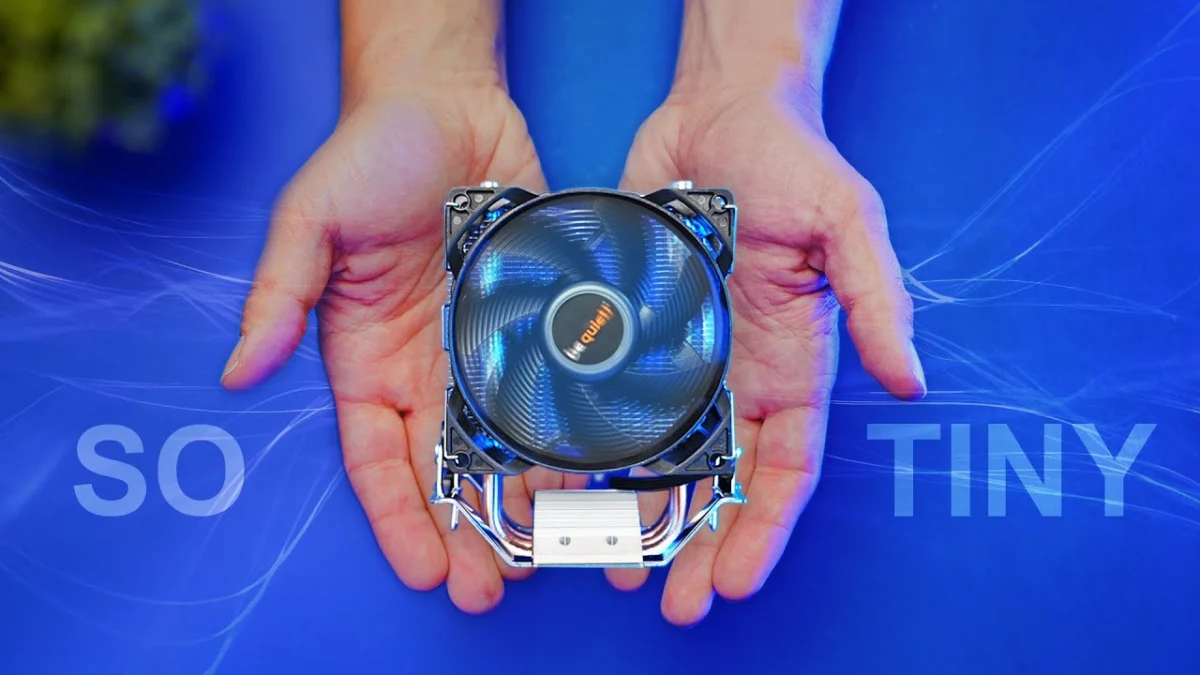
The modern personal computer hardware market is characterized by a relentless pursuit of scale. As flagship central processing units from manufacturers like AMD and Intel push thermal design power limits beyond 250 watts, the cooling industry has responded with increasingly massive hardware. High-end cooling solutions frequently feature dual-tower arrays, heavy-duty 140mm fans, and massive footprints that demand specialized, expansive computer chassis. While these industrial-grade coolers are necessary for extreme enthusiasts and overclockers, they often represent overkill for mainstream users running standard productivity tasks or mid-range gaming configurations.
Into this landscape of heavy, oversized hardware steps the Be Quiet! Pure Rock Slim 2, a compact 92mm tower cooler designed to challenge the assumption that effective thermal management requires a massive financial and physical investment. Priced aggressively at an MSRP of $25, this entry-level cooler aims to deliver broad compatibility, whisper-quiet acoustics, and sufficient cooling capacity for standard consumer workloads. Evaluating whether such a small footprint can satisfy modern hardware demands requires a close examination of its design, installation mechanics, thermal performance, and overall market positioning.
Market Context and Pricing Dynamics
The sub-$30 CPU cooler segment has historically been dominated by iconic 120mm tower coolers, such as the Cooler Master Hyper 212 series, which set a long-standing industry standard for budget performance. However, as motherboards grow more feature-dense and compact form-factor builds—such as Mini-ITX systems—gain mainstream popularity, the physical dimensions of cooling components have become a critical purchasing factor.
Officially launched with an MSRP of $25, the Pure Rock Slim 2 enters a crowded marketplace populated by legacy budget coolers and numerous white-label alternatives. Despite the official pricing, early market availability has experienced minor friction. Independent third-party resellers frequently acquire newly released hardware components immediately upon launch, listing them on major e-commerce platforms like Amazon and Newegg at inflated prices. Consequently, prospective buyers must exercise caution and thoroughly verify listings to secure the product at its intended price point.
Despite these minor distribution hurdles, the Pure Rock Slim 2 stands out as one of the least expensive cooling solutions offered by a tier-one thermal hardware manufacturer. Its introduction reflects a broader industry trend toward maximizing the value proposition of budget components, leveraging manufacturing efficiencies to trickle down advanced heat-dissipation technologies into lower price tiers.
Physical Design and Engineering Specifications
At first glance, the physical dimensions of the Pure Rock Slim 2 highlight its primary design objective: uncompromising compatibility. Measuring 135mm in height, 82mm in depth, and 97mm in width, the cooler is substantially more compact than standard 120mm tower alternatives like the Noctua NH-U12S or the aforementioned Cooler Master Hyper 212 Evo.
This diminutive height profile addresses a major limitation in compact case designs. For instance, popular chassis models such as the Cooler Master NR200 enforce strict CPU cooler height clearances, often capping limits around 155mm. While this restriction comfortably accommodates many mid-tier coolers, it completely eliminates standard tower coolers equipped with larger 120mm or 140mm fans, forcing builders to consider liquid cooling loops or lower-profile alternatives. The Pure Rock Slim 2 bridges this gap by offering a traditional tower layout within a height envelope typically reserved for low-profile, top-down coolers.
Structurally, the unit utilizes a dense aluminum fin array traversed by three 6mm copper heat pipes. These pipes employ a Heatpipe Direct Touch (HDT) base design, establishing direct physical contact with the CPU integrated heat spreader to facilitate rapid thermal transfer. For installation convenience, the base arrives with pre-applied thermal compound, streamlining the mounting process for first-time builders.
Airflow is driven by a proprietary 92mm Be Quiet! Pure Wings 2 fan, capable of operating at a maximum rotational speed of 2,300 RPM. While a 92mm fan operating at high RPMs might theoretically raise concerns regarding acoustic output, the engineering behind the Pure Wings 2 blade design prioritizes laminar airflow to minimize turbulence and mechanical hum.
Comparing the Pure Rock Slim 2 to its predecessor reveals targeted refinements rather than a complete redesign. Be Quiet! extended the surface area of the aluminum fin array slightly toward the rear to marginally improve thermal dissipation. Furthermore, subtle geometric adjustments were made to the base plate, while the installation mechanism and fan specifications received comprehensive overhauls to modernize the user experience.
Installation Mechanics and System Compatibility
Ease of installation has historically been a notable differentiator in the CPU cooler market, with budget models frequently utilizing complex, multi-piece backplates and finicky retention rings. The Pure Rock Slim 2 simplifies this procedure significantly, though the user experience differs depending on the host platform.
For systems built on AMD’s AM4 platform, the installation process is exceptionally streamlined. Acknowledging AMD’s dominant market share in the consumer desktop segment, Be Quiet! designed the cooler to utilize the standard, stock plastic retention brackets that ship pre-installed on virtually all modern AMD motherboards. To mount the cooler, a technician simply orients the unit, attaches the retention clips to the motherboard’s stock mounting blocks, and applies downward pressure to secure the latching mechanism. This tool-free approach minimizes the risk of component damage and drastically reduces assembly time.
Conversely, Intel installations require a minor hardware reconfiguration. Builders must unscrew the pre-installed AMD mounting brackets from the heatsink base and substitute them with dedicated Intel brackets. Furthermore, the cooler relies on the traditional push-pin mounting system for Intel sockets (LGA 1200, 115X, and LGA 1700 compatibility depending on the production batch). While push-pins offer quick, tool-free installation, thermal engineering consensus notes that they generally provide less consistent mounting pressure compared to dedicated backplate and screw-down mechanisms.
One of the most significant mechanical advantages of the Pure Rock Slim 2 is its ultra-slim profile, which completely eliminates memory interference. Even in compact motherboards where all four DIMM slots are fully populated with tall, RGB-adorned memory modules, the heatsink clears the RAM slots entirely. This spatial efficiency ensures that builders do not need to sacrifice memory capacity or select low-profile RAM kits to accommodate an aftermarket cooler.
Thermal Performance and Acoustic Analysis
To evaluate the operational capabilities of the Pure Rock Slim 2, rigorous bench testing under controlled thermal loads provides objective insights into its efficiency. Performance metrics are generally categorized across three distinct Thermal Design Power (TDP) tiers: 95W, 125W, and 150W.
At a baseline 95W thermal load, representing mainstream gaming and standard productivity workloads, the Pure Rock Slim 2 demonstrates exceptional competence. When evaluating fan speed percentages against decibel readings, the Pure Wings 2 fan exhibits remarkable acoustic restraint. At 70% fan speed, the acoustic output reaches the minimum noise floor of standard testing environments, rendering the fan virtually inaudible to the human ear. Even when driven to 100% capacity (2,300 RPM), the cooler peaks at approximately 40 decibels. This acoustic profile places it on par with—and in some cases superior to—larger, more expensive 120mm alternatives.
Pushing the thermal load to 125W brings the cooler near its stated maximum TDP threshold of 130W. Under this demanding load, the Pure Rock Slim 2 maintains structural thermal stability, frequently matching the performance of the premium Noctua NH-U12S while registering a lower acoustic footprint, and outperforming the Cooler Master Hyper 212 Evo across various test iterations.
However, physics imposes strict limits on compact hardware. When the thermal load is elevated to 150W—a threshold typical of high-end, heavily overclocked multi-core processors—the Pure Rock Slim 2 rapidly reaches its thermal saturation point. At this heat load, the surface area of the fin array and the capacity of the three copper heat pipes become insufficient to dissipate energy quickly enough to prevent thermal throttling. Consequently, systems operating continuously at or above 150W will require a substantially larger tower cooler or an all-in-one liquid cooling solution.
Industry Implications and Consumer Recommendations
The introduction and validation of the Be Quiet! Pure Rock Slim 2 highlight several important shifts in the entry-level PC hardware ecosystem. As integrated graphics improve and mainstream processors become more energy-efficient, the thermal demands of standard desktop builds have stabilized, allowing smaller cooling solutions to handle tasks previously reserved for bulky hardware.
For the average consumer—including office workers, casual gamers, and budget-conscious system builders—the Pure Rock Slim 2 represents a highly rational component choice. It delivers a balanced trifecta of desirable attributes: a compact physical footprint that ensures near-universal chassis and memory compatibility, a straightforward installation process for mainstream platforms, and acoustic performance that outperforms stock cooling solutions while rivaling much more expensive aftermarket alternatives.
While enthusiasts pushing high-wattage silicon will inevitably require heavy-duty thermal management, the market reality is that the vast majority of consumer PCs do not operate at peak thermal thresholds continuously. By providing quiet, reliable cooling within a $25 budget, the Be Quiet! Pure Rock Slim 2 demonstrates that effective engineering is not exclusively measured by physical scale, offering a pragmatic solution for builders seeking performance without excess.