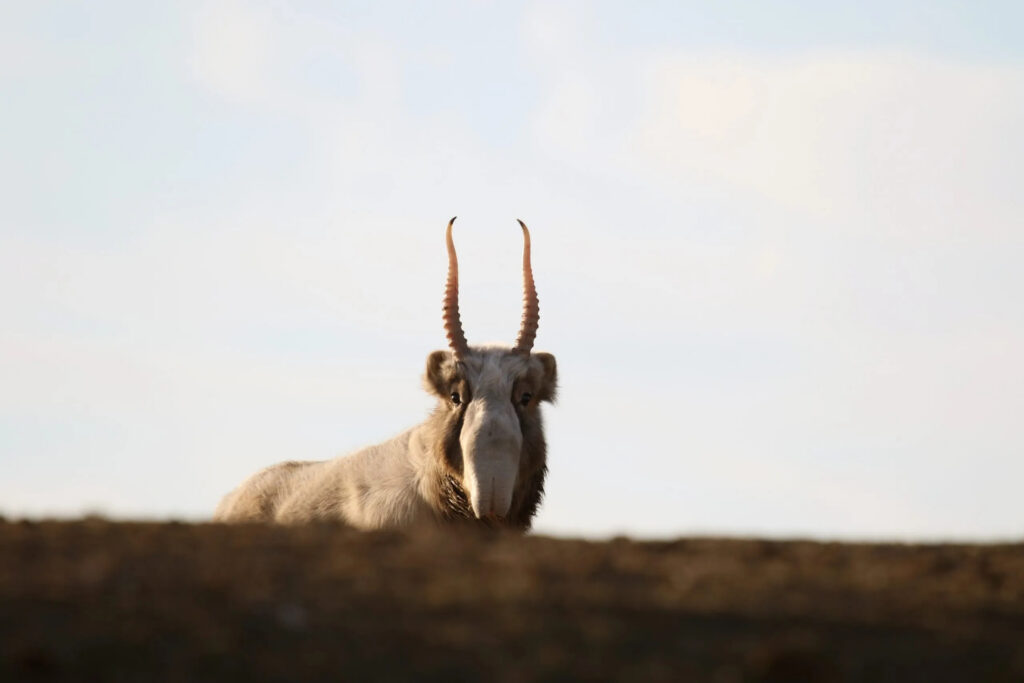
The muddy, tire-rutted tracks of western Kazakhstan offer a jarring introduction to one of the planet’s oldest terrestrial migration routes. Flanking the crude two-track trail are parallel animal paths, forking and merging across a boundless landscape that feels virtually untouched by centuries of human progress. In the distance, howling Siberian winds drive movements reminiscent of a ghost train. Through binoculars, observers can witness an ancient tableau: hundreds of nomadic saiga antelopes piercing the frigid air with ringed horns, inhaling brittle winter shards through remarkably elongated snouts as they sprint across the desolate steppe.
Running at full bore across the treeless plain, the saiga embodies a resilient spirit forged over millennia. These observations stem from a field audit conducted along the western leg of the Association for the Conservation of Biodiversity of Kazakhstan (ACBK), offering a vital window into the pressures facing Central Asia’s most iconic ungulates.
Main Facts: The Biology and Behavior of the Saiga Antelope
The saiga antelope (Saiga tatarica) is a critically adapted survivor of the Pleistocene epoch. Sharing a prehistoric world with woolly mammoths, saber-toothed cats, and giant deer sporting 12-foot antlers, the saiga is the sole survivor of that megafaunal era. When early human caravans first navigated this unforgiving landscape, nomadic travelers historically relied on saigas as natural guides through treacherous terrain.
The field visit coincided with the species’ annual rutting season—a critical biological window marked by large-scale gatherings. Antelopes converge from across the region in massive single-file lines before engaging in competitive battles and mating rituals. For males, the rut requires immense physical expenditure through strutting and headbutting to demonstrate physical prowess. Many males become so consumed by territorial defense and mating that they neglect feeding, occasionally collapsing from sheer exhaustion.
For females, mate selection heavily favors physical vigor, particularly the size of a male’s floppy, elongated snout. These specialized noses are vital physiological adaptations, serving to filter out choking dust during dry summer months and warm frigid winter air before it enters the lungs. Consequently, a large nose functions as the ultimate indicator of genetic fitness and virility.
Chronology and Historical Context
Humanity’s relationship with the Eurasian steppe is deeply rooted in nomadism, tracing back at least to the Early Iron Age. The ethnonym Kazakh is widely believed to derive from the Turkic word qaz, meaning "wanderer" or "vagabond." For millennia, small human groups migrated seasonally—moving to higher altitudes during hot summers for water and greenery, and returning to sheltered valleys ahead of harsh winter gales.
These historical migration corridors directly shaped the development of the Great Silk Road. Rather than a singular highway, the Silk Road operated as an ever-evolving network of pathways, bypasses, and reliable stopovers. Western Kazakhstan, anchored by the fertile banks of the Ural River, emerged as a vital transcontinental crossroads. To this day, the Ural River serves as the natural boundary dividing Asia and Europe. Strategic riverbank settlements provided weary caravans with rest, public baths, knowledge exchange, and resupply points before traversing the continental divide.
Throughout these shifting eras—spanning Turkic tribal reigns, the Mongol Empire under Genghis Khan, and later incorporation into the Russian Empire—traditional nomadic practices persisted. However, the landscape shifted dramatically during the 20th century under the Soviet Union. Mandatory sedentarization programs forced nomadic populations into agricultural settlements, effectively dismantling a lifestyle centered on perpetual motion.
While framed as modernization, the forced transition conflicted with human evolutionary history. Anthropological data indicates that of the approximately 300,000 years Homo sapiens have existed, roughly 288,000 were spent living in small, mobile groups following animal migrations. Furthermore, agricultural initiatives on the steppe largely failed because the local soil was fundamentally unsuited for intensive crop cultivation.
Supporting Data and Infrastructure Impacts
Today, while most human populations in Kazakhstan reside in permanent urban centers, the saigas’ traditional nomadic lifestyle persists—placing them on a direct collision course with modern infrastructure.
For conservationists, monitoring these elusive animals has been revolutionized by technology. Because saigas inhabit wide-open, treeless landscapes, GPS tracking collars deliver reliable daily positional data without visual obstruction. This telemetry data has fundamentally reshaped conservation planning, directly informing the establishment of new wildlife sanctuaries.
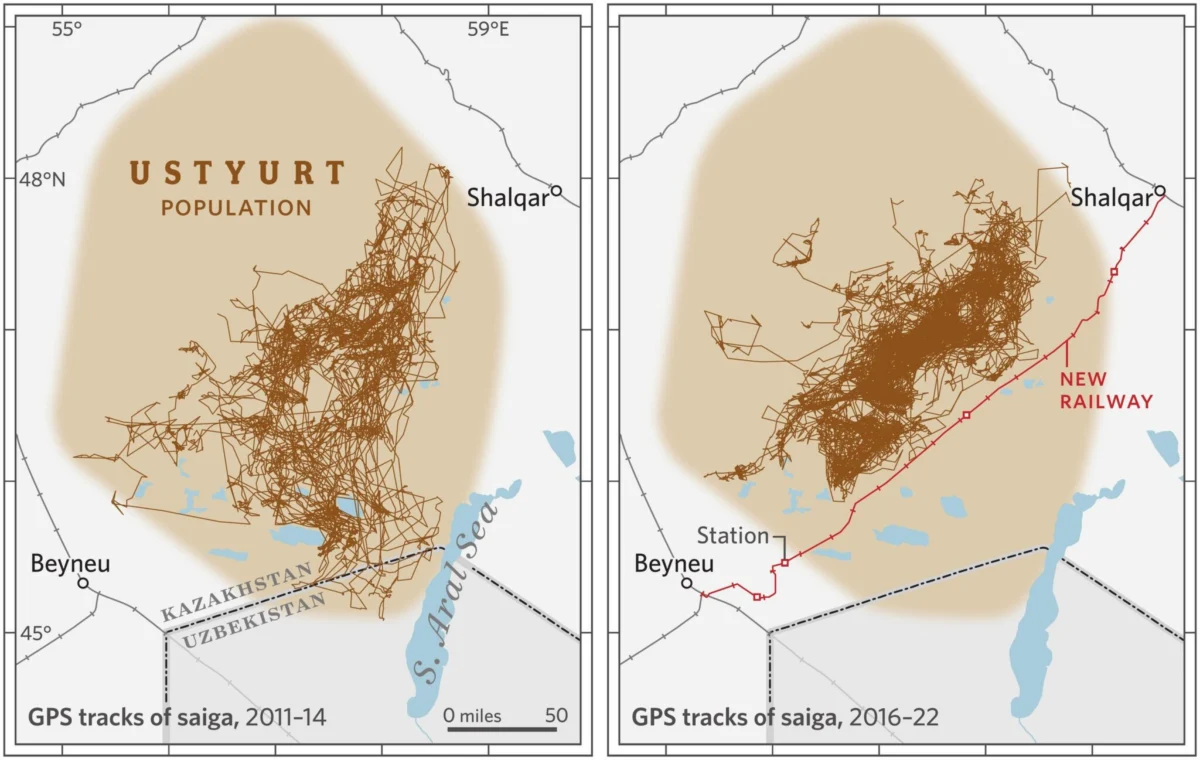
However, historical tracking maps underscore the severe fragmentation caused by linear infrastructure. ACBK tracking data reveals that populations of GPS-collared saigas historically migrated deep into neighboring Uzbekistan. The construction of a major railway line in 2014 abruptly severed this historical route. Pre-construction data shows dense clusters of migratory movement crisscrossing the border, whereas post-construction data depicts animals wandering despondently on the northern side of the tracks while traditional water sources and seasonal grazing lands to the south remain inaccessible.
This physical partitioning induces a severe loss of spatial knowledge among wildlife. Similar to how human nomads forced into sedentary lives lost touch with ancestral navigational landmarks, young saigas learn migration routes, shelter locations, and foraging grounds through active participation and observational learning. When traditional pathways are severed, entire generations lose critical ecological knowledge.
Official Responses and Conservation Mitigation
To counteract the fragmentation of the steppe, conservation groups and regional governments have initiated targeted mitigation projects. ACBK has partnered with the government of Kazakhstan to design and construct saiga-friendly crossing points along railway corridors. These structures feature gently sloping dirt ramps that match the height of the train tracks, creating the visual illusion of a natural gap in the barrier. Additionally, cattle-guard fencing placed at a distance from the crossings prevents direct collisions between trains and wildlife, preserving the illusion of safety.
Collaborative efforts have also extended across international borders. ACBK worked alongside Uzbek authorities to modify traditional border security infrastructure. By replacing solid barbed-wire walls with X-shaped barricades, authorities successfully blocked unauthorized vehicular traffic while leaving precisely enough clearance for saiga herds to pass through unhindered. Conservationists anticipate that these adaptive management strategies will gradually restore connectivity across historical plateaus.
Broader Impact and Implications
The plight of the saiga antelope highlights a fundamental tension in modern conservation: reconciling rapid industrial development with the ecological requirements of wide-ranging migratory species. As roads, railways, and agricultural plots continue to reshape the Eurasian steppe, maintaining ecological corridors is no longer optional; it is an existential prerequisite for the survival of Central Asia’s endemic wildlife.
Through proactive tracking, cross-border policy cooperation, and innovative infrastructure design, organizations like ACBK demonstrate that human development and wildlife migration can theoretically coexist. Yet, the long-term viability of the saiga ultimately depends on society’s willingness to preserve the vast, uninterrupted spaces that define the heart of the Eurasian continent.