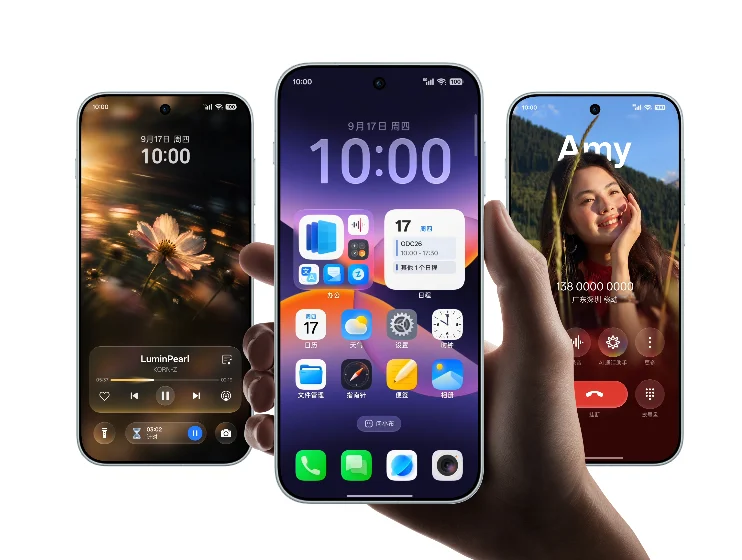
OPPO has officially unveiled ColorOS 17, its latest operating system iteration tailored for the Chinese market, marking a significant evolution in the company’s software ecosystem. Built upon the foundation of Android 17, this release represents a holistic shift toward a more responsive, intelligent, and performance-oriented user experience. The update extends beyond a simple visual refresh, incorporating the proprietary Aurora Engine and a suite of sophisticated artificial intelligence tools designed to bridge the gap between hardware efficiency and user productivity across the OPPO, OnePlus, and realme product lines.
The Philosophy of Fluid Design
At the heart of ColorOS 17 lies the new Fluid Design language. In an era where mobile interaction is defined by rapid multitasking, OPPO has optimized the user interface to reduce perceived latency. Fluid Design focuses on the physics of movement; animations are engineered to be interruptible, meaning that as a user navigates between applications, the system maintains high-frame-rate fluidity even during mid-transition. By aligning visual feedback with touch input, OPPO aims to create an interface that feels less like a series of static menus and more like an extension of the user’s intent. This visual overhaul is not merely cosmetic; it is underpinned by lower-level resource management that ensures the interface remains stable under heavy system loads.
Performance Benchmarks: The Aurora Engine
The technical backbone of this update is the Aurora Engine, a specialized system framework developed to maximize the utility of modern mobile hardware. According to internal performance testing released by the company, the engine addresses the primary bottlenecks of smartphone usability: memory management, application launch speed, and rendering efficiency.
The data provided by OPPO highlights a significant leap in multitasking capabilities. ColorOS 17 reportedly allows the system to keep 55% more applications active in the background compared to its predecessor, a metric that will appeal to power users who frequently switch between productivity and media apps. Furthermore, the system achieves a 35% improvement in application launch stability and a 15% increase in raw launch speeds. Perhaps most impressively, the rendering of high-fidelity visual effects now consumes 30% fewer CPU and GPU resources, effectively extending the device’s battery life during intense usage. Additionally, the native gallery application has seen a 50% increase in browsing speed, a direct result of optimized image processing algorithms that handle large libraries more efficiently.
AI-Driven Assistance and Contextual Awareness
The evolution of the Heytap assistant—the successor to the Breeno platform—serves as the primary vehicle for ColorOS 17’s artificial intelligence ambitions. Unlike traditional voice assistants that rely on rigid command structures, the new Heytap is designed to operate on contextual awareness. By integrating with over 700 distinct services in the Chinese market, the assistant can now synthesize information from emails, calendar entries, and messaging apps to provide proactive reminders for appointments, financial obligations, and time-sensitive tasks.
A notable feature for the multitasking user is the implementation of dynamic progress indicators within notifications. Rather than requiring a user to open an application to check the status of a delivery or a transit arrival, the notification shade now updates in real-time, displaying granular progress. This represents a broader industry trend toward "glanceable" information, minimizing the time a user spends actively interacting with the device to retrieve basic data.
Intelligent Recognition and Creative Tools
ColorOS 17 introduces a sophisticated camera-based recognition mode that functions as an ambient intelligence layer. By leveraging the camera sensor, the system can perform real-time identification of objects, translate text, and even estimate the nutritional content of food items. This technology is also location-aware; for example, when a user enters a transit hub, the device can automatically surface boarding passes or event tickets, reducing the friction of manual navigation through digital wallets.
For the creative user, the native gallery has been upgraded with the DaVinci editor. This tool allows for advanced video and image manipulation using natural-language commands. By describing the desired aesthetic or edit—such as "remove the background noise" or "apply a cinematic color grade"—users can bypass complex manual editing workflows. This integration also extends to external hardware, providing native support for action cameras, network-attached storage (NAS) devices, and various IoT smart equipment, effectively positioning ColorOS 17 as a central hub for a user’s digital creative studio.

Ecosystem Connectivity and Health Tracking
Connectivity is a cornerstone of the ColorOS 17 experience, with simplified pairing processes for the broader ecosystem of smartwatches, automotive infotainment systems, and audio peripherals. The update introduces the FatMax feature for compatible wearables, which utilizes advanced heart-rate monitoring to identify specific aerobic zones. This is supplemented by a personalized "Super Fat Burning Mode," which provides voice-guided coaching during workouts.
Furthermore, the introduction of Air Gestures allows users to control their handsets without physical contact. By using spatial sensing, the device can register hand movements for tasks such as scrolling through media, controlling playback, or triggering the camera shutter, a feature particularly useful when the device is docked or positioned at a distance.
Security and Privacy Protections
As AI capabilities grow, so do the potential vectors for digital threats. OPPO has responded by embedding intelligent fraud detection directly into the OS kernel. The system is now capable of real-time analysis of incoming links and app installation packages, automatically flagging or blocking malicious entities that exhibit behaviors associated with common scams.
Perhaps the most significant security advancement is the integration of deepfake and AI-voice detection. In an age where synthetic media can be used for social engineering, ColorOS 17 monitors video calls and messaging streams for anomalies that suggest AI manipulation. By providing users with alerts when a conversation partner’s digital signature appears suspicious, OPPO is attempting to set a new standard for mobile security in the generative AI era.
Rollout Chronology and Device Support
The deployment of ColorOS 17 is structured in a staggered rollout to ensure system stability across a wide variety of hardware configurations. The initial launch phase includes the flagship Find X10 series and the OnePlus 16, alongside the latest iteration of the OPPO Watch.
The subsequent waves are scheduled as follows:
- October 8: Support expands to the Find N6 series, Find X9 series, OnePlus 15 series, and the realme GT 8 Pro.
- October 16: The update reaches the Find N5, Find X8 series, OnePlus 13 series, realme GT 7 Pro, and several Pad models.
- October 20 & 22: Focus shifts to the Watch X3 series, OnePlus Ace 6 series, and the Reno 16 series.
- October 30: Rollout continues for the Watch X2 series.
- November 26 & December 26: The final phases encompass a broad spectrum of legacy devices, including the Find N3, Find X7, OnePlus 12, and various realme GT and Neo models, ensuring that even older flagships receive the performance and security benefits of the new OS.
Implications and Industry Outlook
The release of ColorOS 17 underscores a strategic pivot for OPPO. By moving away from purely aesthetic improvements and focusing on the "Aurora Engine" and AI-centric security, the company is responding to consumer demand for devices that are not only faster but also safer and more intuitive. The integration of AI into the core OS suggests that OPPO views the smartphone not just as a communication tool, but as a proactive assistant capable of managing a user’s digital life.
As the industry moves toward deeper integration between mobile devices and IoT, the success of ColorOS 17 will likely depend on the reliability of its AI-driven features and the seamlessness of its ecosystem connectivity. With a broad support list spanning several years of hardware, OPPO is clearly aiming to retain its user base by providing a consistent, high-performance experience that remains competitive in a rapidly evolving market. The emphasis on transparency—specifically through its fraud detection and deepfake warning systems—also indicates that the company is positioning itself as a leader in user-centric security, a critical differentiator in the current technological landscape.