The modern backcountry has long enjoyed a symbiotic relationship with petrochemical innovation. For decades, synthetic materials such as nylon, polyester, and Gore-Tex have defined the ultralight backpacking movement. These petroleum derivatives offer high strength-to-weight ratios, rapid drying times, reliable waterproofing, and extreme durability. However, this heavy reliance on fossil fuels carries a mounting ecological cost. With global climate change increasingly disrupting wilderness access—exemplified by historic seasonal trail closures across the Pacific Northwest—and the pervasive discovery of microplastics in remote waterways, outdoor recreation faces an existential environmental paradox.
To investigate whether lightweight wilderness travel can exist independently of fossil fuels, Tom Bonamici, an assistant professor of product design at the University of Oregon, embarked on an unconventional academic experiment. Bonamici challenged himself to design, fabricate, and test a fully functional ultralight backpacking kit completely free of petrochemicals and synthetic plastics. The resulting collection relies entirely on historical, biodegradable, and natural materials, utilizing oiled silk for shelter, Calcutta bamboo for structural support, and natural rubber and wool for mobility and comfort.
The Genesis of the Plastic-Free Experiment
Bonamici’s research primarily centers on lightweight backcountry travel and sustainable design pedagogy, instructing both undergraduate students and candidates in the university’s sports product master’s program. Drawing on a lifelong passion for backpacking and a regional awareness of Pacific Northwest conservation issues, he sought to evaluate the technical compromises required to build an entirely compostable backcountry kit.
Rather than inventing radical new form factors, Bonamici deliberately adopted established ultralight design paradigms. The experiment focused strictly on material substitution, translating modern equipment architectures into centuries-old natural textiles. Going into the project, Bonamici anticipated significant trade-offs in weight, durability, and overall performance, yet the resulting equipment yielded surprising functional successes alongside notable ergonomic compromises.
Engineering the Compostable Backpack
The foundation of any backcountry kit is the pack itself. Bonamici’s prototype mimics a standard-issue, frameless ultralight backpack, relying on the user’s sleeping pad inserted into a dedicated sleeve to provide structural rigidity and back-panel support.
To achieve a fully compostable construction, Bonamici utilized Ventile—a dense, highly durable, and historically significant cotton fabric originally developed during World War II for military flight suits. The main body of the pack, along with side pockets, is constructed from heavy-duty and lightweight variants of Ventile ripstop cotton. Hardware elements were similarly re-engineered: drawstrings utilize pure cotton cord, while closures and tension points are secured with aluminum hardware featuring metal springs, entirely eliminating plastic buckles and cord locks.
The shoulder straps and back pocket incorporate a stretch 100 percent Merino wool jersey for breathability and flexibility. Internal padding for the harness system is supplied by a dense Merino felt, designed to conform ergonomically to the user over time.
However, the most critical vulnerability of a natural-material pack lies in its stitching. While standard ultralight backpacks are assembled using high-tenacity polyester threads capable of withstanding immense shear stress, Bonamici was restricted to 100 percent heavy-duty cotton thread typically reserved for formal tailoring. Finding that individual lines of cotton thread could be snapped manually under high tension, the designer adapted by reinforcing critical seams with multiple passes of stitching. This technique required careful execution to avoid over-perforating the Ventile fabric, which risks compromising structural integrity like a perforated checkbook.
Natural Sleep Systems: Silk, Wool, and the Downproof Dilemma
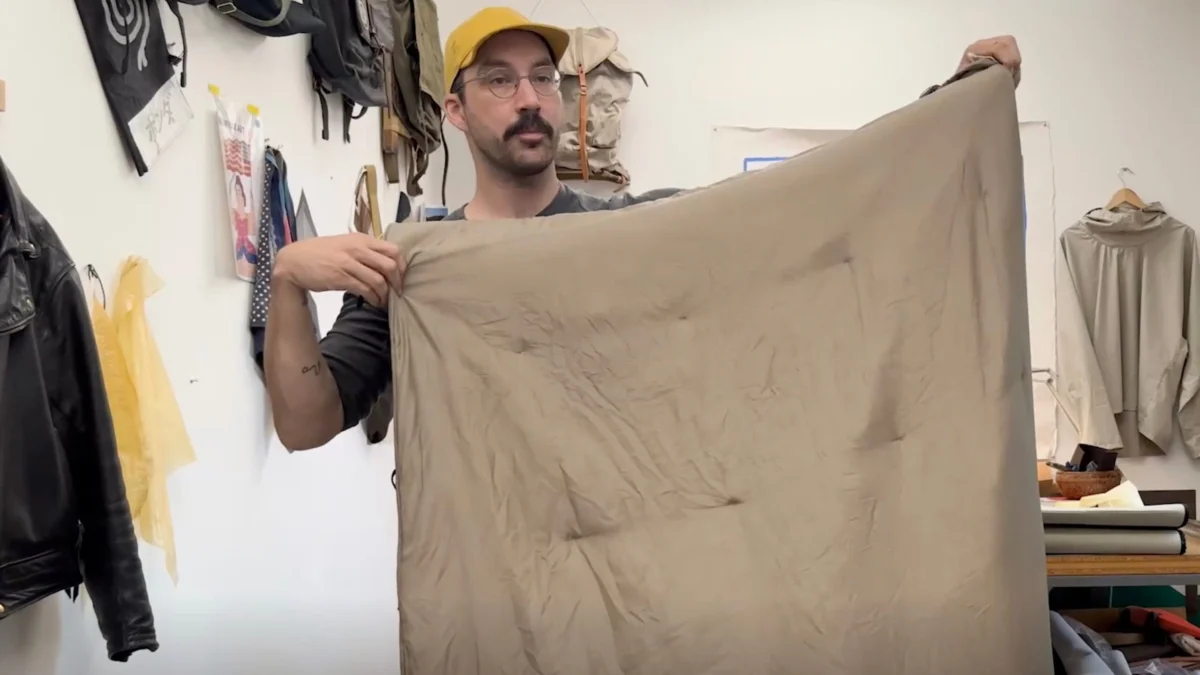
Addressing sleep insulation required balancing thermal efficiency against material availability. For the sleep system, Bonamici constructed a tapered summer-weight quilt rather than a traditional sleeping bag, utilizing cotton ties in place of plastic zippers or snaps.
The exterior shell of the quilt is crafted from a silk-cotton blend traditionally used as high-end suit lining. Insulation is provided by Lavalan, a processed and matted wool batting sourced directly from sheared fleece. While traditional lightweight backpacking quilts utilize goose or duck down for optimal warmth-to-weight ratios, Bonamici deliberately avoided down for this project due to structural constraints.
High-loft down requires specialized "downproof" fabrics to prevent microscopic feather stems from poking through the weave. In industrial manufacturing, this is achieved by calendering—passing lightweight synthetic textiles through heated rollers to melt and fuse the microscopic gaps between warp and weft threads. While certain heavy-duty, tightly woven cotton upholstery fabrics are functionally downproof, adopting them would have tripled the weight and bulk of the quilt.
The resulting wool quilt weighs slightly under two pounds—roughly double the weight of Bonamici’s personal synthetic counterpart—and presents a significantly bulkier packed size. Nevertheless, the wool batting provides resilient thermal regulation and integrates smoothly into the frameless backpack, filling out the internal volume to prevent gear shifting during transit.
The Sleeping Pad and Footwear Compromises
Of all the equipment categories evaluated during the project, sleep systems and footwear proved to be the most technically challenging. Modern inflatable sleeping pads rely entirely on airtight welded thermoplastics, such as TPU-coated nylon, to achieve thick, plush comfort at minimal weights.
Bonamici’s prototype sleeping pad serves a dual purpose as both a thermal break against the cold ground and the structural back panel for the backpack. The pad is constructed from lightweight Ventile fabric sandwiching a thin layer of natural cork—intended to provide a basic thermal barrier—alongside a dense layer of Melton wool.
Weighing just under two pounds, the natural pad represents a severe comfort and weight compromise compared to closed-cell foam pads or modern inflatable mattresses. Bonamici noted that while historical archives, such as early 20th-century outdoor supply catalogs, feature natural rubber or kapok-filled inflatable mattresses, those early iterations weighed between 10 and 15 pounds, rendering them impractical for modern human-powered ultralight backpacking.
Calcutta Bamboo Trekking Poles and Structural Strength
For mobility and shelter pitching, Bonamici integrated trekking poles utilizing Calcutta bamboo—a specialized, thick-walled botanical species renowned for its exceptional flexural strength. Historically utilized for heavy-duty fishing gaffs and traditional ski poles, Calcutta bamboo exhibits superior resistance to bending stress compared to standard aluminum tubing.
To ensure durability on rocky trails, Bonamici sourced specialized aluminum ferrules equipped with carbide tips from a European ski-pole component supplier. Grips are wrapped in natural suede, paired with an adjustable wrist strap anchored by an aluminum buckle, Merino wool lining, and a Ventile outer shell. The top of each pole secures via a brass threaded insert and a mechanical bolt.
To avoid rustic aesthetic tropes, the bamboo shafts were sanded to remove their natural waxy coating and treated with Sumi calligraphy ink, yielding a permanent, matte-black finish. Structurally, Bonamici regards the bamboo poles as the strongest physical component of the entire collection—surpassing the durability of carbon fiber alternatives prone to snapping during river crossings—though they lack modern height-adjustability features.
Oiled Silk Shelters and Historical Rainwear
Completing the shelter system, Bonamici designed a traditional nine-foot catenary-cut tarp utilizing trekking poles for pitch support. To achieve weather resistance without synthetic silicone or polyurethane coatings, the shelter utilizes oiled silk.
Oiled silk—a historically prevalent material documented in maritime literature over a century ago—was fabricated by soaking lightweight silk taffeta in a precise mixture of boiled linseed oil and natural turpentine. Derived from distilled pine sap, turpentine acts as a solvent, thinning the linseed oil to allow deep penetration into the silk weave before curing through oxidation.
Weighing approximately 14 ounces (440 grams), the oiled silk tarp matches the weight expectations of modern ultralight sil-nylon or sil-poly shelters while offering complete water repellency under a garden-hose test. However, Bonamici noted a distinct physical characteristic inherent to the material: as the linseed oil continues to oxidize over time, the fabric undergoes a natural color shift from ivory off-white to a deep amber yellow. This chemical aging process mirrors the historic origins of traditional yellow rainwear, tracing back to nineteenth-century North Sea fishing smocks and the iconic aesthetic of literary figures such as Paddington Bear.
Industry Implications and the Future of Sustainable Design
Bonamici’s plastic-free backpacking kit is not intended as an immediate commercial prescription for the broader outdoor recreation industry. Rather, the project serves as an academic and exploratory benchmark, mapping the precise boundaries of compromise between modern ultralight performance and ecological sustainability.
As consumer demand grows for circular economies and reduced reliance on fossil-fuel extraction, experiments in biodegradable backcountry gear highlight both the limitations and potential of natural material engineering. While immediate adoption of 100 percent natural kits remains constrained by weight penalties and durability thresholds in high-stress applications like stitching and inflatable insulation, Bonamici’s work demonstrates that thoughtful material substitution can successfully bridge centuries-old craftsmanship with contemporary wilderness exploration.