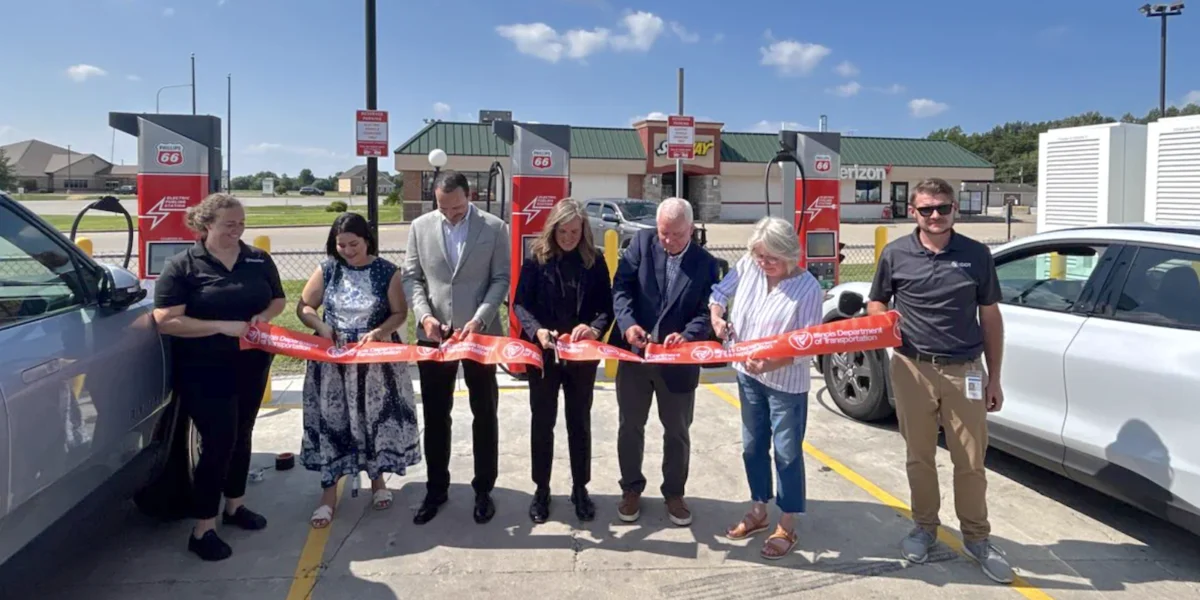
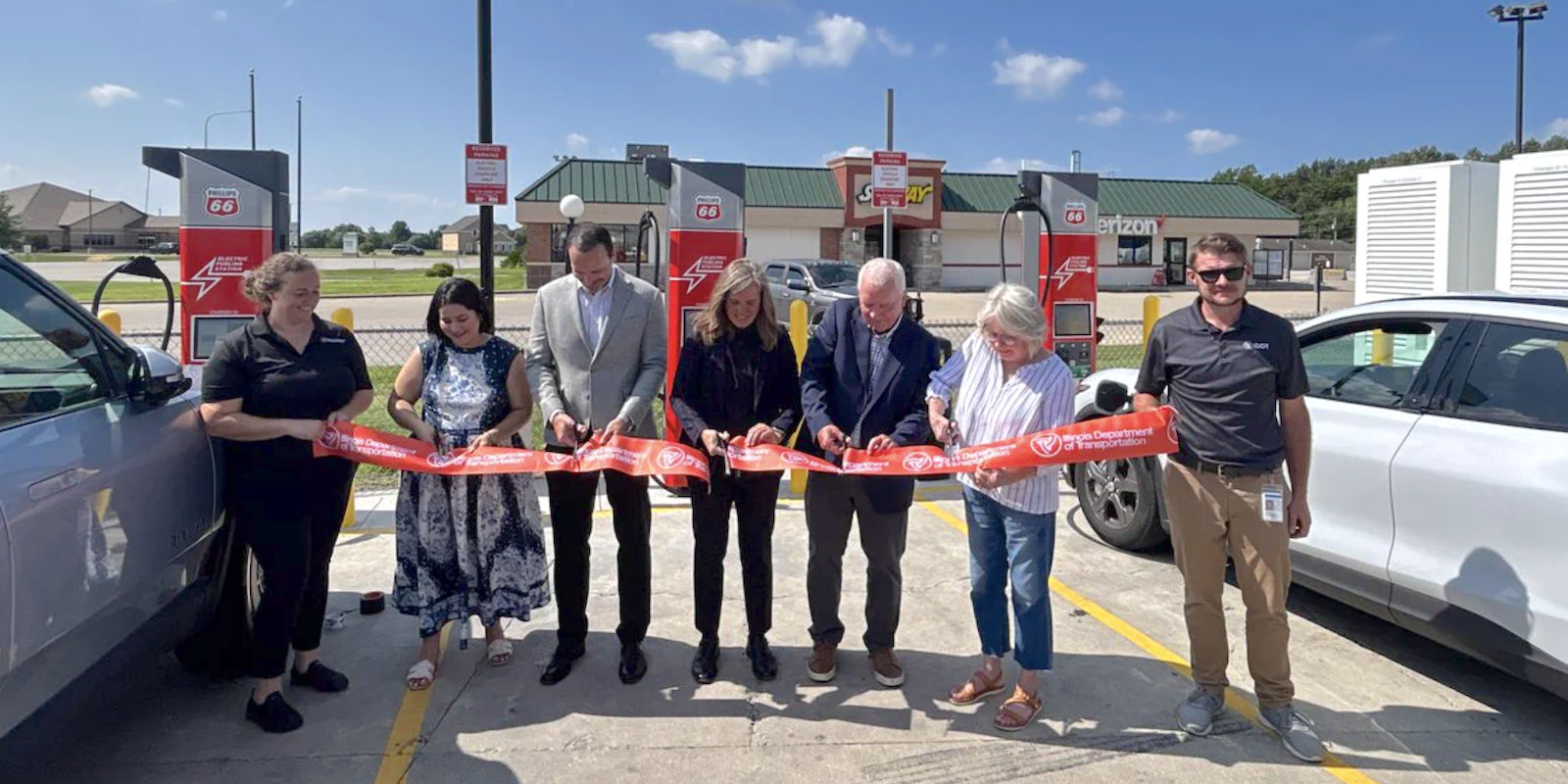
Casey, Illinois, is now home to the state’s inaugural electric vehicle (EV) charging station constructed with federal funding, marking a significant milestone in Illinois’s transition to sustainable transportation. The Illinois Department of Transportation (IDOT) officially inaugurated the high-speed charging infrastructure at a Phillips 66 Mach 1 location this week, signaling a tangible step forward in expanding EV accessibility across the state. This development is a direct result of the National Electric Vehicle Infrastructure (NEVI) program, a federally backed initiative aimed at establishing a nationwide network of EV charging stations.
The newly operational chargers are strategically located on Illinois Route 49, conveniently positioned near Interstate 70 in Casey, a decision that prioritizes accessibility for both local residents and travelers traversing major transportation corridors. The installation features four DC fast charging ports, each capable of delivering up to 350 kilowatts (kW) of power. This rapid charging capability is crucial for modern EVs, allowing drivers to significantly replenish their batteries in a matter of minutes, thereby alleviating range anxiety and making longer journeys more feasible. The deployment of these advanced chargers was facilitated by a substantial $854,641 competitive grant awarded to Phillips 66, underscoring the significant investment being channeled into this crucial infrastructure development. These chargers are integrated into the Electrify America network, one of the nation’s leading EV charging providers, ensuring a seamless and reliable charging experience for users.
Gia Biagi, Illinois Transportation Secretary, highlighted the broader significance of this project during the ribbon-cutting ceremony. "These new chargers are an important step forward in making Governor JB Pritzker’s EV goals a reality, while creating economic opportunity by connecting Illinois communities to a national network of stations," Biagi stated. Her remarks emphasized the dual benefit of the NEVI program: advancing environmental objectives and fostering economic growth. Biagi further elaborated on the observed trends in EV adoption, noting, "Some of the strongest interest we’re seeing for EVs charging is coming from rural areas that see the benefit of having travelers stop in their towns to charge up and spend their dollars at local stores and businesses. We look forward to adding many more throughout the state in the weeks and months ahead." This observation suggests a proactive approach to harnessing the economic potential of EV tourism, particularly in areas that may have previously been overlooked by major commercial developments. The strategic placement of charging stations in such locations can revitalize local economies by drawing in a new demographic of consumers.
The establishment of this first NEVI-funded station in Casey is part of a larger, ambitious plan by IDOT to build out a robust and accessible EV charging infrastructure across Illinois. The NEVI program, established under the Bipartisan Infrastructure Law, allocates significant federal funding to states to deploy EV charging infrastructure along designated Alternative Fuel Corridors, ensuring that charging is available where it is most needed. The program emphasizes the need for reliable, fast-charging stations capable of supporting the growing number of electric vehicles on the road.

Expanding the Network: More Funding Announced
Coinciding with the Casey station’s launch, IDOT also unveiled plans for the next phase of NEVI funding, announcing an additional $23.5 million allocated to further expand the state’s EV charging network. This "Round 3" of funding is earmarked to support the construction of 140 new EV charging ports across 29 distinct locations throughout Illinois. A key requirement for these new sites is the provision of at least four DC fast charging ports at each location, ensuring that drivers can quickly charge their vehicles and continue their journeys without significant delay. This focus on multiple high-speed chargers at each site aims to minimize wait times and enhance the overall user experience, a critical factor in encouraging wider EV adoption.
To date, through the first three rounds of NEVI funding, IDOT has conditionally awarded over $67 million, which is projected to result in the installation of 489 public EV charging ports by the program’s conclusion. This represents a substantial commitment to modernizing the state’s transportation infrastructure and positioning Illinois as a leader in the EV revolution. The "Drive Electric Illinois" initiative, spearheaded by IDOT, provides comprehensive information and resources for individuals and businesses interested in the transition to electric vehicles, including details on available funding and charging station locations. A partial list of recent awardees, illustrating the diverse range of locations and recipients, has been made available, with a complete roster accessible on the Drive Electric Illinois website.
Recent NEVI Awardees Illustrate Broad Impact
The recent IDOT NEVI awards showcase a strategic distribution of charging infrastructure across various counties and recipient types, indicating a comprehensive approach to network development. These awards are designed to not only serve major urban centers but also to reach into more rural communities, addressing the transportation needs of a wider segment of the Illinois population.
In Champaign County, Universal EV received a $641,600 award to install chargers at the AmericInn by Wyndham Urbana-Champaign University Area, located at 1908 N. Lincoln Ave., Urbana. This placement suggests an intention to serve travelers and potentially university community members, integrating EV charging with hospitality services.
Cook County is set to benefit significantly, with multiple awards supporting public facilities and commercial sites. Heartland Charging Services secured $1,152,068 for installation at the Arlington Heights Memorial Library (500 N. Dunton Ave., Arlington Heights) and $1,360,605 for deployment at the Village of Oak Park (130 N. Marion St., Oak Park). These awards highlight a commitment to providing charging at public amenities, making EVs more accessible for residents and visitors alike.
Further expanding the network, Heartland Charging Services also received $1,350,295 for a site in Kane County at the City of Aurora (62 N. Broadway, Aurora), indicating a focus on urban centers with high population density.
In LaSalle County, Universal EV was awarded $654,600 for charging infrastructure at the City of Ottawa (301 W. Madison St., Ottawa), a move that can stimulate local commerce and attract visitors to this historic city.
Lee County will see EVgo Services LLC deploy chargers with an $817,222 award at Infinity Ventures Real Estate Group LLC (1602 S. Galena Ave., Dixon). This partnership with a real estate group suggests opportunities for charging at commercial properties, potentially serving customers and employees.
Sangamon County’s capital city, Springfield, will receive $644,418 through Universal EV for installation at the Days Inn by Wyndham Springfield (5970 S. Sixth St., Springfield), catering to the significant number of travelers visiting the state capital.
St. Clair County is also slated for charging infrastructure with a $656,320 award to Universal EV for a Subway location at 224 S. Madison St., Lebanon. This strategic placement at a popular food service establishment can provide convenient charging opportunities for patrons.

Finally, Will County will benefit from a substantial $1,339,515 award to Heartland Charging Services for a commercial site at 19818 La Grange Rd., Mokena. This indicates the development of charging hubs in high-traffic commercial areas, designed to serve a broad customer base.
The NEVI Program: A Catalyst for EV Adoption
The National Electric Vehicle Infrastructure (NEVI) program, established by the U.S. Department of Transportation, represents a cornerstone of the Biden-Harris administration’s strategy to accelerate the adoption of electric vehicles and build out a national charging network. Authorized by the Bipartisan Infrastructure Law, the program dedicates $5 billion over five years to help states create a network of EV charging stations accessible to all Americans. The program’s primary goal is to ensure that EV charging is readily available, reliable, and convenient, particularly along major roadways.
NEVI funding requires states to develop EV infrastructure deployment plans that meet federal guidelines. These guidelines emphasize the importance of strategically locating charging stations to cover approximately every 50 miles along designated Alternative Fuel Corridors, with a charging station located within one mile of an exit or interchange. Furthermore, the program mandates that charging ports must be capable of delivering at least 150 kW, with a minimum of four such ports at each charging station. This robust standard ensures that drivers of all types of EVs, including those with larger battery packs, can benefit from rapid charging.
The program also encourages private sector participation through competitive grants, fostering partnerships between government agencies and charging network providers, as seen with Phillips 66 and Electrify America in the Casey, Illinois project. This public-private collaboration is essential for the efficient and widespread deployment of charging infrastructure. By providing substantial federal support, the NEVI program aims to overcome the significant upfront costs and logistical challenges associated with building out a new charging ecosystem, thereby de-risking investment for private entities.
Broader Implications for Illinois and the Nation
The activation of Illinois’s first federally funded EV charging station in Casey is more than just a local event; it is a microcosm of a much larger national transformation. As more charging stations come online, the barriers to EV ownership are progressively lowered. This is particularly impactful for residents of rural and suburban areas, who may have previously faced limited charging options and greater range anxiety. The expansion of the charging network is expected to stimulate further investment in EV manufacturing and related technologies, creating jobs and fostering innovation within the green economy.

The economic ripple effects are also significant. As Secretary Biagi pointed out, travelers stopping to charge their vehicles are likely to patronize local businesses, providing a welcome boost to economies that may not traditionally benefit from highway traffic. This can lead to increased sales for gas stations, convenience stores, restaurants, and other local enterprises, creating a virtuous cycle of economic development driven by sustainable transportation.
The timeline for NEVI implementation is aggressive, with states like Illinois working diligently to meet federal targets. The successful launch in Casey, followed by the announcement of further funding and project awards, indicates that Illinois is on track to become a leader in EV infrastructure deployment. The commitment to ensuring at least four fast-charging ports at each new location is a testament to the program’s focus on user experience and network capacity, aiming to prevent the congestion and long wait times that can plague less developed charging networks.
As the NEVI program progresses, the data emerging from these deployments will be crucial for refining future strategies and identifying areas for improvement. The collaboration between state agencies, federal programs, and private companies is a critical model for addressing complex infrastructure challenges. The ultimate goal is to create a seamless, reliable, and ubiquitous charging network that makes owning and operating an electric vehicle as convenient, if not more so, than driving a traditional gasoline-powered car. The initiative in Casey represents a tangible step towards that future, demonstrating the power of federal investment to drive significant progress in sustainable transportation.