Land Rover’s specialized Classic division has announced the completion of a unique restoration project that bridges the gap between the brand’s storied past and its ultra-luxurious future. The project features a meticulously restored 1993 Range Rover Classic, finished in a bespoke specification inspired by the contemporary Range Rover SV Ultra. This one-of-one restoration is not merely a tribute to the original luxury SUV but a technical showcase of how modern materials and finishing techniques can be applied to a vintage chassis. The vehicle is scheduled to be offered as a singular lot alongside its modern counterpart, a Range Rover SV Ultra, at the prestigious RM Sotheby’s auction in Monterey, California, marking a significant moment for collectors of the marque.
A Synthesis of Heritage and Modernity
The 1993 Range Rover Classic serves as the foundation for this project, representing the final years of the first-generation Range Rover’s production cycle—a period when the vehicle had fully transitioned from a utilitarian off-roader to a symbol of high-society status. To align this vintage icon with the new SV Ultra, the Land Rover Classic team employed a "twinning" philosophy, ensuring that the aesthetic DNA of the modern flagship was perfectly mirrored in the 31-year-old vehicle.
Central to this transformation is the exterior finish. The vehicle is coated in Titan Silver, a sophisticated paint technology that made its debut on the SV Ultra. Unlike traditional silver paints, Titan Silver utilizes actual aluminum flakes and advanced pigment technologies to create a "liquid metal" effect. This finish reacts dynamically to light, emphasizing the classic boxy silhouettes and sharp lines of the 1993 model while providing a depth of color that was technically impossible during the vehicle’s original production era.
To further the minimalist aesthetic championed by the current Range Rover design language, the Classic team made several deliberate structural and cosmetic alterations. Most notably, the traditional exterior side moldings and trim were removed, creating a cleaner, more streamlined profile. This "reductionist" approach is a hallmark of modern Land Rover design, and its application here highlights the timeless nature of the original Spen King design.
Technical Specifications and Exterior Enhancements
While the heart of the vehicle remains a traditional V8 engine—a powerplant synonymous with the Range Rover’s effortless torque and distinctive exhaust note—the peripheral components have been updated to meet modern standards of excellence. The vehicle sits on 16-inch wheels finished in Satin Platinum Atlas, a subtle, matte-metallic hue that provides a sophisticated contrast to the Titan Silver bodywork. These wheels feature diamond-turned contrast rims, adding a level of jewelry-like detail usually reserved for modern luxury sedans.
The branding on the vehicle also received a contemporary update. The hood and tailgate feature modern Land Rover badging, utilizing the same fonts and materials found on the current SV lineup. This subtle integration serves to unify the two vehicles when parked side-by-side, signaling that while three decades separate their manufacture, they belong to the same lineage of "Range Rover" excellence.
Interior Innovation: The Shift to Ultrafabrics
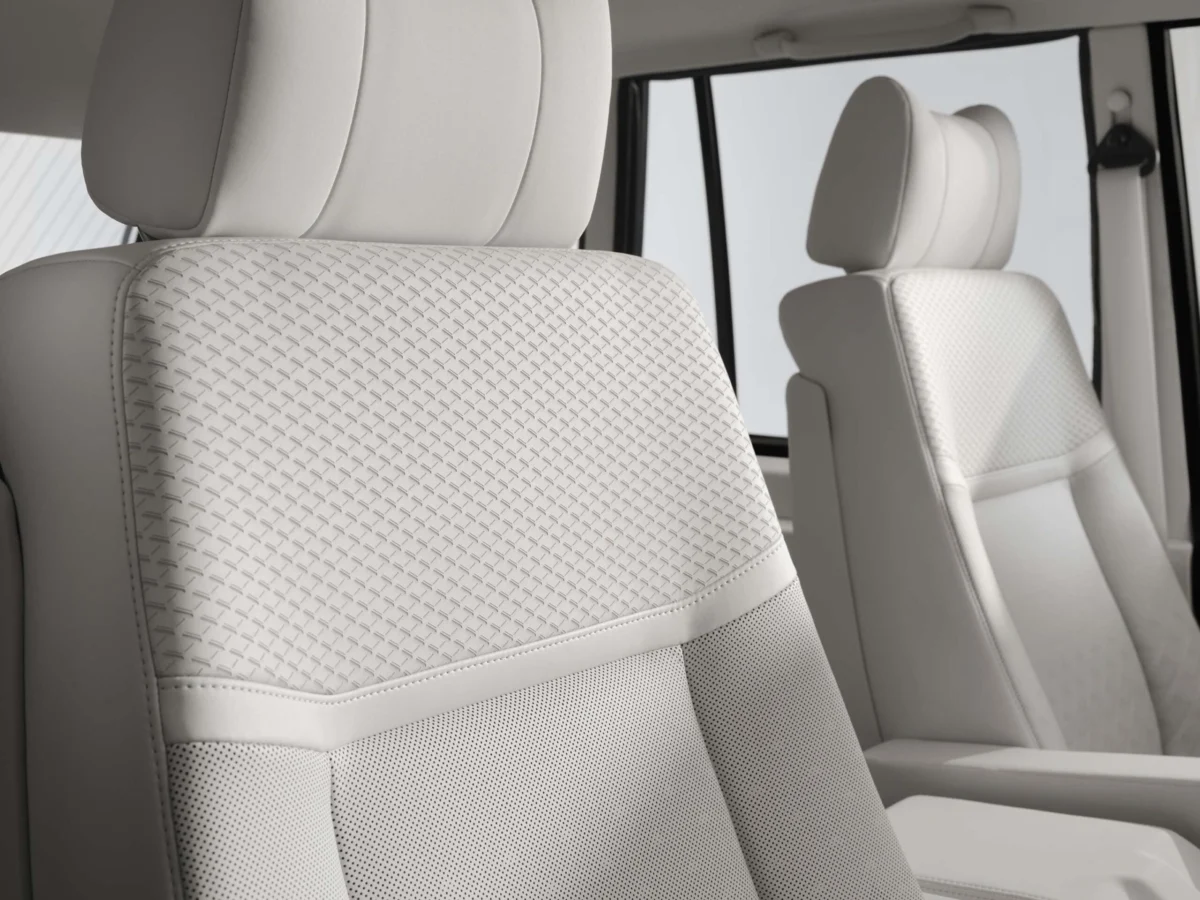
Perhaps the most significant departure from tradition occurs within the cabin. For the first time in a factory-backed Range Rover Classic restoration, the interior has been finished entirely in Ultrafabrics. This high-performance, sustainable textile represents a shift away from traditional leather, aligning with modern luxury trends that prioritize environmental consciousness without sacrificing tactile quality.
The interior features a sophisticated two-tone color scheme of Orchid White and Cinder Grey. This palette creates a bright, airy atmosphere that contrasts with the more somber, wood-heavy interiors typically found in 1990s-era Range Rovers. To enhance the bespoke nature of the build, the seats and door cards feature laser-cut mosaic patterns, a complex geometric design that requires precision engineering to execute on textile surfaces.
The attention to detail extends to the functional components of the interior. The trim pieces are crafted from brushed aluminum, replacing the traditional walnut or burr elm veneers. Furthermore, the speaker covers and various interior finishers have been color-matched to the Orchid White and Cinder Grey scheme, ensuring a cohesive visual experience that feels integrated rather than added on.
Historical Context: The 1993 Range Rover Classic
To understand the significance of this restoration, one must look at the state of the Range Rover in 1993. By this time, the "Classic" (as it would later be known to distinguish it from the P38a successor) had been in production for 23 years. The 1993 model year was a pinnacle for the first generation, featuring the long-wheelbase (LWB) variants and the introduction of electronic air suspension (EAS)—a first for the SUV market.

The V8 engine, originally a Buick-derived design that Rover purchased in the 1960s, had been refined into a 3.9-liter or 4.2-liter powerhouse, providing the smooth power delivery that defined the luxury 4×4 segment. By restoring a 1993 model, Land Rover Classic has chosen a vehicle that represents the "Goldilocks" zone of the original generation: it possesses the classic aesthetic of the 1970 original but benefits from two decades of mechanical and ergonomic improvements.
The SV Ultra: A New Benchmark for Luxury
The inspiration for this project, the Range Rover SV Ultra, represents the absolute ceiling of Jaguar Land Rover’s (JLR) current capabilities. Produced by the Special Vehicle Operations (SVO) division, the SV Ultra is designed to compete with the likes of the Bentley Bentayga and the Rolls-Royce Cullinan. It emphasizes personalization, utilizing rare materials and hand-finished elements.
By pairing the 1993 Classic with the SV Ultra, Land Rover is making a powerful statement about brand longevity. The "twinning" of these vehicles at auction suggests that a Range Rover is not a disposable luxury item but a collectible asset that retains—and increases—its value over decades. This strategy is similar to those employed by high-end watchmakers who release "set" editions featuring a vintage-inspired piece and its modern equivalent.
The Monterey Car Week and RM Sotheby’s Auction
The choice of RM Sotheby’s Monterey auction as the venue for this sale is highly strategic. Monterey Car Week, which culminates in the Pebble Beach Concours d’Elegance, is the premier gathering for the world’s most affluent automotive collectors. In recent years, the market for "restomods" and factory-sanctioned restorations has exploded, with collectors seeking vehicles that offer vintage style with modern reliability and finishes.
Industry analysts expect the pair to command a significant premium. While a standard 1993 Range Rover Classic in good condition might fetch between $50,000 and $80,000, a factory-backed, one-of-one restoration with this level of bespoke detailing—paired with a limited-edition SV Ultra—could easily push the final gavel price into the mid-six-figure range or higher.
Market Implications: The Rise of Factory Restorations
This project highlights a growing trend in the automotive industry: the "Works" restoration. Brands like Porsche, Aston Martin, and Jaguar Land Rover have realized that there is immense value in their back catalogs. By bringing restoration work in-house, they can guarantee authenticity, access original blueprints, and use modern factory paint booths and assembly lines to achieve a level of fit and finish that independent shops struggle to replicate.
The Land Rover Classic "Works Bespoke" program allows customers to specify their vintage Defenders and Range Rovers to a level of luxury that matches their modern counterparts. This 1993 project serves as a "halo" car for that program, demonstrating to prospective clients that the only limit to a restoration is their imagination and budget.
Chronology of Development
The journey of this specific vehicle can be traced through several key phases:
- Sourcing: The selection of a 1993 V8 chassis, chosen for its historical significance and mechanical maturity.
- Strip-down and Assessment: The vehicle was completely disassembled by the Classic team at Ryton-on-Dunsmore, UK, to ensure the integrity of the frame and drivetrain.
- Design Alignment: Designers from the SV division worked with the Classic team to transpose the SV Ultra’s color palette and material selection onto the 1993 body.
- The Restoration Process: This included the removal of exterior trim, the application of the Titan Silver paint, and the complete re-trimming of the interior with Ultrafabrics.
- Testing and Validation: Despite its status as a showpiece, the vehicle underwent rigorous testing to ensure the V8 powertrain and suspension met factory standards.
- Public Debut: The announcement ahead of the RM Sotheby’s Monterey auction in 2026.
Broader Impact on the Range Rover Brand
This project is a masterclass in brand storytelling. It reinforces the idea that the Range Rover has always been at the forefront of luxury, even before the term "luxury SUV" was part of the common lexicon. By applying the "Ultra" treatment to a 30-year-old car, Land Rover proves that its design language is consistent and that its commitment to luxury is a permanent fixture of the brand, not a modern pivot.
For the collector market, this sale will likely set a new benchmark for Range Rover Classic values. It validates the first-generation Range Rover as a legitimate blue-chip collectible, moving it out of the realm of "old SUV" and into the category of "automotive art."
As the automotive world moves toward electrification and increased automation, projects like the Titan Silver 1993 Range Rover Classic serve as a reminder of the tactile, mechanical soul of the industry. Whether it is the rumble of the V8 or the innovative use of Ultrafabrics, this vehicle represents a perfect intersection of where the brand has been and where it is going. The upcoming auction in Monterey will not just be a sale of two cars; it will be a celebration of a design legacy that has defined the luxury off-road segment for over half a century.