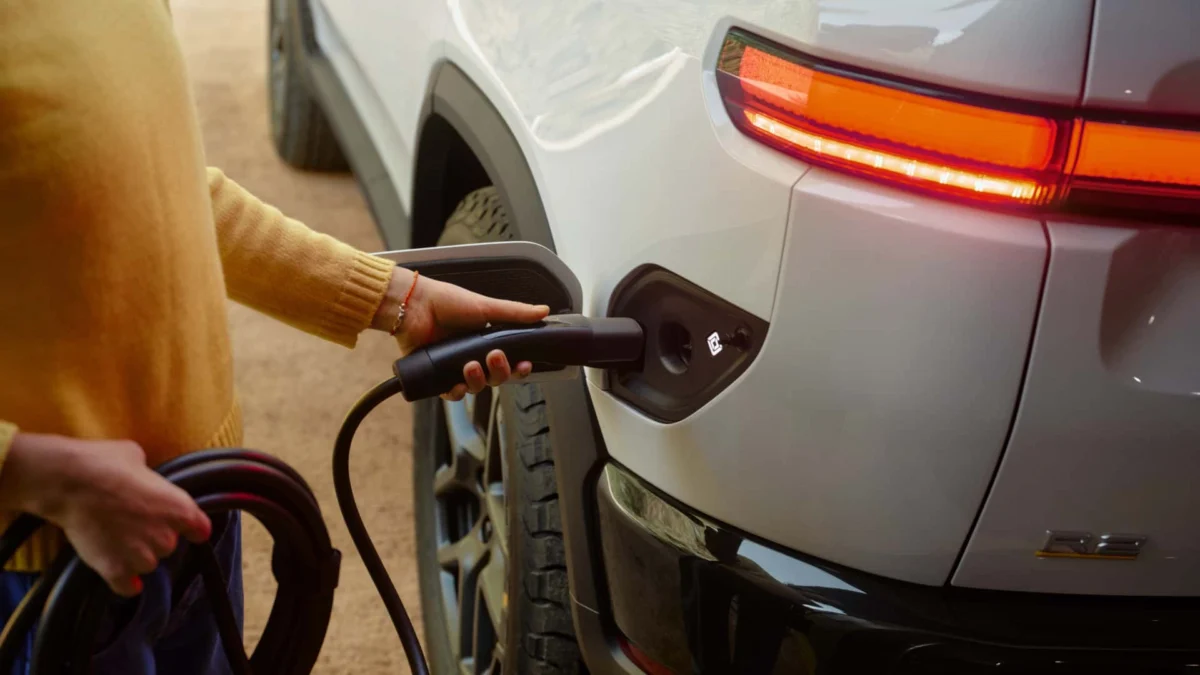
Journalist Tom Moloughney, a prominent voice in the electric vehicle community and host of the "State of Charge" YouTube channel, recently encountered a startling issue while testing the charging capabilities of the highly anticipated Rivian R2. Utilizing an older Tesla adapter to connect the R2 to a CCS charging station, Moloughney witnessed firsthand a critical failure: the adapter’s pins melted. This incident, far from being an isolated malfunction, serves as a significant cautionary tale for R2 owners and potentially other EV drivers, highlighting a critical intersection of vehicle design, evolving charging standards, and the limitations of older charging accessories.
The root of this issue, as explained by Moloughney and industry experts, lies in the fundamental electrical principles of voltage and amperage, and the specific engineering choices made by Rivian for the R2. To achieve a more accessible price point for the R2 compared to its larger sibling, the R1, Rivian opted to retain the 400-volt battery architecture. While this is a common and effective system, it necessitates a higher amperage draw during charging to achieve comparable charging speeds to vehicles employing the more advanced 800-volt systems prevalent among many competitors. This increased amperage is the direct cause of the adapter failure.
Understanding the Amperage Challenge
The Rivian R2, in its pursuit of competitive charging performance within a more budget-friendly package, can draw upwards of 600 amps, and critically, can sustain this high draw for extended periods. This capability, while a boon for charging speed, places a significant demand on the charging infrastructure and, crucially, on any adapters used to bridge different charging connectors.
Older NACS-to-CCS adapters, particularly those designed for earlier generations of EVs that did not anticipate such high amperage demands, are simply not built to handle this level of electrical current. The friction generated by the excessive amperage passing through the adapter’s components causes them to overheat. In the case of the older Tesla adapter Moloughney used, it lacked the sophisticated thermal management systems found in newer, more robust adapters. This meant it continued to draw the full amperage, leading to a catastrophic meltdown of its internal pins rather than a controlled reduction in charging speed to prevent damage.
The Evolution of Charging Adapters and Standards
The automotive industry’s rapid transition to electric vehicles has been accompanied by a parallel evolution in charging standards and hardware. The North American Charging Standard (NACS), originally developed by Tesla, has gained widespread adoption, with many automakers, including Rivian, now equipping their new vehicles with NACS ports. This shift offers greater convenience, allowing access to Tesla’s extensive Supercharger network.
However, the vast majority of public charging infrastructure still relies on the Combined Charging System (CCS) standard. This necessitates the use of adapters for vehicles equipped with NACS ports. The performance and safety of these adapters are paramount. As Moloughney’s experience demonstrates, not all adapters are created equal. Older adapters, designed for a time when charging speeds and amperage draws were generally lower, may not possess the necessary thermal resistance or internal safety mechanisms to cope with the demands of higher-performance EVs like the Rivian R2.
Broader Implications for EV Owners
The Rivian R2 is not an anomaly in its high amperage draw. Several other popular EV models, including certain BMW, Polestar, and even Tesla vehicles, can also pull significant amperage. This means the potential for adapter-related issues extends beyond R2 owners. Any EV owner who relies on a NACS-to-CCS adapter for charging at non-Tesla stations should be aware of their adapter’s specifications and capabilities.
Industry analysts suggest that manufacturers of charging adapters are increasingly designing their products with higher amperage handling in mind. More modern adapters often incorporate advanced heat dissipation materials and internal circuitry that can detect excessive temperatures and automatically reduce the charging rate to prevent overheating and potential damage. Some adapters are even designed to shut down the charging session entirely if thermal thresholds are exceeded.
Rivian’s Response and Customer Guidance
Rivian, while not directly responsible for the performance of third-party adapters, acknowledges the importance of proper charging equipment. The company offers its own NACS-to-CCS adapter, designed to meet the charging demands of its vehicles. In regions adhering to CARB (California Air Resources Board) regulations, Rivian includes this essential adapter as part of the R2’s purchase price, although customers may need to proactively add it to their order during the configuration process.
Moloughney’s investigation revealed that while some adapters might simply slow down the charging to manage heat, the older Tesla adapter he used lacked this crucial safety feature. This highlights a critical distinction: a melting adapter is not just an inconvenience; it poses a significant fire risk and can cause irreparable damage to the vehicle’s charging port.
The message from the EV community and experts like Moloughney is clear: prudence and due diligence are essential when selecting charging accessories. For owners of the Rivian R2, or any EV capable of drawing 600 amps or more, it is imperative to verify the specifications of their charging adapters. Opting for adapters from reputable manufacturers, specifically designed to handle high amperage loads, is not merely a recommendation but a necessity for safe and efficient charging.
The Path Forward: Ensuring Charging Safety
The incident involving the Rivian R2 and the melted adapter underscores the dynamic nature of EV technology. As vehicles become more powerful and charging infrastructure expands, the accessories that connect them must evolve in tandem. The transition to NACS as a dominant standard, while beneficial for interoperability, places a renewed emphasis on the quality and safety of adapters.
Consumers are encouraged to consult their vehicle manufacturer’s recommendations and conduct their own research into adapter specifications. Looking for certifications and reviews that specifically address high amperage handling and thermal performance can help avoid potentially hazardous situations. The long-term viability and safety of the electric vehicle ecosystem depend on the reliability of every component, from the vehicle’s battery to the smallest charging adapter. The Rivian R2’s charging saga serves as a potent reminder that in the world of electric mobility, attention to detail in charging accessories is as vital as the performance of the vehicle itself.