











In the contemporary landscape of artificial intelligence integration, software engineers and data scientists increasingly rely on Large Language Models (LLMs) to ingest unstructured documents and output structured data. While modern frameworks and APIs—such as OpenAI’s Responses API, local vLLM deployments utilizing xgrammar, and direct Pydantic model integrations—have made generating valid JSON schematics a standard feature, most enterprise development tutorials prematurely halt their validation pipelines the moment a JSON object successfully parses. This narrow technical oversight often exposes enterprise applications to silent logic errors, erroneous data ingestion, and compounding compliance risks. To build production-grade AI systems, engineering teams must implement a robust, multi-layered defense architecture consisting of strict contracts, source-text cross-referencing, intelligent and bounded retry loops, and hardware- or software-level constrained decoding.
Background Context and the Evolution of Structured Outputs
The demand for reliable machine learning outputs has accelerated significantly alongside enterprise automation initiatives. Historically, collecting structured data from LLMs involved crafting brittle prompt instructions, such as demanding JSON-formatted blocks, and subsequently deploying heuristic-heavy regex scripts to parse the resulting text strings. This approach frequently failed when models hallucinated keys, omitted required values, or generated syntax errors like trailing commas or unescaped characters.
To mitigate these systemic issues, platform providers introduced grammar-guided generation and native schema-constrained decoders. Tools like Pydantic in Python emerged as the de facto standard for defining data contracts, allowing developers to serialize and deserialize data models seamlessly. However, industry practitioners soon discovered a critical blind spot: structural validity does not equate to semantic correctness. A model can produce a syntactically pristine JSON object that passes every schema check while simultaneously hallucinating financial figures, misinterpreting currencies, or generating data completely detached from the underlying source document. Addressing this vulnerability requires moving beyond syntax checkers and implementing rigorous semantic validation protocols.
The Core Problem: The Illusion of Syntactic Correctness
To understand the limitations of schema-only validation, consider the processing of a standard commercial invoice. When an enterprise finance system ingests an invoice containing the text string "Total due: EUR 1,250.00," an application may prompt an LLM to extract the invoice identifier, currency type, total amount expressed in cents, and the exact source text quote substantiating the figure.
An LLM might return a valid JSON response containing the correct identifier and currency, alongside an integer representing the total in cents and the verbatim text quote. Syntactically, the object passes all parser checks: every required key is present, data types match the specified schema, and the currency falls within the allowed whitelist. Yet, a fundamental calculation error can easily bypass schema validation entirely. If the model incorrectly translates "1,250.00 euros" into 12,500 cents instead of 125,000 cents, no standard JSON parser or schema validator will flag the discrepancy, because 12,500 is a valid integer. The error can only be caught through algorithmic cross-referencing against the original source text. Consequently, enterprise AI pipelines must treat a successfully parsed object merely as an entry ticket to downstream verification rather than a trusted record of truth.
Defining Enterprise Contracts Before Model Execution
Building a resilient extraction pipeline begins with establishing a strict data contract owned entirely by the host application rather than delegated to the prompt instructions. Utilizing data validation libraries like Pydantic in strict mode disables automatic type coercion, preventing silent data corruption. For example, standard validation modes might accept a string like "125000" or a boolean value like True for an integer field, implicitly casting them behind the scenes. Strict configuration settings force these inputs to throw explicit validation errors, ensuring that anomalous model outputs are intercepted immediately.
Furthermore, configuring schemas to forbid extra keys ensures that models cannot smuggle unverified metadata into downstream databases. While these contracts guarantee shape integrity, developers must acknowledge that standard JSON schema exports cannot encapsulate complex semantic rules, such as verifying that mathematical totals match textual quotes. Thus, the data contract serves as the first line of defense, separating structural form from semantic reality.
The Four-Tiered Validation Architecture
Enterprise applications handling financial, medical, or legal documents require a systematic evaluation function that processes model outputs through distinct validation states. A comprehensive evaluation framework typically yields one of four outcomes: accepted, needs_review, rejected, or shape_error.
The validation sequence operates through sequential verification layers:
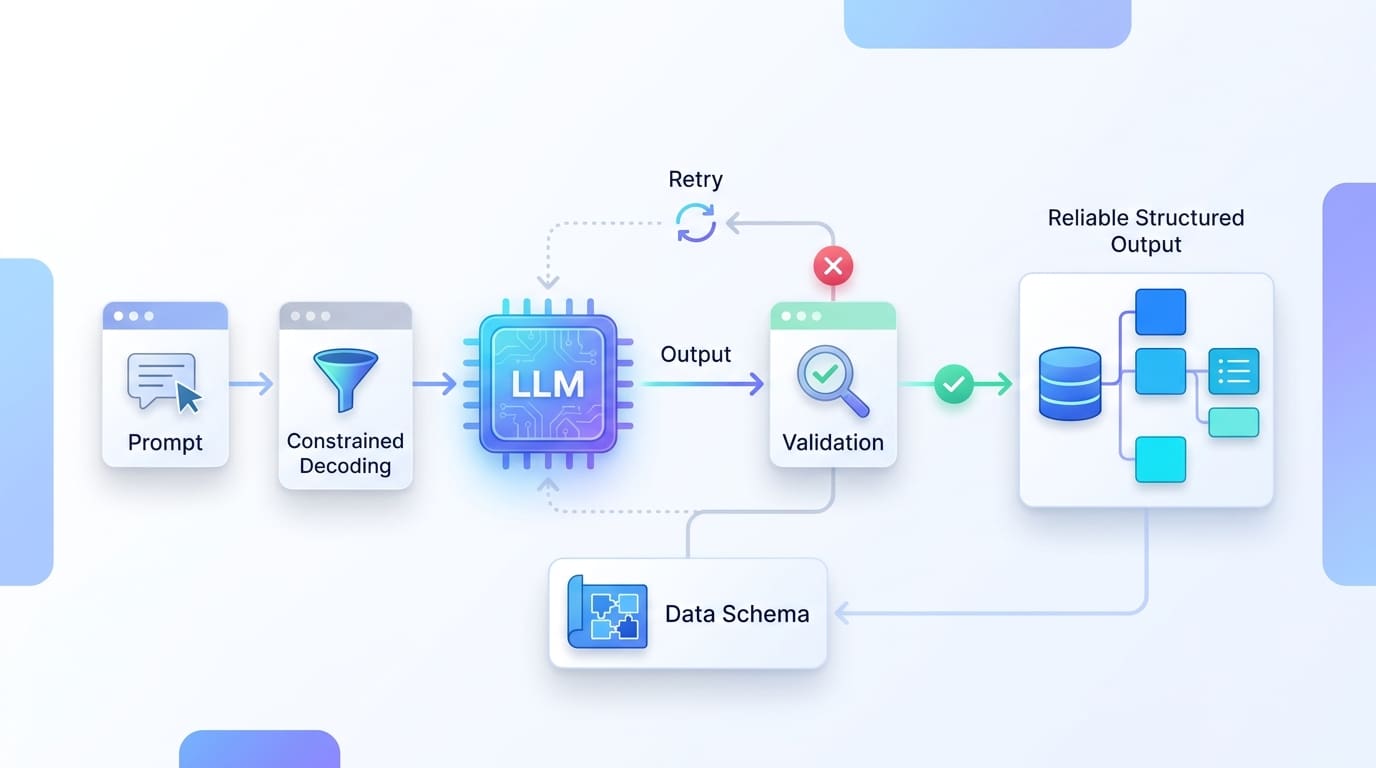
- Shape and Syntax Validation: The system attempts to parse the raw response text into JSON and validate it against the application-owned schema. Any failure at this stage generates a shape error.
- Verbatim Source Verification: The extracted text quotes are checked character-for-character against the source document to ensure they genuinely exist within the provided text.
- Identity and Metadata Cross-Check: Expected identifiers and categorical fields, such as currency codes, are verified against the source text and application parameters.
- Semantic Consistency and Arithmetic Verification: Extracted numerical figures are mathematically derived from or cross-referenced against the supporting source text quotes. For instance, digits stripped from a financial quote must reconcile accurately with stored cent values.
When records fail semantic or source checks, they are formally rejected rather than silently corrected. Conversely, when source documents legitimately omit essential data points—such as an unstated currency or missing total—the pipeline routes the record to a human-in-the-loop review queue (needs_review) rather than instructing the model to hallucinate default values like zero.
Intelligent Retries and Bounded Attempt Budgets
A common anti-pattern in LLM orchestration is the implementation of infinite or poorly bounded retry loops designed to fix every type of generation failure. In production environments, retrying an extraction request must be governed by strict logical constraints based on the nature of the failure.
Because an LLM cannot alter the immutable facts contained within a source document, semantic rejections and business logic failures are terminal. Retrying a request because an invoice total failed mathematical cross-referencing will yield identical results unless the underlying source text changes. Therefore, retries should be exclusively reserved for shape errors—such as malformed JSON syntax or minor structural omissions—where feeding validation error messages back into the model context can guide the generator toward correct formatting.
To maintain system stability and prevent runaway API costs, engineering teams must enforce a strict maximum attempt budget, typically capped at three total attempts. Additionally, developers must audit underlying transport layer configurations. Many modern SDKs automatically execute exponential backoff retries for connection timeouts and rate limits behind the scenes, meaning three application-level extraction attempts can easily balloon into nine or more hidden HTTP requests. Explicitly configuring client timeouts and transport retry limits ensures predictable execution times and resource consumption.
Chronology and Lifecycle of a Validated Extraction Request
To visualize how data moves through a production-grade extraction pipeline, consider the chronological progression of a single document processing event:
- T+0.0s (Ingestion and Preparation): The raw document (e.g., a scanned PDF converted via OCR) is ingested alongside system instructions and a strict Pydantic schema definition.
- T+0.5s (Constrained Generation): The model executes under schema constraints, ensuring that emitted tokens strictly conform to the structural format required by the application.
- T+1.2s (Initial Parsing and Shape Verification): The application receives the candidate object. If a JSON syntax error or type mismatch occurs, the pipeline captures the exact validation errors.
- T+1.3s (Bounded Retry Evaluation): If a shape error is detected and the attempt budget permits, the error messages are appended as feedback to the model context, and a single regeneration call is executed. This cycle repeats no more than three times.
- T+2.0s (Semantic and Source Cross-Referencing): Once a structurally valid object is secured, it undergoes rigorous semantic validation, verifying text quotes and reconciling numerical calculations against the source document.
- T+2.1s (Final Disposition Routing): Based on the evaluation outcome, the record is either committed downstream as an
acceptedverified asset, routed to human operators asneeds_review, or terminated securely via arejectedexception path.
Constrained Decoding vs. Prompt-Based Requests
Relying solely on prompt instructions to enforce structured outputs leaves systems vulnerable to generation drift. Asking a model to "please output JSON" leaves the decoding mechanism free to introduce conversational filler, markdown code fences, or extraneous commentary.
In contrast, constrained decoding operates directly at the token generation layer. By masking out probability distributions for tokens that would violate the active JSON schema, the generator is mathematically restricted from producing malformed structural shapes. While constrained decoding successfully eliminates shape errors, developers must remember that it does not guarantee semantic accuracy. Even under strict decoding constraints, a model can generate an integer that fails to match the textual invoice total. Consequently, combining constrained generation with post-hoc semantic validation provides the highest possible reliability for enterprise workflows.
Broader Implications and Enterprise Best Practices
As artificial intelligence systems transition from experimental prototypes to mission-critical enterprise infrastructure, the methodologies surrounding data validation must mature accordingly. Treating LLM outputs as inherently untrusted inputs—subject to the same rigorous boundary checks, type safety guarantees, and cross-source verification as untrusted user submissions from the public internet—is fundamental to maintaining system integrity.
Engineering organizations deploying automated extraction pipelines should establish comprehensive logging frameworks that track parsing success rates, validation failure categories, and retry attempt distributions independently. By ensuring that every failure path terminates securely before executing downstream write operations, developers can harness the immense generative power of large language models while safeguarding their applications against hallucination, data corruption, and operational failure.