








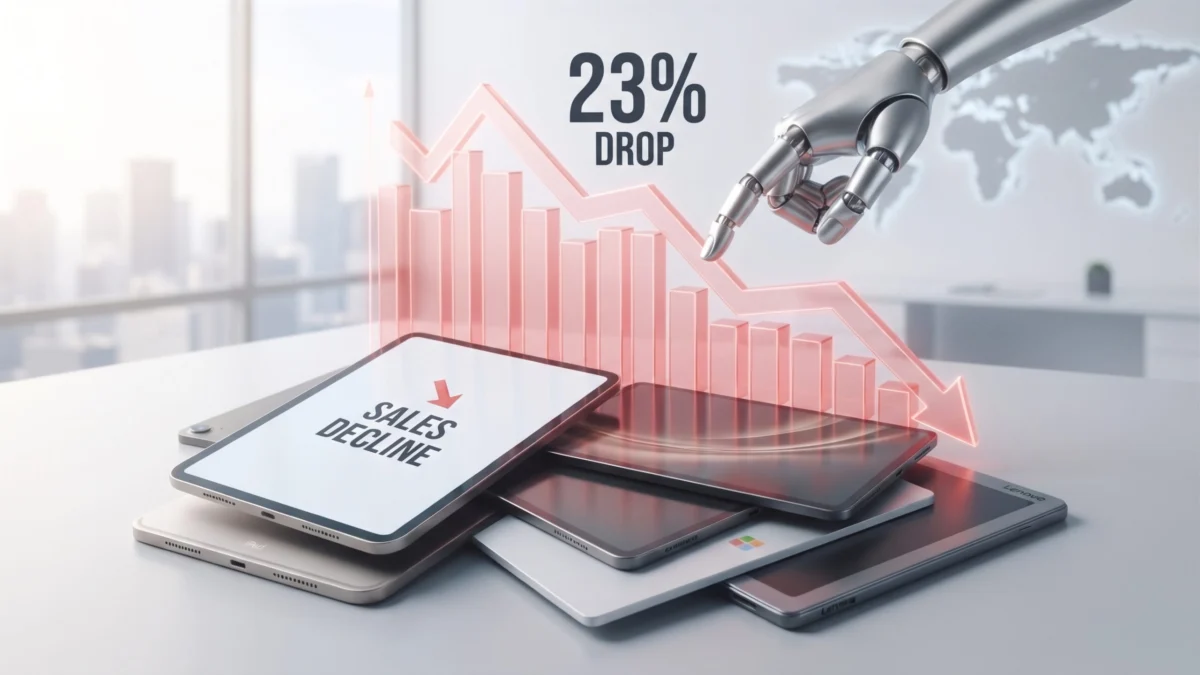
The global tablet market has entered a period of significant contraction, recording a sharp 23 percent decline in shipments during the third quarter of 2026. According to the latest data released by industry intelligence firm Omdia, total global shipments plummeted from 41.8 million units in the same period last year to just 32.2 million units. This downturn, which has affected nearly every major manufacturer, highlights a growing malaise in the consumer electronics sector, driven by a convergence of supply chain bottlenecks, inflationary pressures, and a notable lack of transformative hardware innovation.
A Chronology of Market Cooling
The current decline in the tablet market did not occur in a vacuum; it is the culmination of a multi-year shift in consumer behavior. During the height of the global pandemic in 2020 and 2021, the tablet market saw a massive, anomalous spike in demand. As millions of individuals shifted to remote work and distance learning, manufacturers scrambled to meet an unprecedented surge in orders.
By mid-2023, the initial "pull-forward" effect of that demand began to wane. Consumers who purchased tablets during the pandemic found themselves with relatively modern hardware that did not yet require replacement. By 2025, the industry began to show signs of saturation. The Q3 2026 data confirms that this cooling period has now transitioned into a full-scale contraction, as the replacement cycle for tablets—which has historically been longer than that of smartphones—continues to stretch beyond the typical three-to-four-year window.
Competitive Landscape and Manufacturer Performance
Despite the broad industry downturn, the competitive hierarchy of the tablet market remains largely intact, though all major players are feeling the pressure of diminished volume.
Apple continues to lead the sector with a 36 percent market share. However, even the Cupertino giant has not been immune to the broader trend. iPad shipments fell by 27.5 percent year-over-year, indicating that even the most loyal brand ecosystems are experiencing hesitation in hardware spending. The decline suggests that Apple’s latest iterative updates have not been compelling enough to entice existing users to upgrade their current devices.
Samsung maintains its position as the clear runner-up, holding 16.9 percent of the global market. The Korean electronics conglomerate shipped 5.42 million units in the third quarter, representing a 21.7 percent decrease compared to the previous year. While Samsung remains the primary competitor to Apple in the premium Android space, the company’s volume trajectory mirrors the wider market trend.
A notable outlier in this landscape is Lenovo. Bucking the negative trend that has defined the rest of the top-tier manufacturers, Lenovo achieved an 11.9 percent increase in shipments, securing 12.7 percent of the market share. Analysts suggest that Lenovo’s growth may be attributed to its diverse product portfolio, which includes aggressive penetration into the education and enterprise sectors, as well as its ability to offer mid-range devices that appeal to budget-conscious consumers in emerging markets.
Other major brands have faced more severe consequences. Xiaomi reported a 10.6 percent decline, while Huawei experienced a staggering 43 percent contraction. The collapse in Huawei’s shipments is particularly significant, likely reflecting both the ongoing impacts of international trade restrictions and a shift in consumer preference toward brands that offer a more seamless integration with global app ecosystems.
The Role of Supply Chain Constraints
The fundamental challenge facing the industry, according to Omdia’s research, is not merely a lack of demand, but a lack of differentiation caused by systemic supply chain restrictions. Omdia research manager Himani Mukka noted that the industry is currently trapped in a cycle where manufacturers are struggling to procure the necessary components to integrate meaningful hardware upgrades.

When consumers look at the latest generation of tablets, they are often hard-pressed to find significant improvements over models released two or three years ago. The lack of breakthroughs in display technology, battery efficiency, and processing power—often hindered by component shortages or the high cost of R&D amid slowing revenue—has created a "value gap." Consumers are increasingly choosing to hold onto their existing devices rather than pay a premium for incremental updates that offer little to no tangible improvement in daily performance.
Furthermore, the global semiconductor shortage, which began in 2020, has evolved into a more complex issue involving logistical bottlenecks and the rising cost of raw materials. These factors have forced manufacturers to prioritize production for high-margin devices, often leaving the tablet segment—which occupies a middle ground between smartphones and laptops—with less priority in the global chip allocation queue.
Broader Economic and Industrial Implications
The stagnation of the tablet market has significant implications for the wider consumer electronics industry. Analysts warn that if the current supply chain and innovation constraints persist, the impact will likely ripple into the smartphone market.
Smartphones have already shown signs of saturation in developed markets, and the added pressure of a stagnant tablet market suggests that the entire ecosystem of mobile computing is entering a period of forced maturity. With the tablet and smartphone markets moving in tandem, investors and industry stakeholders are beginning to question whether the next wave of growth will arrive soon enough to offset the current decline.
Moreover, the decline has profound implications for software developers and ecosystem managers. As hardware sales slow, the base of active devices begins to age. This limits the ability of software developers to introduce new, resource-intensive features that rely on the latest processors or AI-driven hardware capabilities, as the majority of the user base is running on older, less powerful machines. This, in turn, creates a negative feedback loop: software becomes less exciting, which gives consumers even fewer reasons to purchase new hardware.
Looking Toward 2027 and Beyond
The current projections for the remainder of 2026 and throughout 2027 remain cautious. Most industry experts do not expect an immediate reversal of the 23 percent decline. Instead, they anticipate a "plateau" where the market stabilizes at a lower volume level than what was observed in 2022 or 2023.
For the industry to return to growth, several factors must align. First, there must be a significant breakthrough in tablet utility, perhaps driven by advancements in generative AI that require more robust, specialized hardware that cannot be easily replicated on older devices. Second, the supply chain must normalize, allowing for a reduction in component costs that could lead to more competitive pricing for consumers.
Until these shifts occur, the tablet market will likely remain a "replacement-only" market, where growth is defined by the necessity of replacing broken or obsolete units rather than the excitement of new, innovative technology. The performance of leaders like Apple and Samsung in the coming quarters will be critical, as they will dictate the overall tone for the industry. If they can introduce compelling, must-have features in their 2027 lineups, they may be able to reignite consumer interest. However, if the status quo of minor, iterative updates continues, the market may face an even longer period of stagnation.
In conclusion, the 23 percent decline in global tablet shipments is a clear signal from the market. Consumers are satisfied with their current devices, and the industry has yet to provide a sufficient reason to change that. As we look ahead to 2027, the focus for manufacturers will shift from aggressive volume growth to efficiency, cost management, and the search for the next "killer feature" that can break the current cycle of stagnation and once again capture the interest of the global consumer. The stakes are high, as the tablet’s role as a primary device for work, education, and entertainment remains secure, even if the hardware market itself is currently in a state of profound recalibration.