




The Commonwealth of Pennsylvania is injecting $37 million in federal funding into the Greater Philadelphia area to construct 515 new public electric vehicle (EV) charging ports, marking a substantial leap forward in regional clean-transportation infrastructure. Announced by the Pennsylvania Department of Transportation (PennDOT), this ambitious initiative targets Bucks, Chester, Delaware, Montgomery, and Philadelphia counties, addressing a critical regional shortage of accessible charging locations for both urban apartment dwellers and suburban commuters.
According to regional transit projections, these newly funded projects will expand overall public charging availability by 27% across the entire five-county southeastern region. More impressively, the initiative is slated to boost public charging infrastructure by a remarkable 53% within Philadelphia proper. This strategic funding allocation underscores the state’s aggressive push to democratize EV ownership, ensuring that the transition to zero-emission transportation is not restricted solely to homeowners with private garages and driveways.
Bridging the Gap for Urban Drivers Through Curbside Charging
One of the most notable features of this funding round is its heavy emphasis on curbside and on-street charging solutions. For urban residents who lack off-street parking or private driveways, the absence of a reliable place to plug in overnight has historically presented a major barrier to purchasing an electric vehicle. Curbside chargers directly solve this problem, allowing vehicle owners to park and power up near their residences much like traditional street parking.
To tackle this challenge, local clean-tech initiatives are receiving substantial financial backing. It’s Electric PA has been awarded $2.93 million to deploy 157 on-street Level 2 charging ports distributed across 13 distinct Philadelphia neighborhoods. Meanwhile, Voltpost has secured additional funding to install 62 curbside ports spanning the four surrounding suburban counties. These deployments are expected to serve as a blueprint for other densely populated metropolitan areas across the United States grappling with the urban EV charging conundrum.

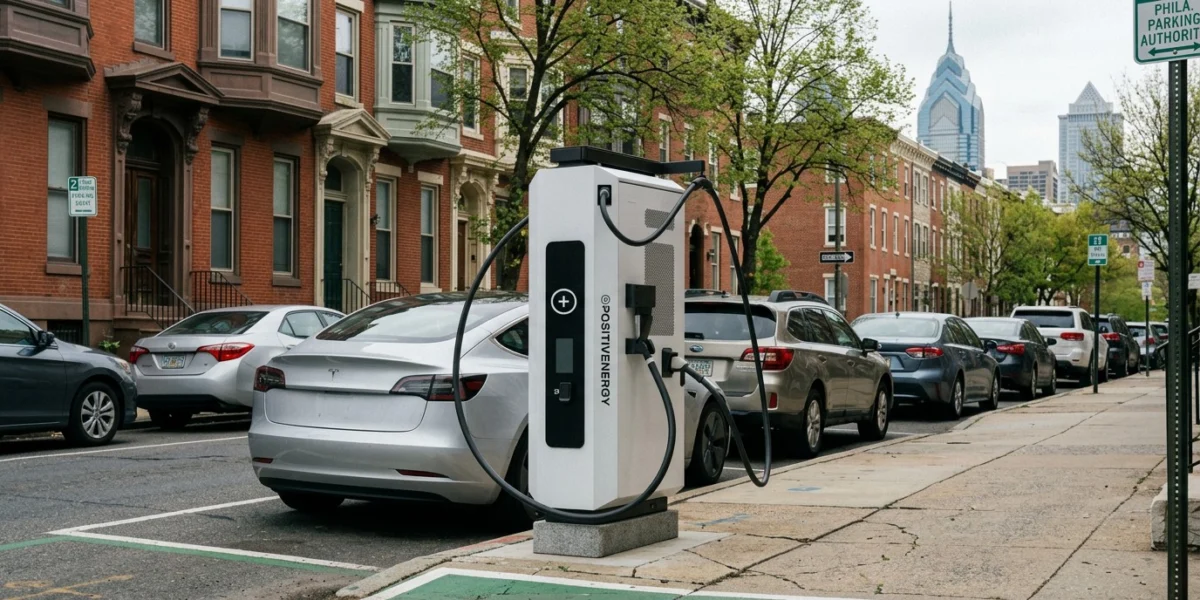
At the same time, high-speed DC fast charging is not being overlooked. PositivEnergy has been awarded $7.2 million to install 54 DC fast-charging ports distributed across 11 Philadelphia Parking Authority (PPA) lots, drastically cutting down wait times for drivers needing a rapid battery replenishment. Additionally, Tesla has secured two separate awards of $392,000 each to build eight-port fast-charging stations at a Royal Farms in Broomall and a Wawa in Plymouth Meeting, further weaving EV infrastructure into everyday convenience retail locations.
The Evolution of the National Electric Vehicle Infrastructure Program
The financial backing for these projects originates from the federal National Electric Vehicle Infrastructure (NEVI) program, a cornerstone of the Bipartisan Infrastructure Law enacted by the Biden administration. Pennsylvania’s total five-year allocation under the NEVI program stands at an impressive $171.5 million, designed to systematically overhaul the commonwealth’s charging landscape.
In its initial phase, the NEVI program maintained a strict focus on establishing rapid-charging corridors along designated interstate highways to facilitate long-distance travel and eliminate range anxiety. However, federal guidelines permit states to pivot toward broader community-based charging programs once the Federal Highway Administration (FHWA) officially certifies that their corridor requirements have been entirely satisfied. Pennsylvania achieved this crucial certification milestone on September 22, 2025.
Since then, the commonwealth has emerged as a national leader in execution speed. Pennsylvania has already successfully operationalized 54 EV charging stations utilizing NEVI funds—a figure that represents more than double the output of any other U.S. state to date.
PennDOT’s community charging program enforces rigorous technical standards for projects receiving state-administered federal funds. Published program minimum requirements mandate that every proposed station must feature at least four individual ports, deliver a minimum power output of 6 kW per port, and incorporate at least two ADA-compliant parking spaces. Furthermore, all ports must utilize standard J1772 or CCS connectors, and the underlying equipment must strictly comply with federal "Buy America" manufacturing guidelines.

A Phased Rollout Across the Commonwealth
The $37 million investment in southeastern Pennsylvania represents just one chapter of a much broader statewide community charging initiative valued at approximately $100 million. PennDOT’s current round encompasses 71 distinct awards in the Philadelphia metropolitan area, but the department’s geographic rollout is moving methodically across the state.
While applications for the western region of Pennsylvania closed on November 20, communities in central and eastern Pennsylvania have until March 12, 2027, to submit their funding proposals. For the recently announced southeastern projects, PennDOT has outlined a structured administrative timeline. Environmental reviews are scheduled to take place between November 2026 and January 2027, paving the way for official agreement executions in January and February.
Despite these administrative victories, motorists in the region will need to exercise patience. Following agreement execution, the awarded companies must still complete comprehensive engineering designs, secure local permits, undergo physical construction, and complete utility commissioning before these charging ports are officially cleared for public use.
Broader Economic and Environmental Implications
The rapid expansion of electric vehicle infrastructure in Pennsylvania carries profound economic and environmental implications. From an environmental standpoint, transportation remains one of the largest contributors to greenhouse gas emissions in the United States. By dramatically lowering the barriers to EV adoption in dense urban neighborhoods—where vehicle ownership is high and tailpipe emissions heavily impact local air quality—this funding initiative directly targets urban pollution reduction and public health improvement.

Economically, the deployment of hundreds of charging ports stimulates local engineering, construction, and electrical contracting sectors. It also positions Pennsylvania as an attractive market for major automotive manufacturers and rideshare fleets looking to transition entirely to electric vehicles. As charging deserts disappear and reliability increases, consumer confidence in EV technology is expected to rise correspondingly, creating a positive feedback loop that accelerates clean energy adoption.
Industry analysts note that programs like NEVI are critical not just for individual vehicle owners, but for regional grid modernization. As utilities work alongside charging network operators, smart charging technologies and localized battery storage solutions will increasingly be integrated to manage peak electrical loads, ensuring that the surge in EV adoption strengthens rather than strains the local power grid.
As Pennsylvania moves forward with its remaining regional funding rounds, the commonwealth serves as a prominent national case study in how federal infrastructure dollars can be effectively translated into localized, equitable, and highly functional clean-energy solutions.