







The landscape of the mobile computing market has experienced a seismic shift with the official unveiling of Intel’s 11th Generation Core H-series processors, codenamed Tiger Lake-H. For several years, Advanced Micro Devices (AMD) has enjoyed an unyielding period of domination in the laptop ecosystem, driven by the exceptional performance and power efficiency of its Ryzen Mobile 4000 and 5000 series architectures. While Intel maintained a firm grip on desktop gaming sectors through incremental refreshes, its laptop lineup struggled to compete with the multi-threaded prowess and thermal efficiency of AMD’s offerings. However, the introduction of the 11th Gen H-series marks a concerted effort by Team Blue to reclaim market share, leveraging a completely overhauled architecture, cutting-edge manufacturing processes, and advanced platform capabilities designed to challenge Ryzen’s supremacy head-on.
The Current Competitive Landscape and Market Dynamics
To understand the significance of the 11th Gen H-series rollout, one must examine the state of the semiconductor industry over the preceding years. Intel’s previous-generation Comet Lake mobile processors labored under the weight of an aging 14nm manufacturing node, continually outclassed by AMD’s Ryzen Mobile architectures. The primary factor preventing AMD from achieving absolute market monopoly was not architectural superiority alone, but persistent supply chain constraints and manufacturing capacity limitations at Taiwan Semiconductor Manufacturing Company (TSMC). These global shortages made acquiring a Ryzen-powered gaming laptop remarkably difficult for consumers.
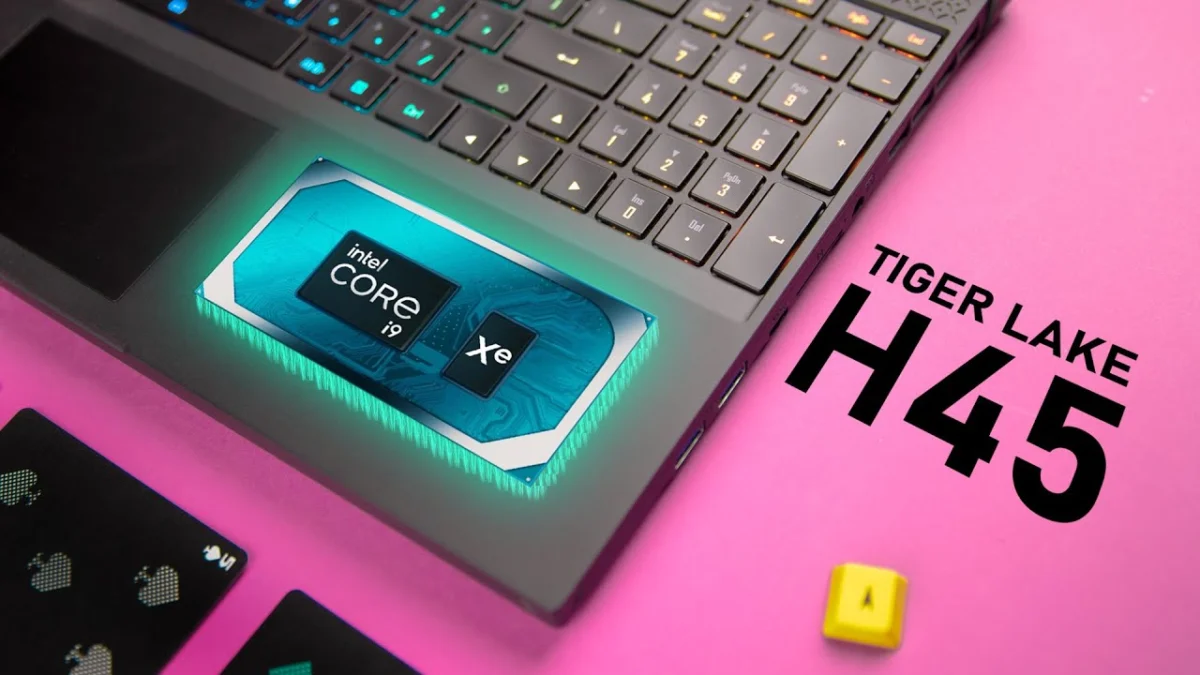
Intel has recognized this window of vulnerability. By deploying the new Tiger Lake-H architecture, the company aims to flood the market with high-performance silicon before AMD can fully resolve its supply deficits and achieve widespread distribution of its Ryzen 5000 chips. Unlike the ultra-low-power Tiger Lake variants found in thin-and-light ultrabooks, or the transitional H35 series released earlier in the year, the H45 lineup scales up to eight cores and sixteen threads, bringing desktop-grade performance metrics into portable form factors.
Architectural Evolution: Moving to 10nm SuperFin
The core engineering breakthrough behind the 11th Gen H-series lies in its departure from the iterated 14nm process node. Tiger Lake utilizes Intel’s advanced 10nm SuperFin manufacturing process, paired with the entirely new Willow Cove microarchitecture and integrated Intel Xe graphics. This transition represents a comprehensive top-to-bottom redesign rather than a simple silicon refresh.
Independent testing of early Tiger Lake implementations has demonstrated notable improvements in lightly threaded tasks, integrated graphics rendering, and overall power efficiency. During the Consumer Electronics Show (CES) earlier in the year, Intel provided initial previews of the platform by emphasizing three key hardware milestones: sustained 5GHz boost clocks, configurations scaling up to 8 cores, and native support for 20 lanes of PCIe Gen4 connectivity. The final production silicon successfully delivers on each of these performance metrics, establishing a formidable technical baseline for OEM laptop designers.

Comprehensive Lineup of the 11th Gen Core H-Series
The newly released 11th Generation Core H-series portfolio is segmented into 45-watt processors, featuring configurations of six cores with twelve threads, and eight cores with sixteen threads. The flagship offering, the unlocked Core i9-11980HK, can be configured by manufacturers up to 65 watts, delivering a maximum boost frequency of 5.0 GHz across two cores and 4.5 GHz across all eight active cores. On paper, these specifications approach the performance thresholds of Intel’s desktop-class Rocket Lake i7-11700K processors, which typically require a Thermal Design Power (TDP) exceeding 125 watts. As an unlocked processor, the i9-11980HK supports manual overclocking via Intel’s Extreme Tuning Utility (XTU) as well as automated tuning through the Speed Optimizer feature.
Positioned below the flagship are the Core i9-11900H and the Core i7-11800H, both utilizing an 8-core, 16-thread layout. Industry analysts view the i7-11800H as a potential pricing and performance sweet spot for mainstream gaming laptops, trailing the flagship HK model by a mere seven to nine percent in generalized workloads. Across all three eight-core Tiger Lake variants, Intel has integrated 24 megabytes of L3 cache—surpassing the cache allocation found in comparable desktop Rocket Lake processors. Furthermore, native memory support has been upgraded from DDR4-2933 to DDR4-3200, enhancing memory bandwidth out of the box.
For the mid-tier segment, Intel offers two six-core, 12-thread Core i5 processors. While maintaining robust clock speeds, these mid-range chips feature a reduced L3 cache of 12 megabytes to differentiate them from the premium eight-core offerings. Despite possessing integrated graphics with only 32 Execution Units (EUs)—scaled down from the 96 EUs found in lower-power Tiger Lake silicon—these processors are expected to be paired almost exclusively with high-performance discrete graphics cards in modern gaming notebooks.
Platform Innovation: PCIe Gen4 and Advanced Connectivity
Beyond the central processing units, the supporting platform architecture introduces significant upgrades over previous generations. Intel has integrated a complete PCIe Gen4 architecture into the mobile platform, allocating eight dedicated lanes for discrete graphics and reserving an additional twelve lanes for high-speed NVMe storage configurations, including RAID setups. This stands in contrast to competing mobile platforms, which have historically restricted storage and graphics lanes to PCIe Gen3 specifications to manage thermal outputs and power consumption.
The inclusion of twenty PCIe Gen4 lanes from the CPU opens up advanced storage capabilities, such as multi-drive RAID arrays capable of leveraging Microsoft Direct Storage APIs. This technology is engineered to reduce CPU overhead during complex input/output requests common in modern video games. Additionally, the Platform Controller Hub (PCH) provides 24 PCIe Gen3 lanes, bringing the platform total to 44 PCIe lanes for expansive peripheral connectivity.
Intel reports that single-drive PCIe Gen4 SSD implementations on the new platform deliver up to an 80 percent increase in bandwidth and a 75 percent reduction in access latency compared to the preceding Comet Lake architecture. Connectivity features also include native support for Thunderbolt 4—offering 40Gbps bidirectional bandwidth capable of driving multiple high-resolution displays and facilitating system charging—alongside integrated Killer Wi-Fi 6E (IEEE 802.11ax), which unlocks access to the uncongested 6GHz radio frequency spectrum for reduced latency and higher throughput.

Comparative Performance and Market Implications
According to initial benchmarks provided by Intel, the new H-series processors demonstrate competitive performance advantages over previous-generation hardware and competing Ryzen 5000 Mobile processors. In comparative evaluations, the flagship Core i9-11980HK paired with an NVIDIA GeForce RTX 3080 Mobile GPU outperformed comparable Ryzen 9 5900HX systems, even when operating at a lower nominal GPU TGP (Total Graphics Power). Similarly, the mid-tier Core i5-11400H demonstrated performance parity with higher-tier Ryzen 9 5900HS configurations in select gaming scenarios, despite featuring fewer physical cores and being paired with a lower-wattage RTX 3060 graphics processor.
In content creation and professional productivity workloads, Intel highlights generation-over-generation gains across multi-threaded applications, though independent verification will determine how these figures translate against AMD’s established multi-core efficiencies in real-world environments.
Conclusion and Outlook for Consumers
The ultimate market viability of the Intel 11th Generation Core H-series will depend heavily on three critical factors: retail pricing, industrial design implementation by original equipment manufacturers (OEMs), and supply chain availability. With Ryzen Mobile establishing a strong reputation for performance and thermal efficiency, OEMs cannot rely solely on historical brand preference to justify premium pricing for Intel-based systems.
If Intel successfully collaborates with hardware partners to deliver well-cooled, ergonomically sound chassis designs while maintaining a steady volume of silicon distribution ahead of seasonal retail cycles, the company is well-positioned to challenge AMD’s mobile dominance. For the broader consumer electronics market, this renewed competition promises accelerated technological innovation, broader feature sets, and balanced pricing dynamics across the gaming laptop sector.