The Internationale Funkausstellung Berlin, better known as IFA 2026, served as the global stage for Epomaker to unveil a sophisticated new suite of mechanical keyboards and gaming peripherals. As the industry shifts away from simple aesthetic customization toward functional integration, Epomaker’s latest lineup—highlighted by the HE75 V2 TMR and the retro-styled Glyph—demonstrates a clear pivot toward high-performance technical engineering and modular adaptability. This evolution in peripheral design reflects a broader trend within the PC gaming sector, where enthusiasts increasingly demand hardware that bridges the gap between professional-grade performance and ergonomic utility.
The Evolution of Keyboard Technology at IFA 2026
IFA remains one of the world’s most significant trade shows for consumer electronics, providing a snapshot of the technological landscape for the remainder of the year and into the next. For the peripheral market, the 2026 iteration of the event highlighted a departure from the "RGB-first" design philosophy that dominated the early 2020s. Manufacturers are now prioritizing tactile feedback, latency reduction, and structural innovation.
Epomaker, a brand that has gained significant market share by catering to both the hobbyist custom-keyboard community and mainstream gamers, utilized its booth to showcase four distinct models: the TH108 Pro, the RT98, the HE75 V2 TMR, and the Glyph. Each device represents a specific segment of the current market, ranging from high-capacity wireless productivity tools to ultra-low-latency competitive gaming hardware.
The HE75 V2 TMR: A Leap in Magnetic Sensing
The most technically significant announcement at the booth was the HE75 V2 TMR. Priced at $129, this keyboard marks a transition in how gaming hardware detects keystrokes. While the industry has widely adopted Hall Effect (HE) sensors for rapid trigger functionality, Epomaker has integrated Tunneling Magnetoresistance (TMR) technology.
TMR sensing offers several distinct advantages over traditional magnetic switches, most notably in power efficiency and sensitivity. By utilizing the quantum mechanical effect of tunneling, these sensors require significantly less power to operate, which is a critical factor for wireless gaming peripherals. The HE75 V2 TMR features a 0.01mm actuation adjustment capability and an 8,000Hz polling rate. The latter is becoming the gold standard for high-performance peripherals, as it drastically reduces input lag—a necessity for competitive titles where millisecond differences determine the outcome of a match.
Furthermore, the board offers a unique hybrid switch compatibility, allowing users to swap between magnetic and standard mechanical switches. This level of flexibility is rarely seen in the gaming keyboard market, where boards are typically locked into a specific sensor architecture. This design choice implies that Epomaker is targeting the "prosumer" segment—users who want the performance of a gaming board but the switch-feel versatility of a custom mechanical keyboard.
Modular Utility: The RT98 and TH108 Pro
While the HE75 V2 TMR focuses on speed, the RT98 and TH108 Pro emphasize productivity and workspace optimization. The RT98, which launched earlier this year in April, features a modular numeric keypad that can be attached to either the left or right side of the main chassis. This "southpaw" configuration is highly sought after by CAD designers and data entry professionals who prefer to keep their mouse and numpad on opposite sides to minimize shoulder strain.
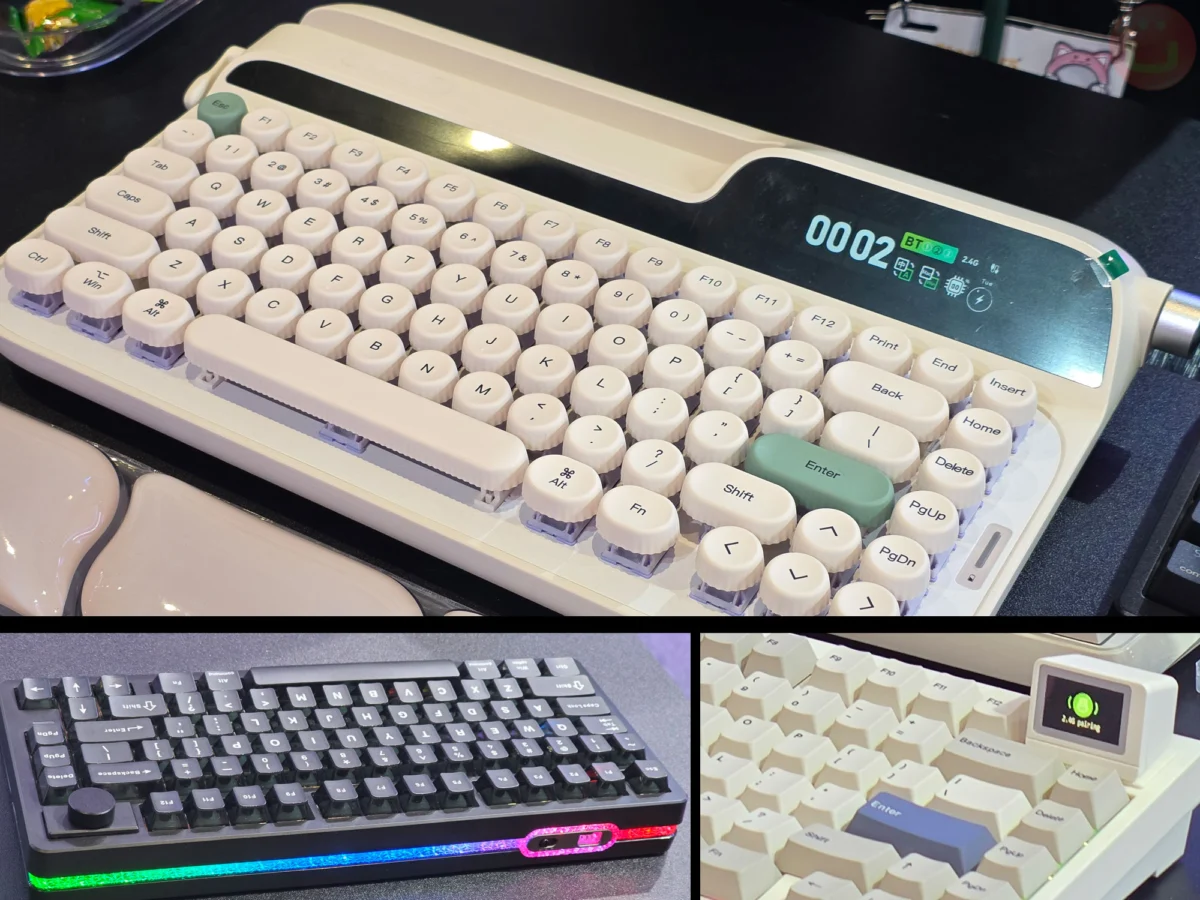
The RT98’s inclusion of a vintage-style magnetic display—modeled after a classic television aesthetic—serves as more than a cosmetic choice; it functions as a diagnostic tool for system monitoring. Capable of displaying CPU temperatures, system utilization, or user-defined animations, this feature highlights the increasing desire for "at-a-glance" hardware information. With an 8,000mAh battery and VIA support—the industry-standard open-source firmware for key remapping—the RT98 positions itself as a $119 mid-range workhorse.
The TH108 Pro, which debuted in early 2026, remains the flagship of the "conventional" layout. Despite its traditional full-size form factor, it incorporates a TFT display and a multifunction rotary knob. The inclusion of a 10,000mAh battery is notable, as it represents a significant increase in power density for a device that must also power vibrant RGB lighting and an active display.
Design Language and The Glyph
Perhaps the most visually distinct keyboard in the lineup is the Glyph, a $139 unit that pays homage to the typewriter era of the mid-20th century. By incorporating round PBT keycaps and a side-mounted mechanical lever that serves as a remappable input (traditionally mapped to Enter or Backspace), the Glyph appeals to the growing segment of users who prioritize desk aesthetics alongside performance.
The functional integration of a recessed slot for tablets or smartphones demonstrates a practical approach to modern desk organization. By mimicking the paper-holder mechanism of a manual typewriter, the Glyph allows users to maintain a secondary screen at eye level without the need for additional desk-cluttering stands. This design convergence of retro-inspiration and modern utility underscores the industry’s move toward "lifestyle" peripherals that serve as centerpieces for home office setups.
Expanding the Ecosystem: Mice and Headsets
Epomaker’s strategy at IFA 2026 was not limited to keyboards. The company demonstrated a concerted effort to expand its peripheral ecosystem. The introduction of the Carbon X, a lightweight carbon-fiber gaming mouse, signals an entry into the ultra-lightweight market, where structural rigidity is balanced against mass reduction.
Additionally, the GX1 gaming headset represents the company’s first foray into audio hardware. By choosing an open-back design, Epomaker is intentionally catering to audiophiles and gamers who prioritize a "wide" soundstage—a hallmark of open-back headphones that allows for better spatial awareness in competitive gaming. This expansion indicates that the company is aiming to become a "one-stop shop" for desktop setups, leveraging its brand loyalty from the keyboard market to secure a foothold in the audio and pointing-device sectors.
Market Implications and Future Outlook
The developments presented by Epomaker at IFA 2026 reflect a broader consolidation in the peripheral industry. As the market reaches a saturation point for basic mechanical keyboards, the competitive advantage has shifted to proprietary sensor technology (like TMR) and physical modularity.
Industry analysts suggest that the integration of higher-capacity batteries and specialized displays is a response to the "desk-setup" culture prevalent on social media platforms. Users no longer treat their peripherals as isolated tools but as integrated components of a broader workstation aesthetic. The transition to TMR sensors, in particular, could set a new benchmark for wireless gaming. If TMR technology proves to be as energy-efficient and precise as claimed, it is highly probable that other major manufacturers will follow suit, potentially rendering traditional optical and mechanical switches obsolete in the high-end gaming tier.
Furthermore, the emphasis on VIA support across the board suggests that consumers are moving away from proprietary, locked-down software suites. By enabling users to customize their hardware at the firmware level, Epomaker is aligning itself with the expectations of the modern power user.
As 2026 progresses, the impact of these technologies will likely be measured by how quickly they move from trade show prototypes to widespread consumer adoption. With its combination of experimental design and high-end sensing technology, Epomaker has established a clear roadmap for the next generation of PC peripherals, balancing the technical demands of gamers with the aesthetic and functional requirements of the modern workspace. The company’s performance at IFA 2026 provides a compelling look at a future where the mechanical keyboard is not just an input device, but a central, intelligent hub for the entire computing experience.