









The emergence of generative artificial intelligence has fundamentally altered the landscape of professional photography, presenting a profound dilemma for wedding photographers who find themselves balancing technical efficiency against the imperative of historical truth. As couples review their wedding galleries, they are increasingly confronted with images that occupy a blurry space between reality and digital reconstruction. While modern tools can eliminate distracting exit signs or balance complex lighting scenarios in seconds, these same capabilities enable the seamless insertion of people who were never present or the creation of atmospheric conditions that never occurred. This technological shift has transformed the central challenge for photographers from mastering software to discerning the precise moment an edit ceases to be a corrective measure and begins to function as a narrative distortion.
The Evolution of the Digital Workflow
The integration of artificial intelligence into the professional creative workflow is no longer a speculative trend but an industry standard. According to Adobe’s 2026 Creators’ Toolkit Report, which surveyed over 16,000 creative professionals across eight international markets, 75% of respondents now classify AI as either an integrated or essential component of their daily production. While this figure represents a broad spectrum of digital media, the wedding photography sector has mirrored this rapid adoption.
The benefits are objectively significant. Historically, tasks such as local masking—the process of isolating specific areas of a photograph for targeted adjustments—required painstaking labor. Today, AI-powered masking allows for the isolation of fabric textures, complex architectural backgrounds, or human subjects in mere seconds. Similarly, automated exposure balancing has mitigated the challenges of moving between dark, candlelit ceremony venues and high-contrast, sunlit reception spaces. In these instances, AI serves as an extension of the traditional darkroom, allowing photographers to focus on delivery speed without fundamentally altering the factual content of the scene.
Defining the Boundary of Modification
The ethical pivot point rests on the distinction between corrective retouching and generative fabrication. Industry practitioners generally categorize the removal of temporary blemishes, the cleaning of background clutter, or the softening of skin textures as standard post-production. These actions are consistent with the long-standing tradition of photographic printing, where a photographer might burn or dodge an image to guide the viewer’s eye.
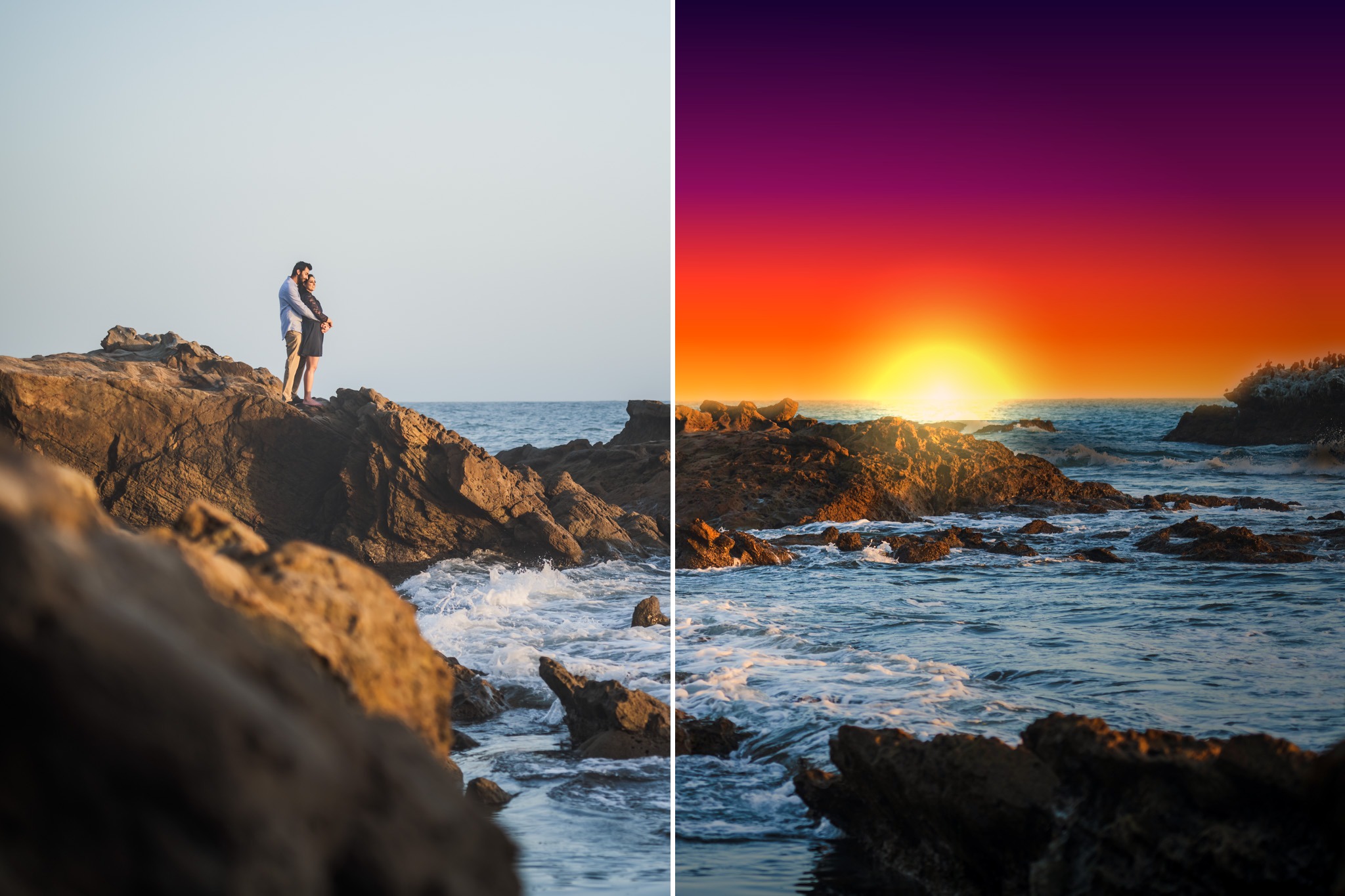
However, the introduction of generative AI—the capacity to create new pixels based on existing patterns—has introduced a new category of risk. For example, applying a “warm sunset” filter to a photograph taken under overcast skies is an aesthetic choice that many couples welcome as an artistic enhancement. The ethical complexity arises when that technology is used to manipulate the guest list or the environmental context. Inserting an absent family member into a group portrait or adding synthetic confetti to a scene where no such celebration occurred fundamentally alters the historical record. When a photographer manufactures a moment that did not take place, the image transitions from a documentary record to a work of fiction.
Professional Standards and Industry Regulation
The professional community has begun to establish formal boundaries to protect the integrity of the medium. The Professional Photographers of America (PPA), through its International Photographic Competition, has adopted a stringent stance against the use of generative AI. The PPA guidelines explicitly prohibit the use of generative content, whether whole or partial, in submitted works. The organization reserves the right to disqualify any entry or reclassify it if it suspects that the technical integrity of the image has been compromised by AI-generated elements.
Other prestigious international photography competitions have followed suit, often requiring participants to submit original raw camera files as a condition of entry. These regulations are not merely bureaucratic hurdles; they are defensive measures intended to preserve the status of photography as a credible witness to history. While these rules govern competitive arenas rather than client deliverables, they serve as a bellwether for the professional standards that clients may soon demand. As the public becomes more aware of the capabilities of generative AI, the value of “authentic” imagery—verified by raw file metadata and a transparent editing process—is likely to increase.
The Challenge of Verification and Metadata
As the potential for digital fabrication grows, the search for reliable verification tools has become a focal point for the industry. Currently, there is no infallible method for detecting AI-generated content. While various software-based detectors exist, they are prone to high error rates and cannot distinguish between a real flower arrangement and a generated one, or verify the presence of a specific guest. Furthermore, common digital practices, such as resizing files for social media or stripping metadata for web optimization, often destroy the very information that could provide proof of authenticity.
The industry is looking toward more robust solutions, such as Adobe’s Content Credentials and the C2PA (Coalition for Content Provenance and Authenticity) standard. These systems are designed to attach a verifiable history to a file, logging editing steps and identifying AI involvement. However, these tools are not yet universal. For the foreseeable future, the most reliable insurance against accusations of misrepresentation remains the preservation of original RAW files and a detailed, documented record of the editing process. A clean score from an AI-detection algorithm provides little security in a dispute; original data remains the only definitive evidence.

Establishing Client Expectations Through Contractual Clarity
To prevent future conflicts, professional photographers are increasingly incorporating explicit language into their contracts regarding AI usage. By clearly defining what constitutes “retouching” and where the limits of digital manipulation lie, photographers can align expectations with their clients before the wedding day. This proactive approach serves as a form of professional liability protection, ensuring that both parties agree on the final vision.
A recommended framework for modern wedding photography contracts includes:
- Documentary Integrity: A clear commitment that all documentary coverage (ceremony, candid moments) will rely on original captures, with only standard adjustments to color, contrast, and exposure.
- Permissible Retouching: A list of approved enhancements, such as blemish removal, object removal (e.g., exit signs), and hair/clothing adjustments.
- Creative Composites: A separate clause allowing for generative AI or artistic compositing, provided it is limited to creative portrait sessions and explicitly agreed upon by the couple.
- Data Disclosure: A clause stating that the photographer will maintain and provide access to original RAW files upon request to verify the authenticity of the delivered images.
The Broader Implications for the Industry
Despite the rise of synthetic media, the fundamental demand for wedding photography remains rooted in the human experience. According to the 2026 Real Weddings Study conducted by The Knot, 88% of couples still prioritize hiring a professional photographer to document their nuptials. This statistic confirms that while couples value high-quality visuals, they are primarily hiring a professional to provide a reliable, emotional, and authentic record of their celebration.
The shift toward AI-assisted editing is not inherently detrimental to the industry, but it necessitates a new level of professional transparency. The challenge for the modern wedding photographer is to integrate these powerful new tools into their workflow while maintaining the trust of their clients. If the industry leans too far into the fabrication of moments, it risks undermining the very value proposition of the profession: that the photographer was there to see, record, and preserve the reality of the event.
In conclusion, the future of wedding photography lies in a judicious middle ground. Photographers must leverage AI to improve efficiency and visual quality, but they must do so within the bounds of a professional code of ethics that prioritizes the truth. As the technology continues to evolve, the most successful photographers will likely be those who can demonstrate that their work is not merely a collection of digital illusions, but a faithful representation of a real, lived human moment. By establishing clear boundaries, embracing transparency, and maintaining rigorous standards for their digital assets, professionals can ensure that their work remains a trusted record for generations to come.