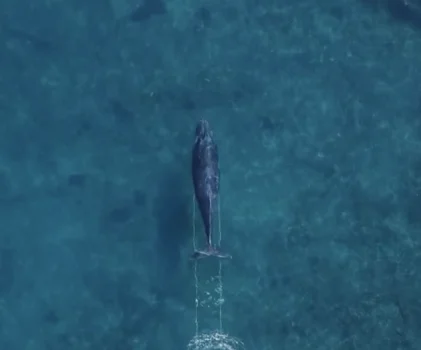
The first two weeks of July painted a distressing picture across both sides of the Pacific Ocean, as multiple humpback whales were sighted trailing significant lengths of fishing line. Rescue teams, including specialized marine animal response units and conservation organizations, mobilized with urgency to aid these entangled leviathans. While some fortunate individuals were successfully freed, others vanished into the vast ocean before responders could reach them, and tragically, at least one whale succumbed to its predicament. This surge in entanglement incidents has reignited concerns about the pervasive threat of marine debris to cetacean populations worldwide.
A Grim Cluster Off Western Australia
The most concentrated cluster of entanglements was reported in the renowned Ningaloo Marine Park in Western Australia, a region typically celebrated for its abundant whale shark encounters. Between July 5 and July 10, the Department of Biodiversity, Conservation and Attractions (DBCA) in Western Australia received an alarming number of reports detailing entangled humpback whales along the Ningaloo coast, with some sightings potentially referring to the same animal.
One particularly harrowing case unfolded on July 8, when responders located a nine-meter humpback whale in a critical state. The department described the animal as "emaciated and heavily embedded in entanglement." In a desperate attempt to track its movements and potentially facilitate future intervention, a satellite tag was affixed before nightfall. However, despite the planned follow-up the next morning, the whale perished overnight. Its carcass subsequently washed ashore on the reef at Mandu, attracting predatory sharks and necessitating the closure of two local beaches due to safety concerns.
The Elusive Source of Entangling Gear
The persistent presence of fishing line on these whales points to a significant, yet often unidentifiable, source: commercial fishing gear. Brinkley Davies, representing the Balu Blue Foundation, articulated the prevailing uncertainty to ABC News, stating, "We’re seeing a lot of rope consistent with commercial fishing gear like crab and cray pots, and there’s a lot of uncertainty as to where they’re coming from and why there’s more this year."
This ambiguity poses a substantial challenge to rescue efforts. An entangled humpback whale is capable of covering tens of kilometers in a single day, meaning a whale reported in one location during the evening could be hundreds of miles offshore and irretrievable by the following morning. The Balu Blue Foundation operates a wildlife rescue hotline in the affected region, relying heavily on the vigilance of ocean users to report sightings and provide crucial information. This collaborative approach is vital in attempting to locate and assist these animals in distress.
A Pacific-Wide Crisis
The Ningaloo incidents were not isolated. On July 4, a humpback whale encountered off the Gold Coast became ensnared in a shark-control net. A complex, four-hour operation was required to free the animal, with the Queensland Fisheries’ Marine Animal Release Team and Sea World Foundation rescuers successfully completing the disentanglement the following day.
New South Wales also reported an uptick in entangled humpbacks during their annual migration period. Across the vast expanse of the Pacific, off the coast of British Columbia, a well-known humpback whale, affectionately nicknamed "Pop Tart," was observed trailing hundreds of meters of line for nearly a week. Whale watchers first alerted authorities to its distressed condition on July 2. However, adverse weather conditions hampered immediate rescue efforts. The Pacific Whale Watch Association’s response network was only able to confirm the whale’s successful release on July 10. During this same period, the Hawaiian Islands Humpback Whale National Marine Sanctuary announced that its teams had managed to free two additional humpback whales from life-threatening entanglements.
The Critical Role of Public Reporting
In the face of this escalating crisis, marine mammal rescuers consistently emphasize the paramount importance of public assistance. The single most impactful action a bystander can take is to report sightings rapidly and provide detailed documentation, rather than attempting a rescue themselves.
In Western Australia, for instance, only trained and authorized responders are legally permitted to undertake disentanglement operations. The DBCA sternly warns that a well-intentioned but untrained intervention can not only be dangerous to the rescuer and the animal but can also critically delay a professional rescue effort.
The Balu Blue Foundation’s request is precise and actionable: if an animal is spotted dragging fishing line, buoys, or floats, or exhibiting unusual behavior, individuals should capture clear video or photographic evidence, record the GPS coordinates of the sighting, note the whale’s direction of travel, and alert the relevant authorities without delay. In U.S. waters, the National Oceanic and Atmospheric Administration (NOAA) echoes this guidance. NOAA further specifies that photos or videos captured from a safe, legal distance – exceeding 100 yards for humpback whales – provide response teams with invaluable, actionable intelligence.
Data Collection: More Than Just Pictures
The images and videos captured by the public are far more than mere visual records; they are critical tools for effective marine mammal rescue. These visual records can help identify individual whales, providing valuable data on their health and migration patterns. Crucially, they illustrate precisely how the entangling gear is wrapped around the animal, allowing responders to assess the severity of the situation and plan the safest and most effective disentanglement strategy. Furthermore, documentation can aid in tracking a whale that might otherwise disappear into the vastness of the ocean.
A Global Threat: Bycatch and Entanglement Statistics
The entanglement of humpback whales is a symptom of a much larger, systemic problem: bycatch and marine debris. The International Whaling Commission (IWC) estimates that over 300,000 whales and dolphins perish annually due to entanglement in fishing gear and other forms of bycatch. Humpback whales, with their distinctive long pectoral fins and their tendency to frequent coastal waters, are particularly vulnerable to these threats, often finding themselves in the path of active or discarded fishing equipment.
The cyclical nature of this tragedy is exemplified by the case of "Starry Knight," a humpback whale in the Salish Sea. This individual was freed from a life-threatening entanglement in July, only to be found snagged again in a nearly identical location weeks later. The new entanglement dug into wounds that had not yet fully healed, underscoring the persistent danger these animals face.
The Call to Action
When observing a whale trailing fishing rope, the importance of meticulous documentation cannot be overstated. Capturing clear images or videos of the wraps, any attached floats or buoys, and the direction the animal is traveling is essential. Recording the precise coordinates of the sighting and making an immediate report to the appropriate authorities can significantly increase the chances of a successful rescue. Each photograph, each video, each accurate report, may be the critical piece of information that enables responders to locate and save a whale in distress. The ongoing incidents of entanglement serve as a stark reminder of the urgent need for stronger regulations, improved fishing practices, and increased global efforts to mitigate marine pollution and protect these magnificent creatures. The future of whale populations depends on a concerted, global response to this pervasive and deadly threat.