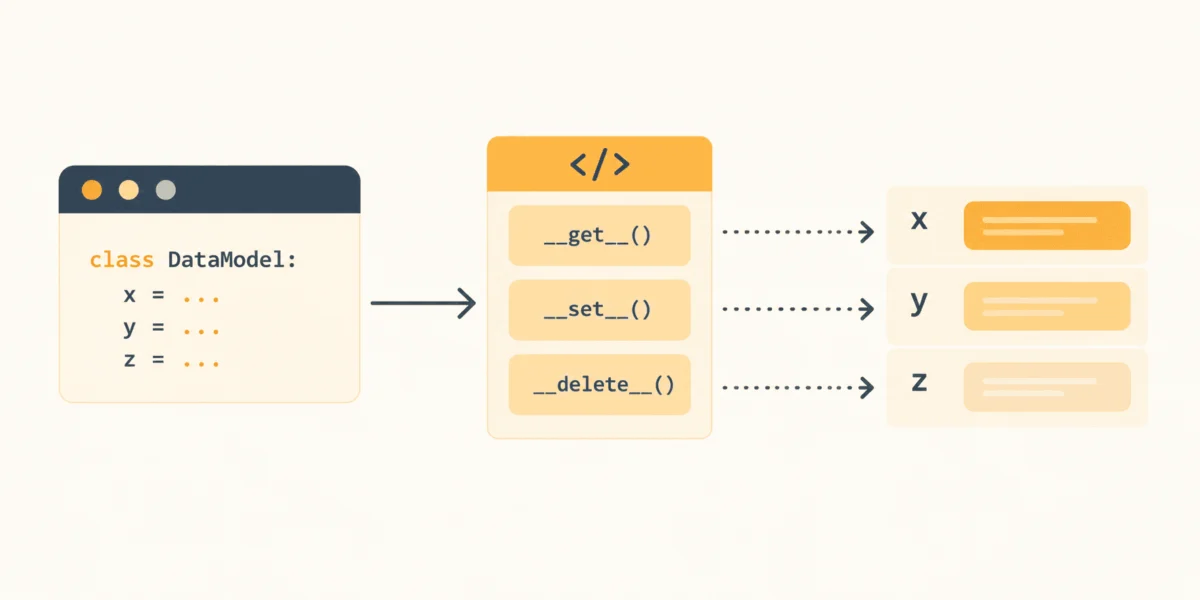
In the realm of advanced software engineering, managing how object attributes are accessed, modified, and initialized remains a foundational pillar of clean architecture. Within the Python ecosystem, this capability is primarily governed by a low-level mechanism known as descriptors. While many developers rely on standard property decorators or boilerplate getter and setter methods to control class attributes, enterprise-grade applications frequently demand a more modular, reusable, and DRY (Don’t Repeat Yourself) approach. By implementing the descriptor protocol—specifically utilizing special methods such as __get__, __set__, __delete__, and the Python 3.6-introduced __set_name__—developers can construct sophisticated class-level attributes that seamlessly handle data validation, dynamic computation, and deferred resource loading.
To understand the practical implications of this architectural pattern, industry engineers often look toward domain-specific simulations. A prime illustration involves a fictitious enterprise Japan tourism application tasked with processing massive volumes of traveler itineraries, multi-currency financial records, and user feedback metrics. Through this case study, software architects can observe how custom descriptors eliminate code clutter, enforce strict data integrity, and optimize memory management without sacrificing readability or performance.
Understanding the Mechanics of the Descriptor Protocol
At its core, a descriptor is any object defined as a class that implements at least one method of the descriptor protocol: __get__(self, instance, owner), __set__(self, instance, value), or __delete__(self, instance). When an attribute is accessed on an instance of a class, Python’s attribute lookup chain checks the instance’s dictionary (__dict__), then the class dictionary, and finally searches through base classes. If the object found in the class dictionary is a descriptor, Python intercepts the standard lookup and invokes the appropriate descriptor method.
The introduction of __set_name__(self, owner, name) in Python 3.6 significantly streamlined descriptor design. Prior to this enhancement, developers were forced to explicitly pass string identifiers when instantiating descriptors (e.g., rating = ValidatedRating('rating')). With __set_name__, the interpreter automatically informs the descriptor of the variable name assigned to it within the owner class at the time of class creation. This automated introspection prevents namespace collisions, simplifies syntax, and allows developers to maintain clean, declarative class definitions.
Engineering Validated Attributes for Data Integrity
Data corruption and invalid input remain primary vectors for runtime application failures. In enterprise applications handling transactional data, ensuring that attributes meet strict type and boundary requirements at the moment of assignment is paramount. Standard Python classes often require repetitive conditional checks inside the __init__ constructor or separate property setters across multiple models, leading to bloated codebases.
To solve this, developers can encapsulate validation logic inside a dedicated descriptor class. Consider a tourism feedback system where user ratings must strictly adhere to numerical boundaries—typically between 1.0 and 5.0.
class ValidatedRating:
    def __init__(self, min_val=1.0, max_val=5.0):
        self.min_val = min_val
        self.max_val = max_val

    def __set_name__(self, owner, name):
        self.public_name = name
        self.private_name = f"_name"

    def __get__(self, obj, objtype=None):
        if obj is None:
            return self
        return getattr(obj, self.private_name)

    def __set__(self, obj, value):
        if not isinstance(value, (int, float)):
            raise TypeError(f"self.public_name must be a number.")
        if not (self.min_val <= value <= self.max_val):
            raise ValueError(f"self.public_name must be between self.min_val and self.max_val.")
        setattr(obj, self.private_name, float(value))
By decoupling this validation rule into ValidatedRating, any class within the application can enforce rating constraints instantly by declaring the descriptor at the class level. When a developer or external API attempts to assign an out-of-range value—such as rating a Kyoto tour package with a 6.0—the __set__ method intercepts the assignment, immediately raising a ValueError before corrupted data can pollute the state.
Implementing Computed Attributes for Dynamic Transformations
Modern software architecture frequently requires attributes that are not stored statically in memory, but are instead derived dynamically from other instance states. In global applications, such as a travel portal operating across multiple currency zones, base prices may be recorded in Japanese Yen (JPY) for local accounting, while international customers require real-time conversion into US Dollars (USD).
While functions or standard properties can compute values on the fly, doing so via a computed attribute descriptor provides a clean, read-only interface that prevents accidental state overwrites.
class ComputedUSDPrice:
    def __init__(self, exchange_rate=0.0067):
        self.exchange_rate = exchange_rate

    def __set_name__(self, owner, name):
        self.name = name

    def __get__(self, obj, objtype=None):
        if obj is None:
            return self
        jpy_price = getattr(obj, 'price_jpy', 0)
        return round(jpy_price * self.exchange_rate, 2)

    def __set__(self, obj, value):
        raise AttributeError(f"self.name is a computed read-only attribute.")
When an application queries tour.price_usd, the __get__ method dynamically accesses the instance’s underlying price_jpy attribute, applies the current exchange rate, and returns the converted figure. Attempting to manually assign a value to price_usd triggers an explicit AttributeError, preserving data immutability and architectural integrity.
Optimizing Performance with Lazily Loaded Attributes
Performance optimization is a critical engineering concern, particularly when applications interact with high-latency resources such as external databases, cloud object storage, or complex JSON parsers. In a tourism itinerary planner, generating detailed daily schedules—complete with Shinkansen bullet train timetables, hotel check-in protocols, and guided excursion data—involves significant computational overhead.
If an application instantiates thousands of tour objects simultaneously, loading all itinerary data upfront would severely degrade memory efficiency and increase application startup times. To mitigate this, engineers utilize lazy loading descriptors.
import time

class LazyItinerary:
    def __set_name__(self, owner, name):
        self.name = name

    def __get__(self, obj, objtype=None):
        if obj is None:
            return self
        print(f"[System] Simulating expensive database query for obj.destination itinerary...")
        time.sleep(1) # Simulate network/database latency

        itinerary = (
            f"Day 1: Arrival in obj.destination, check-in.n"
            f"Day 2: Guided temple tour and local street food tasting.n"
            f"Day 3: Shinkansen departure."
        )

        # Cache it directly on the object's dictionary.
        obj.__dict__[self.name] = itinerary
        return itinerary
The underlying mechanism of a lazy descriptor relies on a clever optimization technique: upon the first access of tour.itinerary, the descriptor intercepts the call, simulates the expensive database query, constructs the payload, and explicitly injects the result directly into the instance’s __dict__ dictionary under the attribute name. On subsequent accesses, Python’s standard attribute lookup finds the key directly in the instance dictionary, bypassing the descriptor entirely and providing instant retrieval speeds.
Integrating Controlled Attributes in Enterprise Models
To observe how these three distinct design patterns function in harmony, software engineers assemble them within a unified model class. Within our simulated Japan tourism application, the JapanTour class serves as the central data structure integrating validation, computation, and lazy loading.
class JapanTour:
    rating = ValidatedRating(min_val=1.0, max_val=5.0)
    price_usd = ComputedUSDPrice()
    itinerary = LazyItinerary()

    def __init__(self, destination, price_jpy, rating):
        self.destination = destination
        self.price_jpy = price_jpy
        self.rating = rating # Triggers ValidatedRating.__set__
When a new tour instance is initialized for Kyoto with a base price of 45,000 JPY and a rating of 4.8, the constructor immediately invokes the descriptor protocol for any attribute defining a __set__ method.
# 1. Initializing the tour
tour = JapanTour(destination="Kyoto", price_jpy=45000, rating=4.8)

# 2. Testing the Validator
print(f"Destination: tour.destination")
print(f"Initial Rating: tour.rating")

try:
    tour.rating = 6.0
except ValueError as e:
    print(f"Validation caught error: e")
Executing this initialization block prints the verified destination and rating. When an erroneous assignment of 6.0 is attempted, the validation descriptor catches the transgression, outputting:
Destination: Kyoto
Initial Rating: 4.8
Validation caught error: rating must be between 1.0 and 5.0.
Similarly, testing the computed price conversion and the lazily loaded itinerary demonstrates the seamless integration of these paradigms:
# 3. Testing the Computed Property
print(f"Price (JPY): ¥tour.price_jpy")
print(f"Price (USD): $tour.price_usd")

# 4. Testing the Lazy Loader
print("n--- Requesting Itinerary (First Time) ---")
print(tour.itinerary)

print("n--- Requesting Itinerary (Second Time) ---")
print(tour.itinerary)
The execution output highlights the efficiency of the caching mechanism:
Price (JPY): ¥45000
Price (USD): $301.5

--- Requesting Itinerary (First Time) ---
[System] Simulating expensive database query for Kyoto itinerary...
Day 1: Arrival in Kyoto, check-in.
Day 2: Guided temple tour and local street food tasting.
Day 3: Shinkansen departure.

--- Requesting Itinerary (Second Time) ---
Day 1: Arrival in Kyoto, check-in.
Day 2: Guided temple tour and local street food tasting.
Day 3: Shinkansen departure.
Broader Implications and Architectural Analysis
The adoption of custom descriptors in production-grade Python applications offers profound implications for software maintainability, scalability, and code hygiene. By centralizing attribute behavior into reusable descriptor classes, development teams eliminate duplicate boilerplate code across multiple models, adhering strictly to enterprise engineering standards.
Furthermore, descriptors empower framework authors and senior developers to build declarative APIs that abstract complex logic away from business domain models. Whether managing database ORM field mappings, implementing reactive state changes, or securing application configuration boundaries, mastering descriptors transitions a developer from writing basic procedural scripts to engineering robust, scalable software architectures.