The rapid integration of autonomous artificial intelligence agents and Large Language Models (LLMs) into enterprise workflows has created an unintended economic side effect: surging operational expenditures driven by token bloat. As businesses deploy AI agents to execute complex, multi-step tasks—ranging from market research and competitor analysis to automated customer support and file retrieval—the underlying infrastructure demands continuous processing of vast quantities of unstructured and semi-structured data. Every query executed by an AI agent initiates a cascade of background processes, including recursive loops, file ingestion, and comprehensive log scanning. Within this architecture, the traditional data formats used to transmit information across the web have emerged as a primary driver of runaway compute costs.
At the heart of the issue is the inherent discrepancy between data designed for machine-to-machine application programming interfaces (APIs) and data optimized for neural network comprehension. Historically, JavaScript Object Notation (JSON) has served as the universal standard for web data exchange. However, JSON was engineered for programmatic parsing, relational databases, and graphical user interface (GUI) rendering, not for cognitive reasoning by deep learning models. Consequently, when an AI agent queries a search engine or retrieves database logs via standard JSON, it ingests thousands of tokens representing redundant keys, structural syntax, nested objects, tracking links, and deep metadata. Because commercial LLM providers charge clients on a per-token basis for both input and output, organizations find themselves bearing the financial burden of parsing hundreds of lines of code that the AI model ultimately ignores.
Recognizing this systemic inefficiency, infrastructure providers are beginning to pivot toward alternative data serialization formats. Notably, SerpApi, a prominent provider of search engine data APIs, has introduced native Markdown output capabilities designed to radically trim token sizes without sacrificing the core informational payload required by LLMs. This architectural shift highlights a broader industry movement toward payload optimization, prompting enterprise data engineers, machine learning operations (MLOps) teams, and Chief Technology Officers to reevaluate how information is shaped before it enters a model’s context window.
The Economic Reality of Token Bloat in Autonomous AI Agents
To understand the financial implications of token bloat, one must examine the mechanics of agentic AI systems. Unlike static chatbots that respond to a single prompt, autonomous agents operate iteratively. A user might issue a relatively straightforward command, such as "look up regional coffee shops and summarize their unique value propositions." To fulfill this request, the agent initiates an external search API call, retrieves a comprehensive list of results, and processes the accompanying documentation.
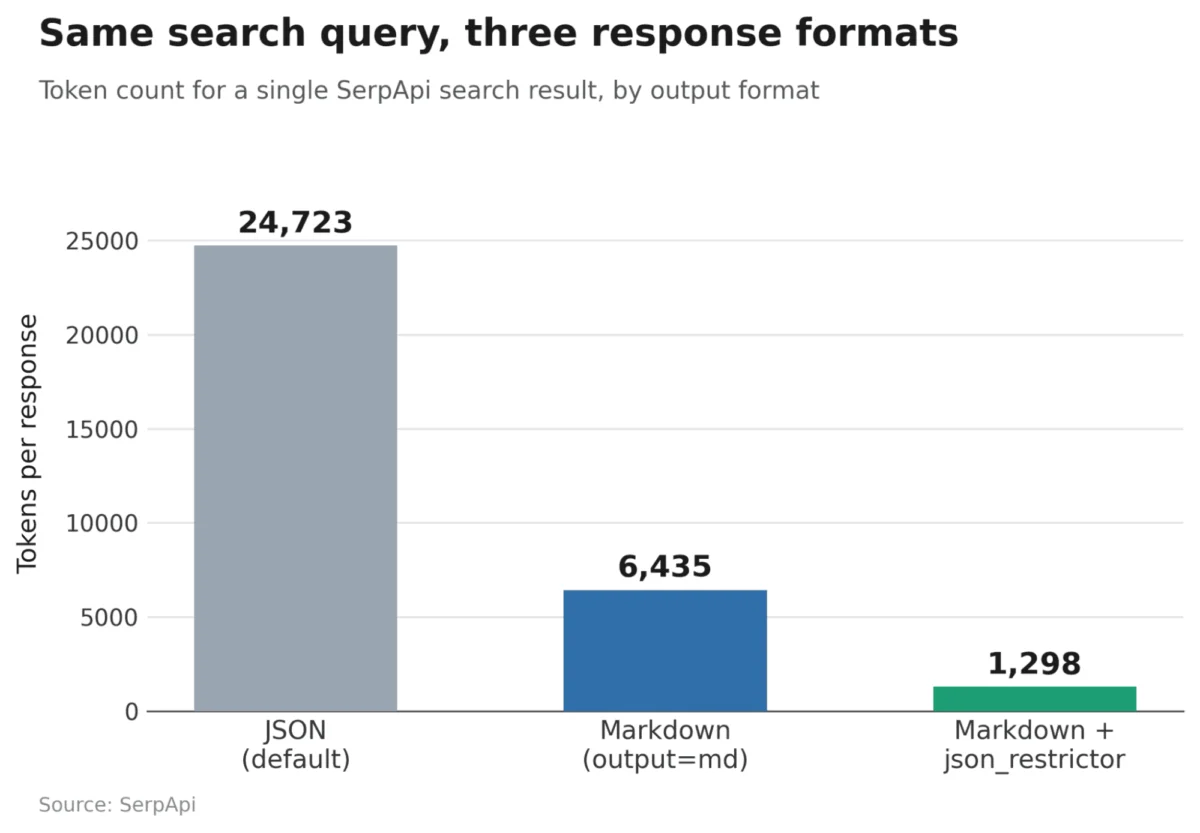
In a conventional JSON payload, a query of this nature does not merely return the names and descriptions of local establishments. It also delivers exhaustive tracking parameters, pagination links, deep nested arrays, status codes, user interface rendering hints, and repetitive key-identifier strings. For instance, benchmark testing conducted on standard search queries reveals that a typical JSON response can consume upwards of 24,723 tokens simply to transmit foundational web results.
When an AI agent ingests this massive block of data, the financial cost is immediate. More critically, token bloat introduces a secondary technical constraint: context window saturation. Even advanced frontier models possess finite context windows. When an agent consumes tens of thousands of tokens on a single search query payload, it rapidly exhausts the available space needed for historical conversational memory, system instructions, and extensive file analysis. This forces the model to either truncate critical information or trigger expensive caching mechanisms, frequently leading to recursive loops as the agent struggles to re-query lost data. The compounding effect of this per-call bloat can escalate cloud infrastructure budgets from manageable operational expenses to unsustainable capital drains within a matter of weeks.
Comparative Analysis: JSON Versus Markdown for Large Language Models
The introduction of Markdown as an API output format represents a fundamental re-alignment of data delivery with the cognitive consumption patterns of transformer-based models. While JSON relies on rigid key-value pairs, brackets, and structural punctuation designed for deterministic code execution, Markdown utilizes lightweight text formatting syntax—such as headers, bullet points, blockquotes, and inline links—that naturally mirrors human reading patterns and, by extension, the training data upon which modern LLMs are built.
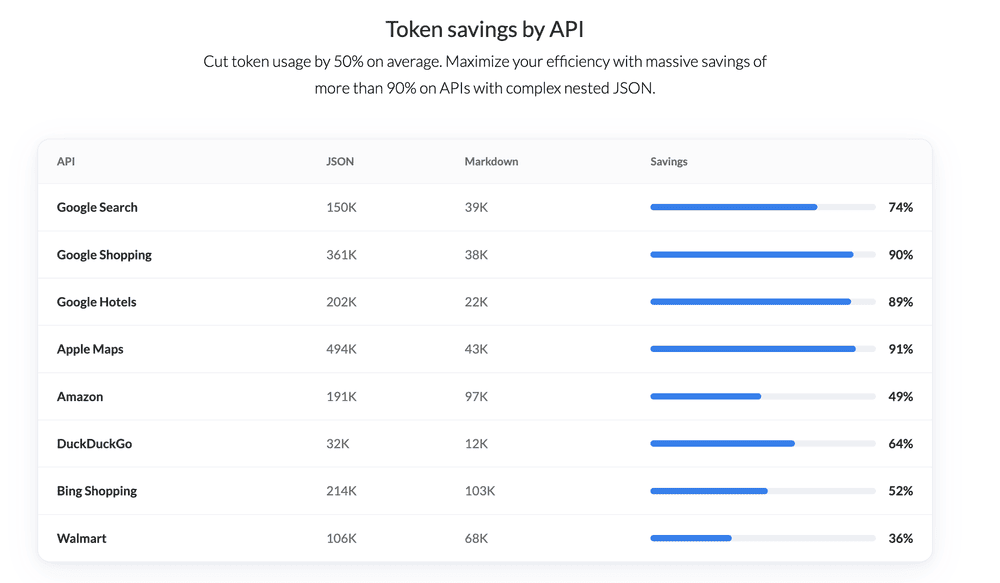
Comparative benchmarks illustrate the sheer scale of efficiency achievable through this transition. In controlled testing involving identical search parameters for the keyword "coffee," a conventional JSON response required 24,723 tokens to transmit the dataset. When the output format was switched to SerpApi’s newly introduced Markdown configuration, the token requirement dropped sharply to 6,435 tokens. This represents an immediate 74 percent reduction in payload size. Furthermore, when combined with advanced server-side filtering mechanisms, the same query can be distilled down to just 1,298 tokens while preserving the essential contextual information required for successful model summarization.
To achieve this compression, the underlying API must intelligently parse the incoming web data and strip away elements that exist exclusively for software applications rather than neural networks. Based on technical documentation from data providers, the transformation process systematically removes or restructures several categories of redundant data:
- User Interface and Rendering Artifacts: Code elements intended to dictate webpage styling, button placements, and responsive design matrices are eliminated.
- Tracking and Analytics Noise: UTM parameters, affiliate tracking codes, and deep redirection links that serve marketing attribution purposes rather than factual information are purged.
- Redundant Key-Value Nomenclature: In JSON structures, identical descriptive keys are repeated across hundreds of array items. Markdown collapses these repeating schemas into clean tabular rows or hierarchical bullet points.
- Extraneous Metadata: Internal database IDs, server timestamps, and localization codes irrelevant to semantic reasoning are stripped from the payload.
By removing these non-essential elements, the data footprint shrinks dramatically, allowing organizations to transmit more core information while utilizing fewer tokens.
Technical Implementation and Workflow Integration
Integrating Markdown outputs into existing software pipelines does not require a complete architectural overhaul. Leading data providers have engineered these solutions to be backward-compatible, accessible via simple query parameters, route extensions, or standard HTTP headers. For instance, developers utilizing SerpApi can request Markdown formatting simply by appending specific parameters—such as output=md—to their existing API requests.
This flexibility spans across extensive libraries encompassing over a hundred distinct search and data extraction endpoints, ensuring that teams can deploy the feature without incurring additional licensing fees or restructuring their core networking logic.
In addition to format conversion, advanced data pipelines often leverage server-side field restrictors. Tools such as json_restrictor in API query strings or --fields in command-line interfaces allow engineers to specify exact keys before the data leaves the server. By combining server-side field restriction with Markdown output, engineering teams can achieve a dual-layer optimization strategy: first, filtering out unwanted data categories at the database level, and second, formatting the remaining data into a token-efficient text structure.
Where Markdown Falls Short: The Continued Necessity of Structured JSON
Despite its distinct advantages for AI agents and conversational models, industry experts emphasize that Markdown is not a universal replacement for JSON. The choice of data format remains strictly dependent on the destination consumer of the pipeline.
While an LLM tasked with summarizing product reviews benefits immensely from Markdown’s streamlined tables and inline links, downstream software applications governed by strict deterministic logic require exact data types. If an enterprise pipeline features a pricing analytics engine, an automated purchasing script, or a quantitative financial model, human-readable text formatting introduces unacceptable parsing risks.
For example, a standard e-commerce query returning data from a regional shopping platform in JSON provides explicitly typed integers for price, old_price, and coupon_price, alongside floating-point values for product ratings and structured arrays for inventory stores. A pricing algorithm requires these precise numeric data types to execute mathematical comparisons, calculate margins, and trigger automated transactions. Forcing a programmatic engine to parse Markdown text for numerical calculations would introduce parsing errors and computational latency.
Consequently, modern MLOps architecture is moving toward a hybrid paradigm. When data flows into a neural network for natural language processing, summarization, or agentic reasoning, Markdown serves as the optimal conduit. Conversely, when data flows into relational databases, analytics engines, or transactional systems, JSON remains the gold standard.
Broader Implications for MLOps and Enterprise Budgets
The operational shift toward token-optimized data delivery reflects a maturing AI industry. During the initial wave of generative AI adoption, enterprises focused primarily on capability—demonstrating that models could successfully execute complex tasks regardless of the computational overhead. However, as artificial intelligence transitions from proof-of-concept pilot programs to deeply embedded enterprise infrastructure, financial governance has taken center stage.
Financial officers and engineering leads are increasingly scrutinizing unit economics, measuring the cost per completed task against traditional software benchmarks. In agentic systems, where a single user request can trigger dozens of recursive API calls, minor inefficiencies at the individual payload level compound exponentially across enterprise-scale deployments. A 74 percent reduction in search-related token consumption does not merely translate to fractional cost savings; it fundamentally alters the return on investment for autonomous AI projects, making previously cost-prohibitive agent workflows economically viable.
Furthermore, optimizing context window utilization yields direct performance benefits. When AI models are not overwhelmed by thousands of tokens of tracking noise and redundant JSON syntax, they demonstrate improved reasoning reliability, reduced hallucination rates, and enhanced accuracy in multi-step task execution.
Moving Forward: Evaluating Token Efficiency in Local Pipelines
As the developer community continues to explore payload optimization, industry analysts recommend a rigorous, empirical approach to format selection. Rather than relying solely on theoretical benchmarks, engineering teams are encouraged to audit their existing production pipelines by measuring token counts before and after implementing alternative output formats.
By executing a representative sample of baseline queries with modified parameters—such as comparing standard JSON payloads against Markdown alternatives and restricted field sets—organizations can quantify their exact real-world savings. This empirical validation allows technical leads to tailor their data pipelines to the specific demands of their models and workflows.
Ultimately, the evolving landscape of AI infrastructure demonstrates that efficiency is not solely a function of model architecture or hardware acceleration. The physical shape of the data itself carries a measurable financial and computational cost. By re-engineering data delivery to align with the cognitive structures of modern neural networks, the technology sector is taking a crucial step toward sustainable, cost-effective, and scalable artificial intelligence integration.