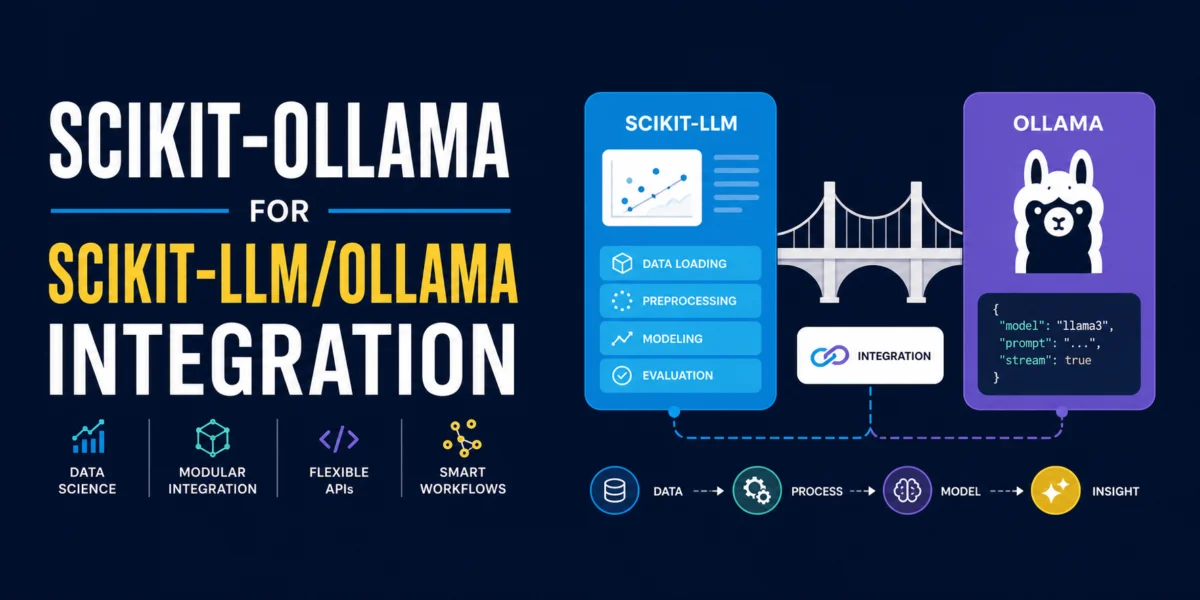
The rapid evolution of generative artificial intelligence has presented a paradox for modern enterprises: while Large Language Models (LLMs) offer unprecedented capabilities in natural language processing, their reliance on cloud-based APIs introduces significant hurdles regarding data privacy, operational costs, and latency. In response to these challenges, a new paradigm of localized machine learning is emerging. Central to this movement is scikit-ollama, an open-source library designed to bridge the gap between the familiar scikit-learn interface and locally hosted LLMs via the Ollama framework. This integration allows developers to perform sophisticated zero-shot text classification without transmitting sensitive data to external servers or incurring per-token subscription fees.
The Shift Toward Localized Intelligence
For the past several years, the standard approach to implementing LLMs involved integrating proprietary APIs from providers such as OpenAI, Anthropic, or Google. While these services offer high-performance models, they require a constant internet connection and the movement of data across organizational boundaries. For sectors such as healthcare, finance, and legal services, this data transfer often conflicts with stringent regulatory frameworks like the General Data Protection Regulation (GDPR) or the Health Insurance Portability and Accountability Act (HIPAA).
Ollama emerged as a solution to these constraints by providing a streamlined way to run open-source models—such as Meta’s Llama 3, Mistral, and Google’s Gemma—directly on local hardware. However, the raw output of an LLM is often unstructured text, which does not easily fit into the structured "fit-and-predict" workflows familiar to data scientists using scikit-learn. The introduction of scikit-ollama addresses this friction, wrapping local LLM calls into a class structure that mirrors traditional machine learning estimators.
Technical Framework: Scikit-Ollama and Scikit-LLM
The scikit-ollama library is built upon the foundation of scikit-llm, an earlier project that pioneered the integration of cloud LLMs into the scikit-learn ecosystem. By pivoting to support Ollama, the library empowers users to utilize local compute resources. The primary value proposition lies in the ZeroShotOllamaClassifier. Unlike traditional classifiers that require thousands of labeled examples to learn the statistical relationship between features and targets, a zero-shot classifier leverages the pre-existing semantic knowledge of a foundation model to categorize text based solely on the descriptive names of the labels provided.
This approach is particularly effective for tasks like sentiment analysis, where the model already understands the nuances of "positive," "negative," and "neutral" language. By using scikit-ollama, the developer can treat a model like Llama 3 as a plug-and-play component within a larger scikit-learn pipeline, enabling seamless integration with preprocessing tools, cross-validation utilities, and evaluation metrics.
Implementation Chronology and Requirements
The deployment of a local zero-shot classification system follows a structured technical path. The first requirement is a modern development environment running Python 3.9 or higher. This version requirement is critical, as the underlying asynchronous calls and type-hinting utilized by scikit-ollama rely on features introduced in recent Python iterations.
Once the environment is established, the installation process involves two distinct layers. First, the Ollama application must be installed on the host operating system to manage model weights and serve the inference engine. Second, the Python library is installed via the standard package manager:
pip install scikit-ollama
Following installation, the user must "pull" the desired model. In current benchmarks, the llama3:latest model is frequently cited as the optimal balance between computational efficiency and linguistic reasoning for classification tasks. The command ollama pull llama3 downloads the necessary weights to the local machine, ensuring that all subsequent operations are performed entirely offline.
The Data Workflow: From Raw Text to Structured Prediction
In a typical implementation scenario, such as analyzing movie reviews for sentiment, the workflow begins with data acquisition. Using the skllm.datasets module, developers can access standardized text-based datasets. A sample review might read: "I was absolutely blown away by the performances… A truly captivating cinematic experience."
In a traditional scikit-learn workflow, this text would need to be converted into a numerical vector (using TF-IDF or Word2Vec) before being passed to a Support Vector Machine or Random Forest. With scikit-ollama, the raw text is passed directly to the model. The ZeroShotOllamaClassifier is initialized with the specific local model name.
The "fitting" stage in this context is a departure from classical training. In zero-shot learning, the .fit() method does not update internal weights; instead, it registers the candidate labels. For instance, by passing ["positive", "negative", "neutral"] to the fit method, the library constructs a prompt that instructs the local Llama 3 model to restrict its output to one of those three specific strings. This "constrained generation" ensures that the LLM behaves like a categorical classifier rather than a free-form chatbot.
Supporting Data and Performance Analysis
The move to local LLM integration is supported by compelling economic and performance data. According to industry cost analyses, a high-volume sentiment analysis task processing 1 million reviews could cost between $500 and $2,000 using premium cloud APIs, depending on the model’s token usage. Conversely, the cost of running the same task locally via Ollama is limited to the electricity consumed by the hardware and the initial investment in a GPU (such as an NVIDIA RTX 3060 or better).
Furthermore, latency benchmarks indicate that for small-to-medium batch sizes, local inference can outperform cloud APIs by eliminating the round-trip time of network requests. While a cloud API might take 500ms to 2 seconds to return a result due to traffic bottlenecks, a local Llama 3 8B model running on an Apple M-series chip or an NVIDIA GPU can often process text at rates exceeding 50 tokens per second, resulting in near-instantaneous classification for short reviews.
Implications for Data Privacy and Security
The security implications of scikit-ollama cannot be overstated. In the current cybersecurity landscape, "shadow AI"—the unauthorized use of cloud AI tools by employees—poses a major risk for data leaks. By providing a local alternative that integrates with standard data science tools, organizations can offer their developers the power of LLMs within a "walled garden" environment.
Because the data never leaves the local machine, the risk of third-party data breaches or the use of proprietary data for model retraining by cloud providers is eliminated. This makes the scikit-ollama and Ollama combination an ideal choice for government agencies and research institutions handling classified or sensitive personal information.
Industry Impact and Future Outlook
The integration of LLMs into the scikit-learn ecosystem marks a significant milestone in the democratization of artificial intelligence. It signals a shift away from the "AI as a Service" (AIaaS) model toward a more decentralized "AI as Infrastructure" model.
Industry analysts suggest that as open-source models continue to shrink in size while maintaining high performance (through techniques like quantization and distillation), the use of local classifiers will become the standard for routine NLP tasks. The ability to use a single syntax—the scikit-learn API—to manage everything from a simple linear regression to a complex Llama 3-powered classifier simplifies the tech stack and reduces the learning curve for new data scientists.
In conclusion, scikit-ollama represents more than just a convenient wrapper; it is a foundational tool for the next generation of privacy-first machine learning. By bridging the gap between local LLM execution and the industry-standard scikit-learn framework, it provides a viable, cost-effective, and secure path for organizations to harness the power of large language models. As the open-source community continues to refine these models, the reliance on cloud-based "black box" APIs is likely to diminish, giving way to a future where high-performance intelligence is hosted right where the data lives: on the local machine.