








As generative artificial intelligence transitions from conversational assistants to autonomous software engineering agents capable of writing, executing, and iterating upon raw code, the computing industry faces a critical security imperative: isolation. An autonomous agent is only as secure as the infrastructure that executes its commands. Without robust sandboxing, a compromised or hallucinating model can read sensitive environment variables, manipulate host filesystems, saturate memory banks, or propagate unauthorized network requests. This architectural vulnerability has spurred engineers to design, test, and deploy multi-tiered execution boundaries ranging from lightweight operating system processes to hardened kernel-level microVMs.
The Evolution of Agentic Workflows and Security Risks
The paradigm of software development has shifted dramatically with the widespread adoption of tool-use capabilities in large language models. Rather than merely outputting text snippets, modern AI systems are granted execution loops—environments where the model generates Python scripts, invokes them via an API, reads stdout and stderr, and modifies its approach based on runtime feedback.
While this feedback loop drastically enhances agent productivity, it introduces unprecedented security vectors. Untrusted, model-generated code can intentionally or inadvertently trigger resource exhaustion attacks, infinite loops, fork bombs, and unauthorized data exfiltration. Consequently, platform architects must implement strict boundary parameters before executing a single line of agentic code. These security policies must be enforced strictly at the infrastructure layer rather than relying on the compliance or internal logic of the language model itself.
Chronology of Isolation Standards: From Subprocesses to Hypervisors
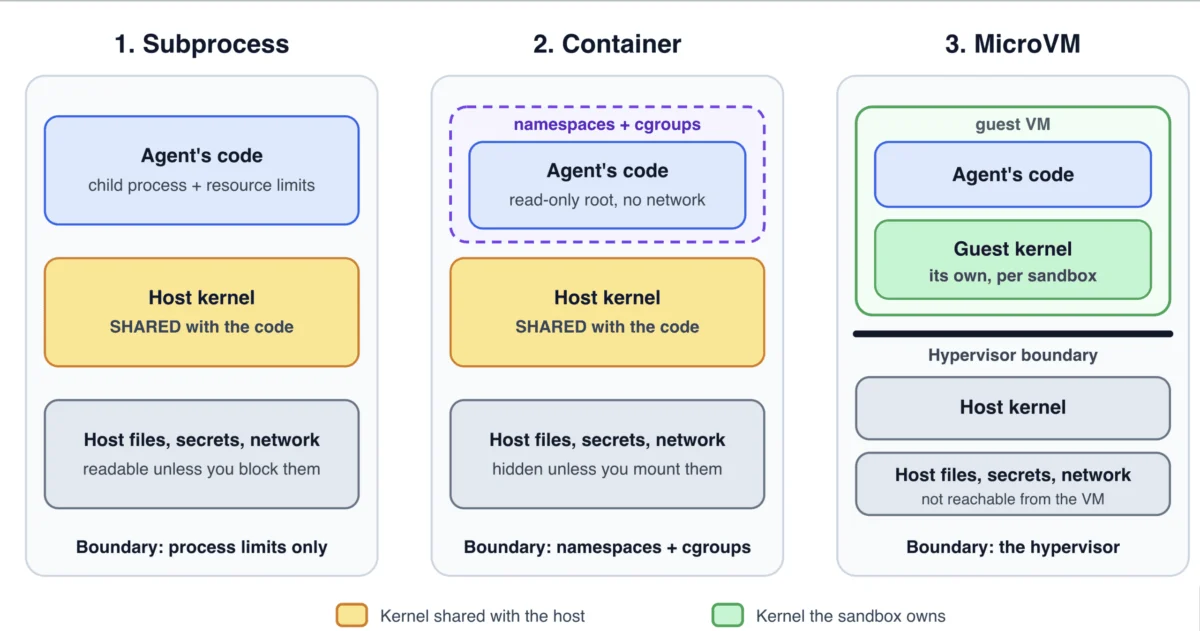
The methodology for containing untrusted code has evolved across three distinct architectural tiers, each trading off execution latency against security isolation.
Tier 1: Limited Subprocesses
Historically, the simplest approach involved spawning a child process directly on the host operating system, restricted via POSIX resource limits (such as resource.setrlimit) and network namespaces (unshare --net). While this method boasts near-instantaneous startup times, it fundamentally shares the host kernel and filesystem. Without extensive containerization wrappers, a process operating within this tier can access host files depending on user permissions and may bypass resource caps if system limits are not meticulously configured.
Tier 2: Hardened Containers
The containerization revolution popularized by Docker introduced cgroups and namespaces to isolate processes from one another while sharing a single host kernel. However, default container configurations remain vulnerable. Without explicit constraints, containers operate with unconstrained network access, writable root filesystems, and elevated capabilities. Recent container breakout vulnerabilities—such as the runc exploits documented in late 2025—demonstrate that shared-kernel architectures inherently carry breakout risks. Hardening a container requires enforcing read-only root filesystems, dropping all Linux capabilities, disabling new privileges, and explicitly stripping network connectivity.
Tier 3: MicroVMs and Hardware-Level Virtualization
The contemporary gold standard for secure code execution relies on microVMs powered by lightweight hypervisors such as Firecracker. Unlike traditional virtual machines, microVMs strip away legacy device emulation to provide a minimal, highly optimized environment where each execution session boots an isolated guest kernel. Security leaders, including Amazon Web Services and major container platform providers, have widely adopted microVM architectures for serverless compute and AI sandboxing. This hardware-enforced boundary ensures that even a complete kernel exploit remains strictly contained within the ephemeral microVM instance, preventing lateral movement to the host infrastructure.
Comparative Implementation: Building a Multi-Tier Sandbox Architecture
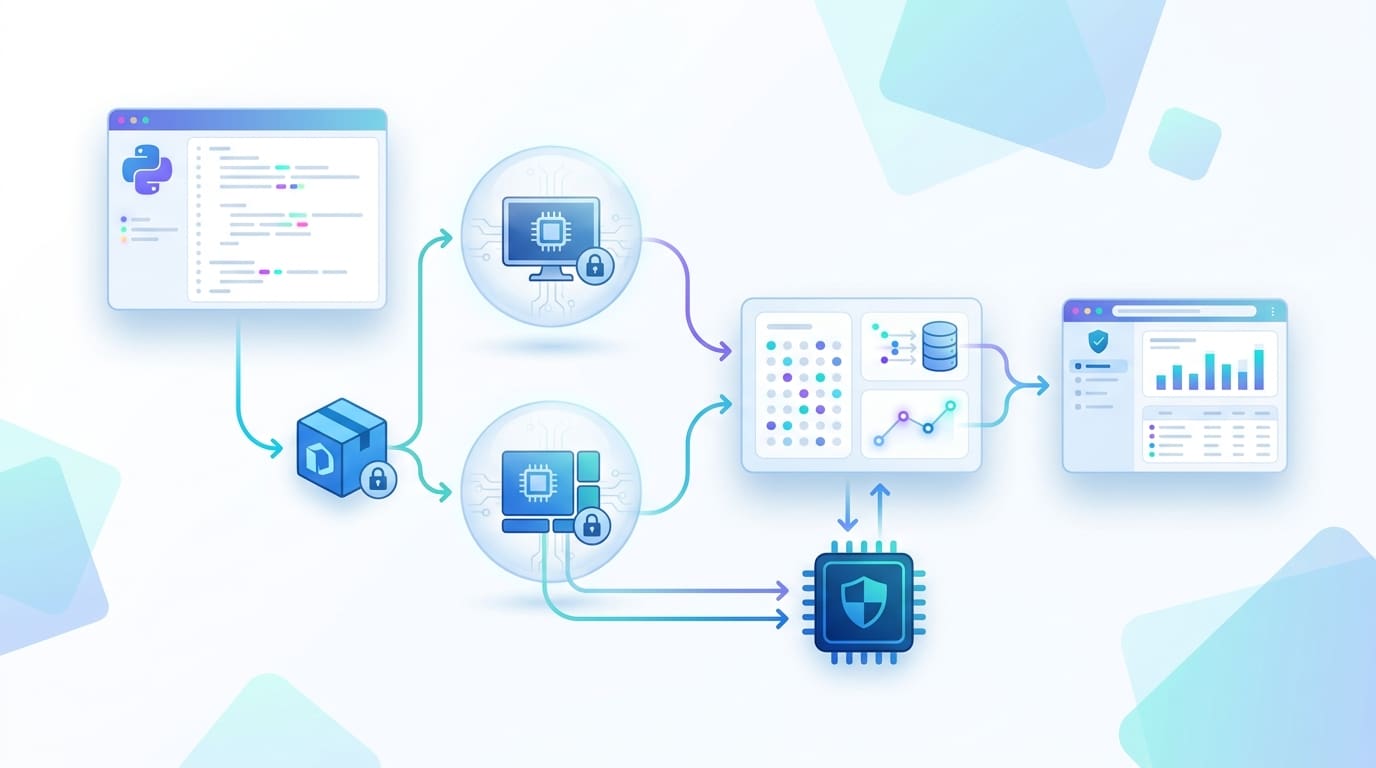
To evaluate the safety and latency trade-offs of these isolation levels, developers can construct a unified execution interface that routes agent-generated Python code through subprocess, Docker, and E2B (Firecracker-based) backends.
Implementing this system requires configuring distinct runtime constraints for each environment:
- Subprocess Backend: Utilizes Python’s
subprocessandresourcemodules to enforce CPU time limits (RLIMIT_CPU), address space bounds (RLIMIT_AS), and file size restrictions (RLIMIT_FSIZE), dropping privileges to an unprivileged user where applicable. - Docker Backend: Executes container instances using strict operational flags, including
--network none,--read-only,--cap-drop ALL,--security-opt no-new-privileges, and hard caps on memory and process counts (--pids-limit). - E2B MicroVM Backend: Provisions a fresh, ephemeral Firecracker microVM instance for every individual code execution request via an API-driven SDK, guaranteeing complete state destruction upon session termination.
Empirical Security and Latency Benchmarks
Rigorous testing against hostile code samples highlights the distinct security profiles of each tier. When subjected to adversarial test suites—encompassing CPU exhaustion loops, 512 MB memory allocations, 200-process fork floods, 50 MB disk writes, unauthorized file reads of sensitive credentials, and internal network service probes—the variance in containment becomes apparent.
- Subprocess Sandboxes: Effectively manage resource consumption and block network requests when properly configured with network namespaces, but frequently fail to isolate host filesystems if executed under privileged user accounts, allowing the retrieval of local credentials.
- Hardened Containers: Successfully mitigate filesystem and network attacks by enforcing read-only storage and dropping Linux capabilities, provided the container runtime engine remains patched against underlying kernel or container-engine vulnerabilities.
- MicroVMs: Provide absolute isolation. Host-level secrets and internal loopback services are structurally inaccessible because the guest environment possesses an independent network stack and kernel space.
Latency metrics correspondingly scale with the depth of isolation. Benchmarking trivial execution tasks (such as a basic print(1) command across multiple iterations) demonstrates that subprocesses achieve sub-millisecond execution times due to minimal overhead. Hardened containers introduce modest startup overhead, while microVM solutions incorporate virtualization boot latency. Industry evaluations indicate that modern microVM platforms achieve initialization times of approximately 150 milliseconds, striking an optimal balance between high-security guarantees and acceptable user-experience latency.
Industry Implications and Future Outlook
As enterprise adoption of autonomous AI agents accelerates, security architectures are rapidly standardizing around hardware-level virtualization. The introduction of managed microVM solutions by cloud providers and container ecosystems signals a broader industry consensus: application-layer trust models are insufficient for autonomous agent operations.
Infrastructure engineers deploying code-writing agents must adopt a defense-in-depth strategy. By establishing immutable execution boundaries before deploying language models, organizations can harness the computational power of generative AI while safeguarding sensitive corporate infrastructure, proprietary codebases, and production environments from emerging threat vectors.