The HUAWEI Watch GT 7 Pro represents the latest evolution in the company’s premium wearable lineup, blending high-end industrial design with a specialized focus on outdoor performance. Positioned at a $500.00 MSRP, the device targets a demographic that values long-term durability and extended battery life over the short-cycle charging requirements of mainstream smartwatches. By integrating titanium alloy, nano-tech ceramic, and sapphire glass, Huawei is positioning this iteration as a direct competitor to high-performance outdoor watches, emphasizing a build quality intended to withstand extreme environments.

Chronology of the GT Series Development
The GT series has historically been Huawei’s answer to the demand for multi-day battery life, a feature often sacrificed by competitors utilizing power-hungry operating systems like Wear OS or watchOS. Since the launch of the original Watch GT, the company has transitioned from basic fitness tracking to more advanced health monitoring. The GT 7 Pro arrives after a steady progression of features, including the introduction of ECG monitoring, improved dual-band GNSS, and professional-grade diving support (EN 13319). This latest model marks a shift toward a more aggressive, athletic aesthetic, moving away from the office-centric designs that characterized the series’ earlier years.
Technical Specifications and Material Science
The device features a 46 mm chassis measuring 45.6 x 45.6 x 11.25 mm, weighing approximately 55.5 grams without a strap. The display is a 1.47-inch AMOLED panel with a resolution of 466 x 466 pixels (317 ppi). Huawei highlights a manufacturer-rated peak brightness of 3,000 nits, which is a significant upgrade intended to ensure visibility in direct sunlight—a critical requirement for backcountry navigation.

Durability is the cornerstone of the Pro branding. The case is constructed from a titanium alloy, paired with a nano-tech ceramic bezel and a sapphire glass lens. This combination provides high resistance to impact and abrasion, consistent with the requirements for outdoor sports such as trail running, cycling, and freediving. The water resistance rating of 5 ATM and IP69 certification further underscores its utility in varied weather conditions and aquatic environments.
Performance and Battery Metrics
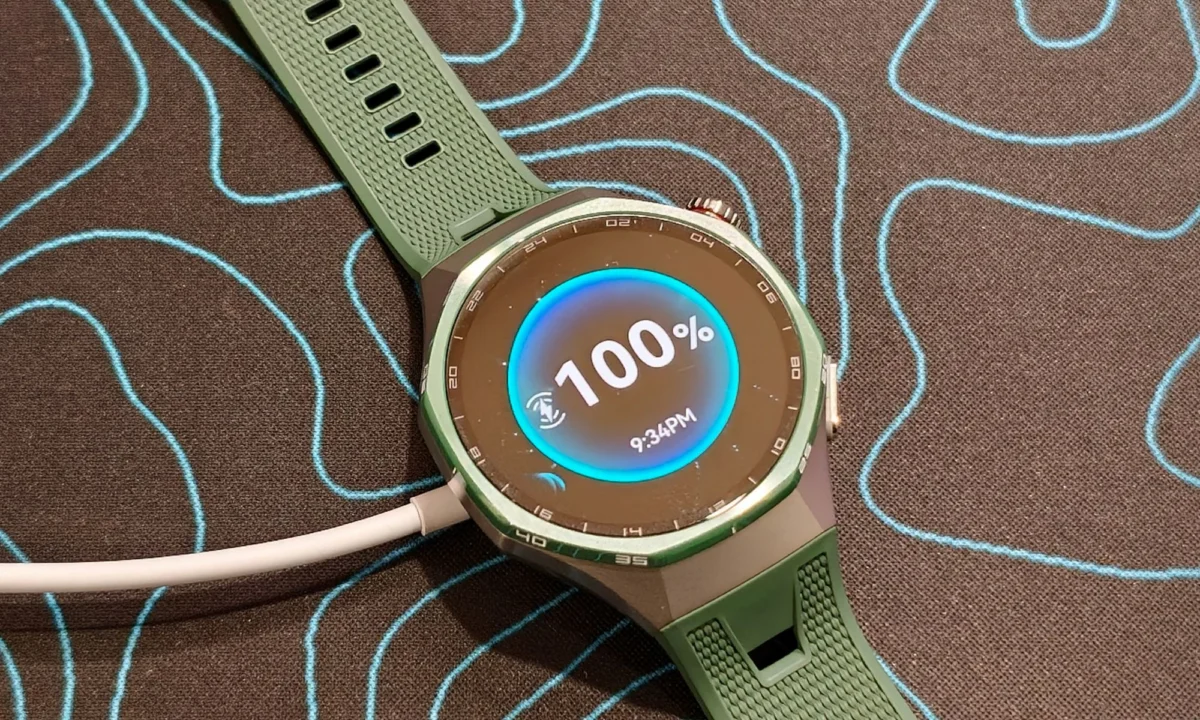
A defining characteristic of the GT 7 Pro is its power management system. Huawei specifies a battery life of up to 21 days for light use, 12 days for typical use, and seven days with the always-on display (AOD) enabled. For specialized activities, the device supports up to 51 hours of continuous GPS tracking in trail-running mode.

Field testing confirms that the watch successfully minimizes "battery anxiety," a common pain point for users of modern smartwatches. In practical scenarios, the watch sustains performance for over ten days on a single charge. While the device supports wireless charging, the reliance on a proprietary charging puck remains a point of divergence from the industry trend toward universal charging standards.
Fitness and Health Monitoring Ecosystem
The GT 7 Pro supports over 100 workout modes, including specialized profiles for skiing, golf, and cycling. The health suite includes optical heart rate monitoring, ECG (electrocardiogram) functionality, pulse-wave analysis, skin temperature sensing, and a barometer for altitude tracking. A central feature is the "Physical Readiness" score, which aggregates data from sleep patterns, heart-rate variability (HRV), and stress levels to provide a recovery recommendation.

While the automated activity recognition is proficient for cardio-based exercise, the device faces limitations in complex strength training, where it struggles to identify specific lifting movements. Furthermore, the step-counting algorithm occasionally interprets the vibration of a vehicle steering wheel as physical activity, leading to inflated step counts during long commutes—a technical challenge common to many wrist-worn accelerometers.
Navigation and GPS Reliability
The watch utilizes a dual-band, multi-system GNSS (Global Navigation Satellite System) to maintain accuracy in challenging environments, such as dense forests or urban canyons. A standout feature is the "walk-back" navigation, which allows users to retrace their path without relying on a smartphone. This functionality serves as a vital safety redundancy for hikers, providing a rudimentary but effective visual map of the return route. The integration of newer algorithms to estimate position when satellite signals are temporarily obscured has demonstrated improved reliability over previous generations.

Software Limitations and Connectivity Constraints
The user experience is mediated through the Huawei Health application, which serves as the primary interface for data synchronization and device configuration. Unlike the Apple Watch or Samsung Galaxy Watch, the GT 7 Pro does not operate on a third-party app store ecosystem. This limits the availability of third-party apps, meaning users are largely confined to the suite of tools provided by Huawei.
Connectivity presents a mixed profile. The watch supports Bluetooth calling, provided the device is paired with a smartphone. However, the lack of an eSIM means the device cannot function as a standalone communication tool; users must keep their phone within range for cellular alerts.

Cross-platform integration also reveals specific pain points. When paired with an iPhone, users may encounter "blind spots" in notification management. For instance, the system does not consistently display images from WhatsApp, and it lacks the ability to toggle Gmail notifications. These software gaps suggest that while the hardware is compatible with iOS, the experience is optimized for HarmonyOS or Android, where deeper integration is possible.
Implications of Regional Variations
The utility of the GT 7 Pro is partially dependent on geography. NFC payment integration, which relies on services like Curve Pay, is not globally available. Potential buyers must verify whether their specific region and banking institution support the necessary digital payment infrastructure. Similarly, warranty coverage and technical support can fluctuate significantly between markets, making the purchase of imported versions a potential risk for the end-user.

Market Positioning and Competitive Landscape
The market for high-end wearables is increasingly bifurcated between lifestyle-oriented smartwatches and purpose-built outdoor devices. The Samsung Galaxy Watch Ultra2 competes directly with the GT 7 Pro by offering a broader app ecosystem through Wear OS and standalone LTE connectivity. Conversely, the Apple Watch Series 12 remains the benchmark for integration within the iOS environment, despite its shorter battery life.
The standard HUAWEI Watch GT 7 serves as the primary internal alternative, offering most of the same core fitness and navigation features for a lower price. The Pro model’s premium is essentially a cost for the use of titanium, sapphire glass, and specialized health sensors like the ECG. For users who do not require these high-grade materials or advanced health metrics, the base model may represent a more efficient investment.

Conclusion and Future Outlook
The HUAWEI Watch GT 7 Pro succeeds in its objective to serve as a reliable, durable, and long-lasting companion for outdoor enthusiasts. Its ability to provide actionable data without the constant requirement for power management distinguishes it from many of its contemporaries. However, the lack of an eSIM and the limitations of its third-party app ecosystem define it as a specialized fitness tool rather than a comprehensive smartphone replacement.
The device’s performance over the two-month evaluation period demonstrates that the hardware is robust enough to endure significant physical wear, and its outdoor tracking capabilities provide genuine value for hikers and athletes. As wearable technology continues to evolve, the challenge for Huawei will be to address the software integration gaps—particularly for iOS users—and expand the regional support for its digital services. For the target demographic of outdoor-focused users who prioritize battery longevity and rugged construction, the GT 7 Pro remains a formidable option in the current market.