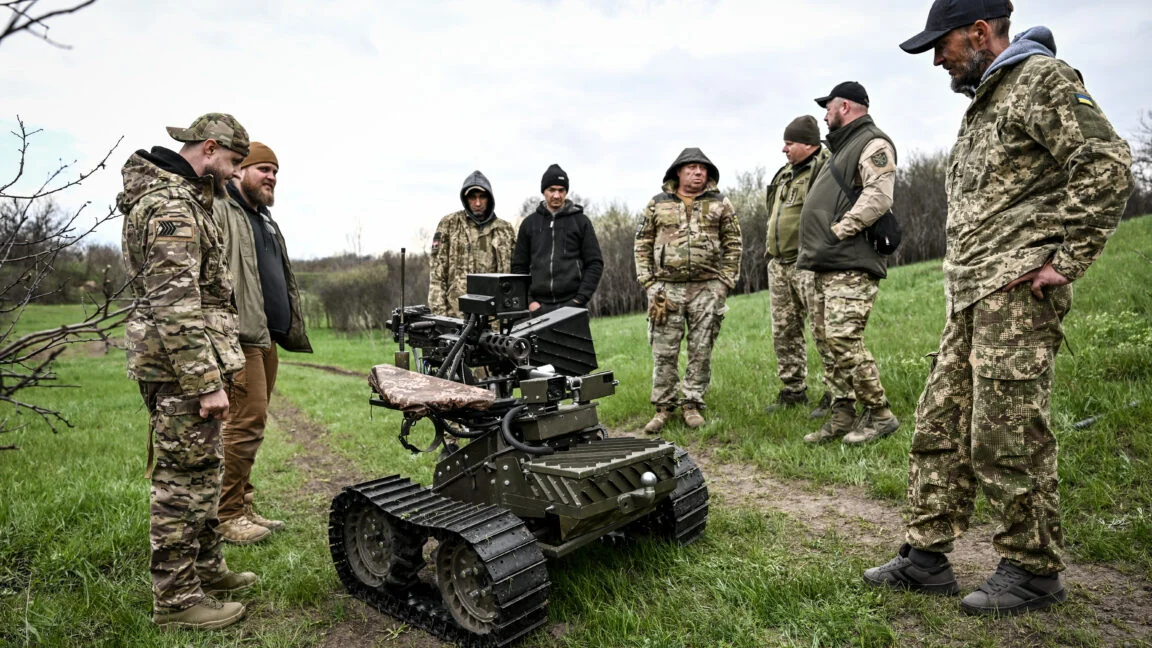
In a significant evolution of modern combat, Ukraine has introduced novel tactics leveraging both aerial drone carriers and unmanned surface vessels to deploy ground robots, some armed with weapons or explosives, directly into contested battle zones. These innovative drone-assisted deployments represent a critical strategic pivot, enabling slower wheeled robots to circumvent challenging terrain and entrenched Russian defenses, and notably facilitating an unusual robotic amphibious assault on a strategically vital position. Such tactics underscore the Ukrainian military’s relentless pursuit of technological innovation to counter Russia’s numerical superiority in manpower, simultaneously mitigating the risks faced by Ukrainian soldiers in perilous combat scenarios.
The Genesis of Robotic Deployments: Bypassing Obstacles and Saving Lives
The battlefield in Ukraine has become a crucible for advanced military technologies, with both sides heavily reliant on unmanned systems. However, Ukraine’s latest developments in integrating aerial and naval drone platforms with ground robots mark a new frontier. Traditional ground robots, while offering immense potential for reconnaissance, logistics, and direct engagement, are often limited by terrain, speed, and vulnerability to detection. The strategy of deploying these robots from the air or by sea addresses these inherent limitations, granting them unprecedented operational flexibility and reach.
On July 19, a compelling video circulated on a Russian military Telegram channel, depicting a Ukrainian hexacopter drone expertly carrying a ground robot suspended beneath it by a cable. The Russian channel identified the heavy-lift drone as a "bomber drone" and detailed its deployment of a four-wheeled ARK-1 robot, reportedly armed with explosive anti-tank mines, directly onto the ground. The ground robot then proceeded towards Russian military positions, a maneuver that, according to reports, provoked considerable outrage and alarm among pro-Kremlin social media users. While the immediate success of this particular mission remains unconfirmed, the strategic implications are profound. This aerial deployment method significantly enhances the survivability of ground robots by enabling them to bypass conventional detection methods, such as Russian aerial surveillance and drone strikes, while rapidly closing the distance to their intended targets. The ARK-1 robot, capable of speeds nearing 28 miles per hour, exemplifies the kind of agile, multi-role platform that benefits immensely from such swift and covert deployment.
Amphibious Robotic Assault: The Kinburn Spit Operation
Beyond aerial delivery, Ukraine has also demonstrated the use of ground robots in complex amphibious operations. On June 25, Ukrainian ground robots played a supporting role in a military operation targeting the Kinburn Spit, a narrow, sandy peninsula extending westward into the Black Sea, vitally connected to the Russian-occupied left bank of the Kherson Oblast. The Kinburn Spit holds significant strategic importance, as its control allows for the regulation of southern Ukraine’s access to vital Black Sea ports, including Mykolaiv.
Russian military forces seized the Kinburn Spit in June 2022, establishing fortified positions that facilitated their control over maritime access and provided a launching pad for potential offensives. However, by early June 2023, Russian forces commenced a partial withdrawal from the peninsula, a direct consequence of sustained Ukrainian mid- and long-range drone strike campaigns that severely strained Russian supply lines and logistics. The terrain of the Kinburn Spit—a mix of sand, marsh, and shallow waters—presents formidable challenges for conventional military operations, particularly amphibious assaults, which are inherently high-risk for human personnel. The integration of ground robots into such an operation allows for the reconnaissance of enemy positions, the neutralization of obstacles, and potentially direct engagement, all while minimizing the exposure of Ukrainian soldiers to enemy fire and treacherous environmental conditions. This incident highlights a strategic shift towards leveraging unmanned systems for operations that would traditionally incur heavy casualties.
Strategic Rationale: Offsetting Manpower Disparity
The deployment of ground robots via aerial and naval drones is a direct response to Ukraine’s strategic imperative to offset Russia’s considerable advantage in manpower. With a significantly larger population, Russia can sustain a more extensive mobilization effort. Ukraine, in contrast, must maximize the effectiveness of its available personnel and minimize casualties. Unmanned systems, from small FPV drones to sophisticated ground robots, serve as force multipliers, allowing a smaller, technologically adept force to challenge a larger, more traditional military.
Ukrainian defense officials have consistently emphasized the critical role of technological innovation in achieving battlefield parity. By deploying robots for dangerous tasks such as mine clearance, reconnaissance of heavily fortified positions, or direct assaults, Ukraine significantly reduces the risk to its soldiers. This not only preserves valuable human resources but also maintains morale and operational readiness. The ability to conduct "unusual robotic amphibious assaults" or deploy explosive-laden robots against enemy positions without risking human life represents a paradigm shift in military strategy, prioritizing machine over man for tasks deemed too hazardous.
The Broader Context of Ukraine’s Drone Warfare
The conflict in Ukraine has been dubbed the "first true drone war," with both sides deploying thousands of unmanned aerial vehicles (UAVs) for a myriad of tasks, including reconnaissance, artillery spotting, target acquisition, and direct attack. Ukraine, in particular, has rapidly innovated, adapting commercial drones for military use and developing specialized military platforms. The "Army of Drones" initiative, launched by the Ukrainian government, has seen substantial public and international support, funding the acquisition and development of thousands of drones.
This extensive drone ecosystem provides the backdrop for the latest robotic deployments. The hexacopter drone used for aerial delivery is likely a heavy-lift variant, capable of carrying payloads of several kilograms, indicating a sophisticated understanding of drone capabilities and their potential for inter-platform synergy. Similarly, the use of drone boats to transport ground robots suggests an integrated approach to multi-domain unmanned operations, where air, sea, and ground assets work in concert to achieve tactical objectives. This layered approach complicates Russian defensive strategies, forcing them to contend with threats from multiple vectors simultaneously.
Technological Advancement and Adaptation
Ukraine’s rapid adoption and adaptation of advanced technologies are a hallmark of its defense strategy. Faced with an existential threat, the nation has transformed into a living laboratory for military innovation. The ARK-1 robot, with its high-speed capability, exemplifies the engineering prowess being applied to ground robotics. While some ground robots are considerably slower, designed for endurance or heavy lifting, the ARK-1’s speed suggests its role in rapid deployment, hit-and-run tactics, or scouting missions where quick ingress and egress are crucial.
The development and deployment of these systems are often driven by direct feedback from the front lines, allowing for rapid iteration and improvement. This agile development cycle, characteristic of tech startups, contrasts sharply with the often lengthy procurement processes of traditional militaries. This adaptability has allowed Ukraine to quickly integrate cutting-edge solutions, turning perceived disadvantages into tactical opportunities. International defense analysts view Ukraine as a crucial testbed for future warfare, where the lines between manned and unmanned systems, and between different domains of operation, are increasingly blurring.
International Reaction and Future Implications
The emergence of these advanced robotic tactics has garnered significant attention from military strategists and defense establishments worldwide. International observers note that Ukraine’s battlefield innovations provide invaluable insights into the future of warfare, particularly regarding the increasing role of autonomous and semi-autonomous systems. The successful integration of aerial and naval platforms for ground robot deployment signifies a major step towards multi-domain unmanned warfare, a concept many leading militaries are exploring.
From an ethical standpoint, the increasing reliance on robotic systems, particularly those capable of deploying weapons or explosives, reignites ongoing debates about autonomous weapon systems and the "human in the loop" principle. While these Ukrainian deployments are currently controlled or supervised by human operators, the trajectory towards more autonomous battlefield roles for robots is clear. Military analysts suggest that these developments will likely accelerate investment and research into similar technologies across NATO and other allied nations, as they seek to understand and potentially replicate Ukraine’s successes. The cost-effectiveness of these systems, especially when compared to the training, equipping, and potential loss of human soldiers, also presents a compelling economic argument for their broader adoption.
Challenges and Countermeasures
Despite their advantages, robotic deployments are not without challenges. Russian forces are actively developing and deploying countermeasures, including sophisticated electronic warfare (EW) systems designed to jam drone signals, disrupt GPS navigation, and even hijack control of unmanned vehicles. Anti-drone defenses, ranging from specialized drone-hunting firearms to short-range air defense systems, are also becoming more prevalent. The survivability of these robotic assets remains a critical concern, as their loss represents a significant financial and technological investment.
The success of these robotic tactics often hinges on surprise and the inability of the adversary to adapt quickly. As Russia learns from these encounters, it is likely to develop more effective ways to detect, track, and neutralize these unmanned threats. This continuous cycle of innovation and counter-innovation defines the technological arms race playing out on the Ukrainian battlefield.
Conclusion: A Glimpse into Tomorrow’s Battlefield
Ukraine’s pioneering use of flying drone carriers and drone boats to deploy armed ground robots represents a seminal moment in modern military history. These tactics not only offer concrete operational advantages—bypassing difficult terrain, evading surveillance, and enabling high-risk amphibious assaults—but also serve a broader strategic purpose: to offset manpower disadvantages and safeguard human lives. By demonstrating the effective integration of unmanned systems across air, sea, and land domains, Ukraine is providing a compelling preview of tomorrow’s battlefield, where technological ingenuity and rapid adaptation are paramount. The lessons learned from these innovations will undoubtedly shape defense doctrines and military procurement strategies globally for decades to come, marking a significant step towards a future where unmanned systems play an increasingly central role in the conduct of warfare.