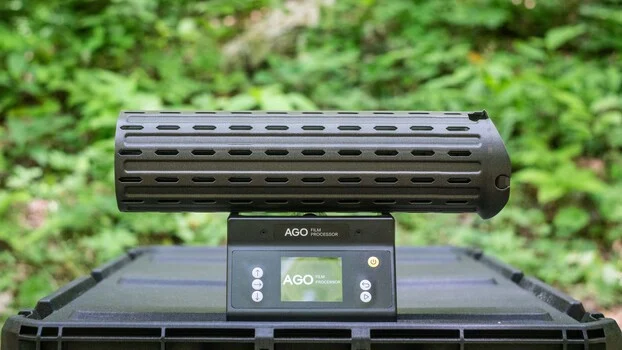
The intersection of traditional analog photography and modern field mobility has long presented logistical hurdles for fine-art photographers. Producing high-quality silver-gelatin or color photographic prints typically requires a stationary, climate-controlled darkroom equipped with multiple chemical processing trays, running water, and strict light-tight controls. However, recent developments in photographic accessories aim to dismantle these traditional constraints. Among the latest entries in this niche market is the REEL Paper 8, manufactured by Vintage Visual, a device engineered to facilitate the processing of photographic paper up to 12×16 inches without the need for traditional open trays. To evaluate the practical capabilities and operational limits of this hardware, field testing was recently conducted in the remote terrain of the Nantahala National Forest in North Carolina, utilizing a mobile darkroom setup.
Background and Technological Context
The evolution of mobile analog photography has accelerated alongside the rise of nomadic lifestyles and remote artistic practices. For decades, field photographers working with large-format film—ranging from 4×5 to ultra-large formats like 11×14—faced a distinct bottleneck: while capturing and developing negatives in the field had become increasingly streamlined through changing tents and compact daylight-loading tanks, the printing phase remained stubbornly tethered to stationary facilities.
Traditional darkroom printing demands expansive flat surfaces to accommodate at least three, and ideally five, processing trays for developer, stop bath, fixer, and water rinses. Transporting these rigid plastic trays, along with the substantial volumes of chemistry required to fill them, presents a significant burden for mobile practitioners. Furthermore, environmental factors such as extreme ambient temperatures, humidity, and wind can severely compromise chemical efficacy and paper handling when working outdoors.
Vintage Visual designed the REEL Paper 8 specifically to address these spatial inefficiencies. Engineered to integrate with the Paterson Super System 8-reel developing tank, the device allows photographic paper to be loaded onto a specialized spool and processed within a closed, light-tight cylinder. This approach mirrors the familiar workflow of roll-film development, applying rotary or inversion processing principles to large-format sheets.
Anatomy and Specifications of the REEL Paper 8
From a structural standpoint, the REEL Paper 8 is constructed from durable ABS plastic, featuring a precision-molded cylinder designed to accommodate paper dimensions up to 12×16 inches. Physical measurements indicate a length of approximately 12.75 inches (32.4 cm) and a diameter of roughly 3.5 inches (8.9 cm). Despite its capacity to handle substantial print sizes, the unit remains lightweight, making it suitable for inclusion in mobile gear kits.
The system is optimized for automated mechanical operation, specifically pairing with the AGO Film Processor. When used in tandem with a motorized processor, the REEL Paper 8 benefits from programmable agitation cycles, precise temperature regulation, and timed processing phases. These automated controls are intended to mitigate the human error often introduced during manual tank rotation, thereby ensuring consistent tonal rendition and chemical saturation across multiple sheets of silver-gelatin or RA-4 color paper.
Field Testing Methodology in North Carolina
The empirical assessment of the REEL Paper 8 took place in the backcountry of the Nantahala National Forest. The testing protocol encompassed an end-to-end analog workflow: exposing 4×5 film in the field, developing the negatives on location, and subsequently producing prints using the REEL Paper 8 system housed within a portable, light-controlled environment.
During this field trial, six sheets of 8×10 Ilford Fiber-Base Gloss silver-gelatin paper were processed. The primary objective was to observe whether the hardware could successfully execute development, stop, fixing, and washing stages within a single enclosed container while eliminating the requirement for traditional tray setups.
Operational Advantages: Efficiency and Space-Saving
The field evaluation highlighted several distinct operational advantages offered by the REEL Paper 8, particularly for photographers operating outside of traditional studio environments.
Most notably, the device successfully eliminated the need to transport standard 11×14 developing trays. By consolidating the entire chemical processing cycle into a single Paterson 8-reel tank, the physical footprint required for print processing was reduced exponentially. This spatial economy translates directly to weight and volume savings in transit, a critical factor for backcountry expeditions, overlanding setups, or mobile darkroom vehicles.
Chemistry conservation emerged as another notable benefit. Because processing occurs inside a closed cylinder rather than across wide, open trays, the total volume of required chemistry can be reduced by approximately one-third. While the tester elected to use standard mixing volumes for consistency during the trial, the potential for reduced chemical consumption offers both economic and environmental advantages for remote field work.
Furthermore, the mechanical build quality of the REEL Paper 8 proved robust. Mold imperfections were absent, and the interior architecture accommodated 8×10 paper sheets without causing physical snags, creases, or emulsion gouges. When paired with automated agitation systems, the device delivered uniform chemical distribution across the paper surface.
Operational Limitations and Financial Considerations
Despite its performance benefits, the evaluation also identified significant drawbacks, primarily concerning cost, system dependencies, and workflow prerequisites.
The most prominent barrier to entry is the substantial upfront financial investment. The REEL Paper 8 retails at approximately $115 USD through major photographic distributors such as B&H Photo, with direct purchases from Vintage Visual occasionally bundling accessory items like a quick-pour funnel. However, utilizing the reel requires ownership of the Paterson Multi-Reel 8 Tank, which adds roughly $100 USD to the total equipment cost for photographers who do not already own the hardware.
Furthermore, because the system is engineered to maximize efficiency when paired with motorized units like the AGO Film Processor, prospective users must factor in the cost of the processor itself if they wish to avoid manual agitation over extended processing periods. For practitioners without existing investments in modular tank systems, the cumulative capital expenditure can approach several hundred dollars.
Another critical consideration involves the darkroom requirement itself. While the REEL Paper 8 successfully eliminates the need for wet-processing trays, it does not exempt the user from the necessity of a light-tight environment during the initial exposure phase. Exposing silver-gelatin or RA-4 color paper requires a controlled darkroom or specialized changing setup combined with an appropriate enlarger or light source. While alternative processes—such as cyanotypes or salt prints—rely on UV exposure and bypass traditional darkroom lighting constraints, silver-gelatin printing still demands strict adherence to safelight conditions prior to loading the paper into the processing cylinder. Consequently, characterizing the device as a complete replacement for a darkroom is technically inaccurate for traditional silver-gelatin workflows.
Comparative Analysis and Market Implications
Analyzing the broader market implications of the REEL Paper 8 reveals a product tailored to a highly specific demographic within the photographic community.
For high-volume printers, color darkroom practitioners utilizing RA-4 chemistry, or extreme off-grid photographers requiring a compact footprint, the hardware delivers measurable utility. The ability to achieve consistent, repeatable results without permanent studio infrastructure positions the device as a viable tool for specialized workflows. Similarly, photographers who already possess large-format Paterson tanks will find the cost-to-benefit ratio considerably more favorable.
Conversely, for traditional darkroom operators with dedicated studio space and no operational requirement for field mobility, the system offers few compelling advantages over conventional tray processing. In a stationary environment, open trays provide immediate visual feedback during development, allowing for local dodging and burning techniques that are difficult or impossible to execute within a sealed rotary processing tank.
Conclusion and Industry Outlook
The Vintage Visual REEL Paper 8 represents a calculated engineering solution to a specific logistical challenge in analog photography. By bridging the gap between large-format print dimensions and daylight-tank processing, it successfully reduces the physical and chemical burdens associated with wet-process photography in remote locations. While financial barriers and workflow dependencies—such as the requirement for light-tight exposure conditions—limit its universal appeal, the device demonstrates the ongoing viability of adapting traditional photographic methods to modern, mobile lifestyles. Whether innovations of this nature signal a permanent shift in field photography or remain specialized tools for niche practitioners will depend largely on the evolving demands of the analog community.