







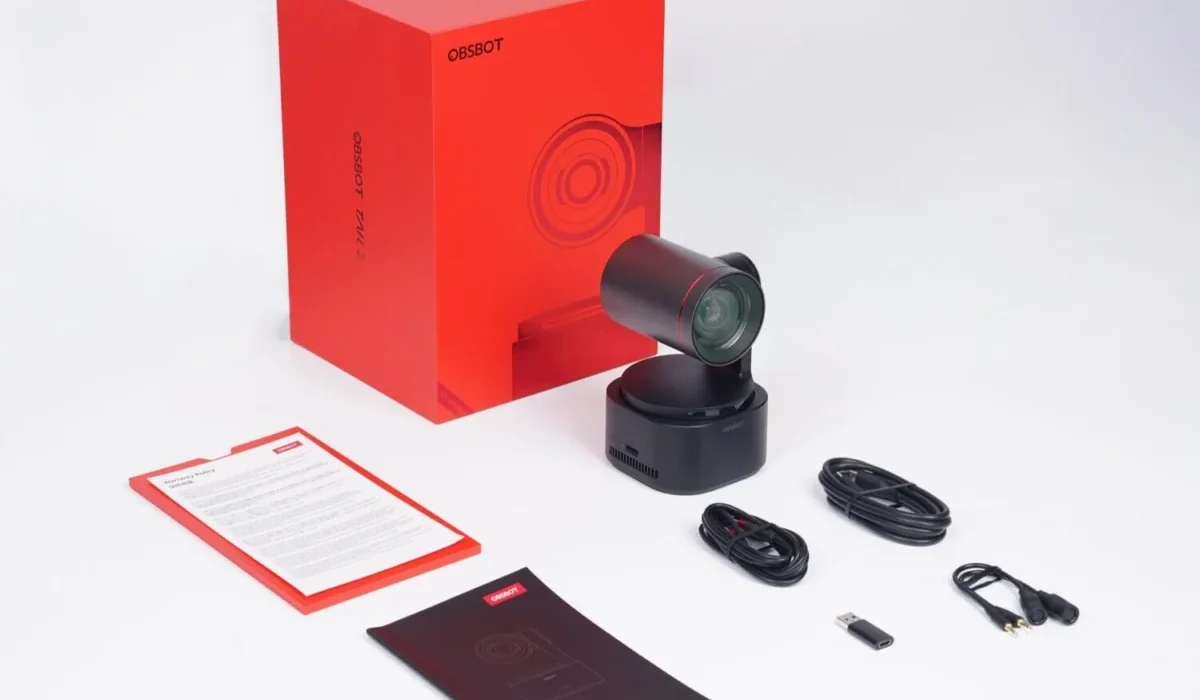
The landscape of professional content creation has undergone a tectonic shift over the past five years, moving away from static, tripod-mounted studio setups toward dynamic, autonomous production workflows. Obsbot, a company that has established itself as a frontrunner in AI-integrated camera hardware, has officially announced the launch of the Tail Air 2. This device represents a significant leap forward in the evolution of robotic, intelligent camera systems, specifically tailored to meet the rigorous demands of solo content creators, high-end live streamers, and multi-camera production teams.
Technical Evolution and Hardware Specifications
At the heart of the Tail Air 2 is a newly engineered 1-inch CMOS sensor, a substantial upgrade that directly addresses the industry’s ongoing demand for superior light sensitivity and dynamic range. When paired with a wide f/1.9 aperture, the camera is designed to thrive in challenging, low-light conditions—a common pain point for independent creators operating in home studios or event spaces with inconsistent lighting.
Beyond the sensor, the Tail Air 2 integrates a sophisticated mechanical design headlined by a new roll axis. This feature allows the lens to physically rotate 90 degrees, providing a true native vertical 4K video capture. This is a critical development for social media optimization. Unlike previous generations of cameras that relied on digital cropping—which often discards pixels and compromises image fidelity—the Tail Air 2 maintains full sensor resolution for platforms such as TikTok, Instagram Reels, and YouTube Shorts. Furthermore, this motorized roll axis enables automatic horizon leveling, a feature that ensures stable, professional-grade framing even when the device is deployed on uneven or non-standard mounting surfaces.
The imaging pipeline is bolstered by 4K video recording capabilities at up to 60 frames per second (FPS), with a specialized 1080p mode reaching 120 FPS for high-quality slow-motion sequences. For advanced users, the inclusion of an 8-bit log color profile and the ability to load custom Look-Up Tables (LUTs) directly through the companion app suggests that Obsbot is positioning this unit not just as a "webcam," but as a legitimate tool for cinematic production. Phase-detection autofocus and LOFIC (Lateral Overflow Integration Capacitor) HDR mode further ensure that the camera can manage high-contrast environments without losing detail in the shadows or highlights.
Chronology of Obsbot’s Market Expansion
The journey to the Tail Air 2 began with the company’s initial forays into gesture-controlled hardware. In early 2019, the debut of the Obsbot Tail introduced the concept of AI-based subject tracking to a consumer audience. The reception of that first device highlighted a clear demand for autonomous filming assistants. However, early users noted limitations in software processing speed and sensor quality.

By 2022, the launch of the original Tail Air refined these concepts, introducing a more portable form factor and improved connectivity. This allowed for the integration of the camera into professional live-streaming workflows. The release of the Tail Air 2, slated for shipping on December 8, represents the culmination of three years of user feedback, software refinement, and hardware integration. The company’s trajectory has consistently trended toward replacing the "cameraman" role with algorithms, effectively lowering the barrier to entry for high-quality, multi-angle production.
AI Tracking 2.0: The Intelligence Layer
The core differentiator of the Obsbot ecosystem remains its AI-driven tracking software. The newly introduced AI Tracking 2.0 is an evolutionary step, significantly expanding the camera’s recognition capabilities. While earlier iterations were primarily optimized for human facial and torso tracking, the 2.0 system is now capable of identifying and maintaining focus on over 30 animal species and more than 200 distinct object categories.
This level of granular recognition is achieved through on-device processing, which minimizes latency—a vital requirement for live broadcasts where every millisecond of lag can lead to a "lost" shot. By reducing the reliance on cloud-based processing, the Tail Air 2 ensures that tracking remains consistent even in environments with poor internet connectivity, a frequent reality for location-based creators.
Connectivity and Professional Integration
For the professional broadcast market, the Tail Air 2 addresses the necessity for modular integration. The device features a robust I/O suite including dual USB ports, a Micro HDMI output, and a dedicated microSD card slot. Wireless performance is upgraded to Wi-Fi 6, ensuring stable data transmission during high-bandwidth 4K streaming.
Perhaps most significant for the broadcast industry is the camera’s support for industry-standard protocols such as SRT, RTSP, and RTMP. These allow the camera to be integrated directly into hardware switchers and software-based production environments like OBS Studio or vMix. Furthermore, the inclusion of timecode and Precision Time Protocol (PTP) synchronization allows the Tail Air 2 to operate in perfect harmony with other cameras in a multi-angle setup. This is a deliberate design choice aimed at small production houses that previously required significantly more expensive, human-operated equipment to achieve similar levels of synchronization.
Market Implications and Industry Context
The introduction of the Tail Air 2 occurs at a time when the "creator economy" is increasingly consolidating around professional-grade production values. Data from current market analysis suggests that the demand for automated production tools has seen a 22% year-over-year growth, driven primarily by the need for companies to produce high-quality internal training videos, remote presentations, and social media content without the overhead of a dedicated production crew.

By offering a specialized version with pre-activated NDI HX3 support for $999—alongside the base model at $799—Obsbot is explicitly targeting two tiers of users. The standard model serves the individual content creator, while the NDI-enabled version positions the Tail Air 2 as an affordable solution for enterprise-level AV setups, such as lecture halls, corporate boardrooms, and event venues.
Industry analysts have noted that the hardware specifications of the Tail Air 2 place it in direct competition with traditional mirrorless cameras that have been repurposed for streaming. However, the Tail Air 2’s distinct advantage is its "plug-and-play" robotic nature. While a mirrorless camera might offer superior lens interchangeability, it requires a human operator or a secondary, less-sophisticated gimbal system to track movement. Obsbot’s value proposition is the elimination of these extra components, offering a unified, all-in-one solution that reduces the complexity of the "setup-to-broadcast" pipeline.
Future-Proofing the Production Pipeline
The shift toward native vertical video is perhaps the most salient indicator of where the market is headed. As major social media platforms continue to prioritize short-form vertical content over traditional landscape formats, hardware manufacturers are being forced to adapt. The Tail Air 2’s physical rotation mechanism is a direct response to this trend. It acknowledges that for a modern creator, the ability to switch between 16:9 for YouTube and 9:16 for TikTok is not a secondary concern, but a primary requirement.
Moreover, the integration of log color profiles and LUT support signals that Obsbot is paying attention to the color-grading needs of modern editors. By allowing creators to bake in a "look" or preserve a flat image for later grading, the company is bridging the gap between "consumer-grade" and "prosumer" hardware.
Conclusion and Availability
The Obsbot Tail Air 2 is currently available for pre-order, with the official shipping window beginning on December 8. As the market for live-streaming equipment becomes increasingly saturated with budget-tier webcams and over-engineered cinema cameras, the Tail Air 2 occupies a specific niche. It offers the automation of a robotic PTZ (Pan-Tilt-Zoom) camera with the compact, portable design of a lifestyle device.
Whether this device will succeed in fully disrupting the small-studio market remains to be seen. However, by focusing on high-end imaging hardware—specifically the 1-inch sensor—and professional-grade protocols like PTP and NDI, Obsbot has signaled that it is no longer satisfied with being a niche player in the webcam market. Instead, the company is making a concerted effort to provide the foundation for a new generation of automated, high-fidelity production environments. For the solo creator, this represents a significant increase in capability, effectively allowing a single person to manage the output of what would have previously required a multi-person crew. As the technical specifications move toward 4K60 and HDR, the distinction between a "home-made" stream and a professional broadcast continues to narrow, with the Tail Air 2 sitting firmly at the center of that convergence.