










The release of the Lenovo Legion Tab Gen 5 marks a significant attempt by the Chinese technology giant to recapture the niche market of high-performance, small-form-factor gaming tablets. Historically, the category of "portable gaming slates" has been sparse, with the most notable predecessor being the Nvidia Shield Tablet, which gained cult status in the mid-2010s for its focus on mobile emulation and front-facing audio. Lenovo’s latest iteration arrives at a critical juncture for the Android ecosystem, where hardware manufacturers are increasingly competing with dedicated handheld consoles like the Steam Deck and the Nintendo Switch. Despite its technical capability, the device enters a crowded market facing scrutiny over its $900 price point, software optimization, and the absence of premium display technology.

The Evolution of the Portable Gaming Slate
The journey of the compact gaming tablet is one of peaks and valleys. When Nvidia discontinued the Shield Tablet following the K1 refresh, a void was left in the market for users who preferred a screen larger than a smartphone but more portable than a traditional 12-inch tablet. Lenovo has attempted to bridge this gap through five generations of the Legion Tab series.
The progression of the Legion Tab line has been characterized by consistent iterative hardware updates. The Gen 3 model, released in 2025, established the baseline design language: an 8.8-inch display, a robust internal cooling system, and a focus on high-refresh-rate gaming. By the time the Gen 5 reached the market in late 2026, the industry had shifted its focus toward PC emulation, with software platforms like DroidDeck allowing users to run traditional x86 games on ARM-based Android architecture. This shift has elevated the expectations for hardware; users now demand not just smooth mobile game performance, but the ability to handle more complex computational tasks.

Technical Specifications and Design Constraints
At the heart of the Legion Tab Gen 5 is the Snapdragon 8 Elite chipset, a processor capable of handling demanding titles and complex emulation layers. The device features an 8.8-inch 16:10 LCD panel, which offers high resolution and fast response times. However, the reliance on LCD technology in a flagship-priced device has drawn criticism. In an era where OLED panels have become standard for competitive mobile gaming due to their superior contrast ratios and true black levels, the choice of an LCD panel at the $900 price point creates a significant value proposition challenge.
Physically, the device echoes the industrial design of the original Shield Tablet. It features a matte-black, boxy chassis and weighs approximately 360 grams. While this weight provides a premium feel, it introduces ergonomic challenges during extended portrait-mode sessions. Furthermore, the inclusion of a prominent camera bump—a design choice often criticized by power users—prevents the tablet from lying flush on flat surfaces.

One of the device’s most notable design successes is the placement of its stereo speakers. Unlike many competing tablets where the user’s hands inadvertently muffle the audio output, the Legion Tab Gen 5 aligns its speakers along the right side of the device in landscape orientation. This configuration ensures consistent audio delivery, though the absence of a 3.5mm headphone jack remains a point of contention for a device marketed specifically toward the gaming demographic.
Software Hurdles and Optimization Concerns
While the hardware possesses significant potential, the software experience remains the most pressing issue for the Legion Tab Gen 5. The device runs on a version of Android that, according to initial reports, suffers from inconsistent optimization. Users have documented a recurring bug where the display becomes locked at 60Hz, failing to utilize the panel’s higher refresh rate capabilities.

Beyond frame rate inconsistencies, the user interface exhibits signs of "bloatware" that detract from the premium experience. During the initial setup process, the device prompts users to install a variety of third-party applications and games—including various match-three titles and utility apps—which is an uncommon practice for devices at this price bracket.
Furthermore, the lack of advanced biometric security is a notable omission. The device relies exclusively on camera-based face recognition, which often struggles in low-light environments. The absence of an under-display or side-mounted fingerprint scanner forces users to rely on PIN entry, which is significantly less efficient for a portable device intended for quick gaming sessions.

Emulation and Performance Capabilities
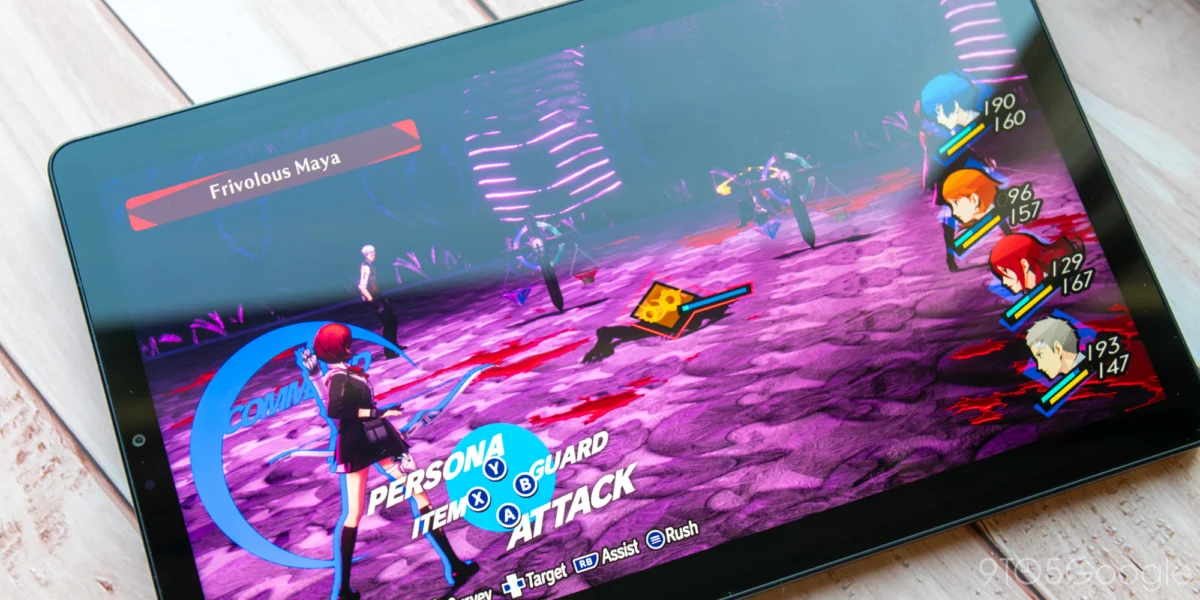
The primary selling point for the Legion Tab Gen 5 is its capability to function as a bridge between mobile gaming and PC gaming. Using software like DroidDeck, users have successfully accessed titles such as Persona 3 Reload. While the hardware can run these titles, the experience is not without caveats. Users must frequently adjust graphical presets to low to maintain stability, and occasional frame rate dips are common in more intensive scenes.
The device’s battery life is generally considered a strong point. Despite the power-intensive nature of emulation, the tablet’s longevity during media consumption and casual gaming is sufficient for most use cases. The inclusion of a 68W fast-charging adapter and the presence of two USB-C ports—allowing for convenient charging in both landscape and portrait orientations—are thoughtful additions that improve the daily utility of the device.

Market Position and Competitive Analysis
The financial viability of the Legion Tab Gen 5 is perhaps its most significant barrier to adoption. At an $850 to $900 launch price, it exceeds the cost of the Apple iPad Mini, which occupies a similar physical footprint. Additionally, the device is priced $100 higher than the base model OLED Steam Deck. For the average consumer, the comparison to the Steam Deck is unfavorable; the latter offers a purpose-built gaming ecosystem, physical controls, and a more mature software environment.
Lenovo has attempted to mitigate this by occasionally offering promotional discounts, bringing the price down to $700. However, even at this reduced rate, the value remains questionable given the lack of an OLED display and the presence of software-level bugs. Analysts suggest that the device is effectively a "first-generation" attempt at the current hardware iteration, with consumers likely to find more value in the anticipated Gen 6 model, which rumors suggest will finally feature an OLED display and 5G connectivity.

Broader Implications for the Tablet Market
The Legion Tab Gen 5 reflects a broader trend in the tech industry where manufacturers are attempting to monetize the "pro-gamer" aesthetic and high-performance branding in the tablet space. While the demand for high-end small tablets exists, the current execution by Lenovo highlights the difficulty of achieving a balance between mobile portability and the performance demands of modern gaming.
The device serves as a case study in the importance of software-hardware synergy. Even with top-tier silicon like the Snapdragon 8 Elite, a device cannot achieve market success if the underlying operating system feels unoptimized or if the physical hardware fails to meet the expectations of its price bracket. As the industry moves toward 2027, the success of tablets like the Legion series will depend on whether manufacturers can move away from the "rough-and-ready" approach to AOSP (Android Open Source Project) and toward a more polished, user-centric software experience.

Conclusion and Future Outlook
The Lenovo Legion Tab Gen 5 is a device caught between two worlds. It is too expensive for the casual media consumer and too unrefined for the hardcore enthusiast who likely already owns a specialized handheld console. While its physical build and smart speaker placement show promise, the combination of software bugs, lack of biometric security, and a dated display technology make it difficult to recommend in its current state.
For those who are determined to purchase a small, gaming-focused Android tablet, the most prudent course of action is to wait for the next iteration. As emulation software continues to evolve, the underlying hardware will become increasingly important, but the current Gen 5 model serves better as a proof-of-concept than a finished product. Unless a significant price correction occurs or major software patches address the current stability issues, the Legion Tab Gen 5 remains a niche curiosity rather than a standard-bearer for the future of mobile gaming.