
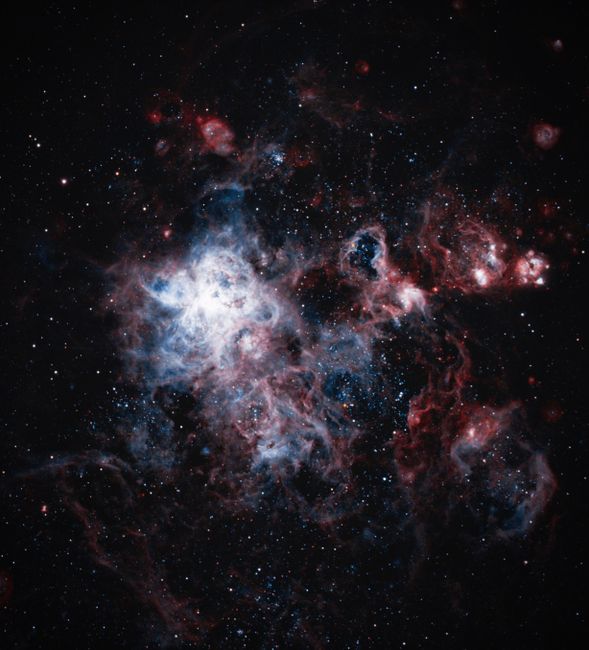
Euclid Telescope Unleashes First Stunning Space Data Images, Unveiling the Universe’s Dark Secrets
The European Space Agency’s (ESA) Euclid telescope has officially transitioned from its calibration and commissioning phase to delivering its first science-ready data images to the public and scientific community. This momentous occasion marks the beginning of a new era in cosmology, promising to revolutionize our understanding of dark energy and dark matter, the enigmatic forces believed to shape the universe’s evolution and structure. The initial release showcases Euclid’s remarkable capabilities, featuring breathtaking views of galaxies and nebulae, but more importantly, it provides the crucial data that will underpin years of groundbreaking research. These first images, while aesthetically pleasing, are a testament to the sophisticated instrumentation onboard Euclid and its potential to map the universe with unprecedented precision. The telescope’s primary mission is to observe billions of galaxies across the cosmos, charting their positions and shapes to infer the distribution of dark matter and the expansion history of the universe. This comprehensive survey aims to shed light on the nature of dark energy, the mysterious force accelerating cosmic expansion, and dark matter, the invisible substance that provides the gravitational scaffolding for galaxies and galaxy clusters. Euclid’s unique design, optimized for surveying vast swathes of the sky with exceptional clarity, positions it as a crucial instrument in answering some of the most profound questions in modern physics and astronomy. The telescope’s instruments, the Visible and Near-Infrared Spectrometer (VIS) and the Near-Infrared Spectrometer and Photometer (NISP), work in tandem to capture a wealth of information about celestial objects. VIS is responsible for imaging, while NISP offers both spectroscopic and photometric capabilities, allowing scientists to determine the distances to galaxies and analyze their chemical composition. The success of this initial data release is a direct result of rigorous testing and calibration, ensuring that the images and associated data are accurate and reliable for scientific analysis. The scientific community has eagerly awaited these first glimpses of Euclid’s observational power, and the initial results are already exceeding expectations, promising a wealth of new discoveries.
The first science images released by Euclid provide a tantalizing preview of the telescope’s capabilities and the vast scientific potential it holds. Among the highlights are stunning portrayals of the Perseus Cluster, a colossal assembly of galaxies, and the dramatic spiral galaxy NGC 6872, also known as the Condor Galaxy. These images are not merely aesthetically pleasing; they represent a significant leap forward in our ability to study the cosmos. The Perseus Cluster, one of the most massive structures in the universe, offers Euclid a prime target for understanding how dark matter influences the formation and evolution of galaxy clusters. By meticulously mapping the shapes of the galaxies within the cluster, scientists can infer the distribution of invisible dark matter, which exerts a powerful gravitational influence. Similarly, NGC 6872, a highly elongated spiral galaxy, provides a unique laboratory for studying the intricate interplay between galactic dynamics and the underlying dark matter halo. Euclid’s resolution and sensitivity allow for detailed analysis of these cosmic structures, revealing subtle features that were previously obscured. Beyond these individual objects, Euclid’s survey will systematically map millions of galaxies, enabling statistical studies of their distribution and evolution. This large-scale mapping is crucial for unraveling the mysteries of dark energy, which drives the accelerated expansion of the universe. By measuring how the distances and recession velocities of galaxies have changed over cosmic time, cosmologists can constrain the properties of dark energy. The accuracy of these measurements is paramount, and Euclid’s advanced instrumentation, coupled with sophisticated data processing techniques, ensures that the gathered information is of the highest scientific caliber. The NISP instrument, in particular, plays a vital role by enabling the measurement of redshifts for millions of galaxies. Redshift is a direct indicator of a galaxy’s distance and recession velocity, making it a cornerstone of cosmological studies. The ability to accurately determine redshifts for such a vast number of objects is a key factor in Euclid’s groundbreaking potential. The initial data release signifies the culmination of years of dedicated effort by thousands of scientists and engineers, and it represents a powerful testament to international collaboration in space exploration.
The scientific objectives underpinning the Euclid mission are ambitious and directly address some of the most pressing questions in fundamental physics and cosmology. At its core, Euclid is designed to probe the nature of dark energy and dark matter. These two components, collectively comprising approximately 95% of the universe’s energy density, remain largely mysterious. Dark energy is thought to be responsible for the observed acceleration of the universe’s expansion, a phenomenon that challenges our current understanding of gravity and the universe’s ultimate fate. Dark matter, on the other hand, is inferred from its gravitational effects on visible matter and light, acting as the invisible scaffolding upon which galaxies and larger cosmic structures are built. Euclid’s primary method for studying dark energy involves precisely measuring the expansion history of the universe. This is achieved by observing the shapes and distances of billions of galaxies across a vast range of cosmic epochs. By studying how the distribution of galaxies has changed over time, scientists can infer how the expansion rate has varied. This variation is directly linked to the properties of dark energy. The shape of galaxies is also a crucial observable. Weak gravitational lensing, a phenomenon where the gravity of intervening matter distorts the light from distant galaxies, allows astronomers to map the distribution of dark matter. Euclid’s exceptional imaging capabilities enable it to measure these subtle distortions with unprecedented precision, providing detailed maps of the dark matter distribution throughout the universe. The galaxy clustering technique is another cornerstone of Euclid’s science plan. By studying how galaxies cluster together, scientists can gain insights into the gravitational influence of dark matter and the expansion rate of the universe. The patterns of galaxy clustering are sensitive to the underlying dark matter distribution and the overall geometry of the universe. The baryon acoustic oscillations (BAO) are a particularly important imprint in the distribution of galaxies. These are relic sound waves from the early universe that have left a characteristic scale in the distribution of matter, acting as a standard ruler for measuring distances in cosmology. Euclid’s vast survey will allow for precise measurements of the BAO feature across different cosmic epochs, providing robust constraints on the expansion history of the universe. The synergy between these different observational probes – weak lensing, galaxy clustering, and BAO – is what makes Euclid so powerful. By combining data from these independent methods, scientists can build a more complete and robust picture of the universe’s evolution and the nature of its dominant, yet elusive, components. The success of the mission relies on achieving unprecedented statistical precision, requiring extremely large datasets and meticulous control over systematic errors. The first science data release is a critical step in validating these efforts and paving the way for groundbreaking scientific discoveries.
The technological prowess of the Euclid telescope is central to its scientific mission and the quality of the data it produces. Launched in July 2023, Euclid is equipped with two state-of-the-art instruments: the Visible and Near-Infrared Spectrometer (VIS) and the Near-Infrared Spectrometer and Photometer (NISP). VIS is the primary imaging instrument, designed to capture high-resolution images across a broad range of visible and near-infrared wavelengths. Its large field of view allows it to survey vast areas of the sky efficiently, a crucial requirement for a mission focused on mapping billions of galaxies. The instrument boasts an impressive 600-megapixel sensor, capable of capturing intricate details in distant celestial objects. The NISP instrument complements VIS by providing both spectroscopic and photometric capabilities. Photometry involves measuring the brightness of celestial objects in different wavelength bands, which, when combined with redshift information, allows for distance estimations. Spectroscopy, on the other hand, splits light into its constituent wavelengths, revealing information about an object’s chemical composition, temperature, and velocity. NISP’s ability to measure redshifts for millions of galaxies is fundamental to Euclid’s cosmological investigations. The telescope itself is designed for long-term stability and precise pointing, essential for the sensitive measurements required for weak lensing studies. Its orbit around the Sun-Earth L2 Lagrange point provides a stable thermal environment and minimizes interference from Earth’s light and gravity, further enhancing observational quality. The data processing pipeline for Euclid is also a critical component of the mission’s success. Raw data from the instruments undergoes a rigorous processing chain that includes calibration, sky subtraction, and image reconstruction. Advanced algorithms are employed to extract meaningful scientific information from the vast amount of data generated. The quality of these first science images is a testament to the meticulous design, construction, and testing of both the telescope and its instruments, as well as the sophisticated data processing techniques that are being employed. The ability of Euclid to simultaneously capture high-quality images and spectral information across its wide field of view is a significant advancement over previous missions, enabling a more comprehensive and efficient approach to cosmological surveys. The careful selection of wavelengths covered by both VIS and NISP is optimized to minimize atmospheric absorption (relevant for ground-based telescopes) and to capture the spectral signatures that are most informative for cosmological studies, particularly in the near-infrared where the light from distant galaxies is redshifted.
The impact of Euclid’s first science data on the field of cosmology will be profound and far-reaching. The release of these meticulously processed images and associated data marks the official commencement of Euclid’s legacy, ushering in an era of unprecedented precision in our understanding of the universe’s fundamental constituents and evolution. Cosmologists have long sought to pin down the precise nature of dark energy, a force that continues to defy conventional explanations. Euclid’s observations, particularly its ability to map the expansion history of the universe with exquisite accuracy through the analysis of galaxy clustering and baryon acoustic oscillations, will provide tight constraints on cosmological models. This will allow scientists to differentiate between various theoretical explanations for dark energy, such as a cosmological constant or more dynamic theories. Similarly, the precise mapping of dark matter distribution through weak gravitational lensing will shed light on its particle nature and its role in structure formation. The detailed maps of dark matter halos around galaxies and galaxy clusters will allow for direct tests of models of dark matter, potentially revealing deviations from standard predictions or even pointing towards new physics. The statistical power of Euclid’s survey, encompassing billions of galaxies, will enable the exploration of rare cosmological events and phenomena, potentially uncovering unexpected insights into the universe’s past and future. Beyond the overarching goals of understanding dark energy and dark matter, Euclid’s data will also contribute to a wide range of other astronomical research areas. The telescope’s sensitivity and wide field of view make it an exceptional tool for studying galaxy evolution, star formation, and the properties of exoplanetary systems. The wealth of data will undoubtedly lead to serendipitous discoveries, as is often the case with large-scale astronomical surveys. The scientific community is poised to engage in intensive research, analyzing the released data to publish groundbreaking findings. The availability of these first science-ready datasets marks a critical milestone, allowing researchers worldwide to begin their investigations and contribute to our collective understanding of the cosmos. The long-term implications of Euclid’s mission are immense, with the potential to fundamentally alter our perception of the universe and our place within it, solidifying its position as one of the most important astronomical observatories of the 21st century. The commitment to open data sharing, as exemplified by this initial release, ensures that the scientific benefits of the Euclid mission will be maximized, fostering global collaboration and accelerating the pace of discovery in cosmology and astrophysics.
