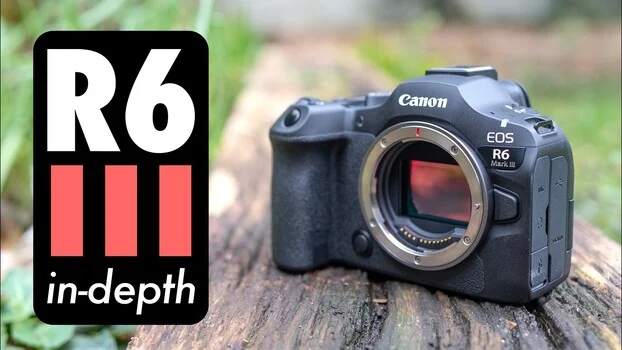
Choosing between the Canon EOS R6 Mark III and the Sony a7 V at the same price point is genuinely difficult, and the spec sheets don’t tell the whole story. Both cameras launched within a month of each other in late 2025, making a direct comparison not just useful but necessary before you hand over that kind of money. Coming to you from Gordon Laing of Camera Labs, this thorough video puts the Canon EOS R6 Mark III through its paces against the Sony a7 V and the Panasonic Lumix S5 II, covering resolution, noise, dynamic range, rolling shutter, autofocus, burst performance, and more. Laing also compares the R6 Mark III directly to the Canon EOS R6 Mark II, which will continue selling at a lower price, making the upgrade question very real. One of the more surprising findings is that the R6 Mark III’s sensor, though not stacked or back-illuminated like the a7 V’s, performs almost identically in real-world resolution, noise, and even rolling shutter tests. Laing shoots side by side with both cameras on the same rig, so the comparisons are as controlled as you’re likely to see outside a lab.
Unpacking the Latest Mirrorless Contenders
The late 2025 camera release window saw a highly anticipated dual debut from industry giants Canon and Sony, introducing their latest iterations in the highly competitive full-frame mirrorless segment. The Canon EOS R6 Mark III and the Sony a7 V, both positioned at a similar flagship price point of approximately $2,800 USD, represent the culmination of years of technological advancement and consumer feedback. This parity in launch timing and pricing necessitates a granular examination, moving beyond the often-hyped specifications to understand their real-world performance and user experience.
Gordon Laing, a respected figure in the photography review community, has provided an in-depth comparative analysis in a recent video from his popular YouTube channel, Camera Labs. His comprehensive review pits the Canon EOS R6 Mark III head-to-head not only against its primary competitor, the Sony a7 V, but also includes the Panasonic Lumix S5 II for broader context. The investigation delves into critical aspects that directly impact image quality and shooting workflow, including resolution, noise handling across various ISO sensitivities, dynamic range capabilities, the prevalence and impact of rolling shutter distortion, autofocus system performance, and the sustained burst shooting capabilities.
A Direct Lineage: R6 Mark III vs. R6 Mark II
Beyond the direct rivalry with Sony, Laing’s review also addresses a crucial internal comparison: the Canon EOS R6 Mark III versus its predecessor, the Canon EOS R6 Mark II. With the Mark II expected to remain on the market at a reduced price point, the decision for existing R6 Mark II owners to upgrade becomes a significant consideration. This aspect of the review is particularly valuable for understanding the tangible benefits offered by the latest generation and whether they justify the premium.
One of the most intriguing revelations from Laing’s testing is the performance parity observed between the R6 Mark III’s sensor and that of the a7 V, particularly in key areas of image quality. Despite the Sony a7 V featuring what is generally understood to be a more advanced sensor design – potentially incorporating stacked or back-illuminated technology for enhanced speed and light-gathering – the R6 Mark III’s sensor delivers nearly identical results in real-world resolution, noise performance, and even in mitigating rolling shutter effects. This suggests that Canon has achieved remarkable efficiency with their sensor technology, achieving comparable output through potentially different engineering pathways. The methodology employed by Laing, utilizing a side-by-side shooting setup on identical rigs, ensures a high degree of control and comparability, offering a level of scientific rigor often absent in casual reviews.
Autofocus Prowess: Tracking Birds in Flight and Beyond
The autofocus systems of modern mirrorless cameras are often the most significant differentiator for photographers, particularly those engaged in action, wildlife, or sports photography. Laing’s review dedicates substantial attention to this critical area, employing a multi-stage testing protocol. The initial phase involved simultaneous testing of both cameras in a controlled garden environment, likely assessing general subject acquisition and tracking in less demanding scenarios.
The real test, however, came with a trip to Brighton Seafront, where the cameras were tasked with capturing seagulls in flight. This challenging scenario demands exceptional speed, accuracy, and sustained tracking capabilities. Utilizing the Canon RF 100-500mm zoom lens on the R6 Mark III, Laing observed a distinct advantage for the Canon camera. The R6 Mark III demonstrated a superior ability to acquire and maintain focus on birds at considerably greater distances compared to the Sony a7 V. Furthermore, it exhibited more consistent subject lock, even as the birds changed direction or presented their less-than-ideal profile. This indicates a refined subject recognition and tracking algorithm within the R6 Mark III, crucial for photographers who rely on capturing fleeting moments of action.
Burst Speed, Buffers, and Storage: Pushing the Limits
Beyond autofocus accuracy, the ability to capture rapid sequences of images is paramount for freezing fast-paced action. The Canon EOS R6 Mark III boasts an impressive electronic shutter speed of 40 frames per second, significantly outstripping the Sony a7 V’s 30 frames per second. This difference in burst rate, when combined with the varying performance characteristics of different memory card formats like CFexpress Type B and SD cards, presents a practical examination of buffer depth and write speeds. Laing’s review subjects these elements to a real-world workout, revealing how effectively each camera manages sustained high-speed shooting and the impact of storage media on workflow continuity.
The review also highlights several advanced shooting modes where the R6 Mark III appears to offer a more robust or distinct feature set. Pre-burst capture, a feature that records images before the shutter button is fully pressed, focus bracketing for enhanced depth of field in macro or product photography, multiple exposure capabilities, and interval shooting for time-lapse creation are all explored. Laing details how the R6 Mark III either surpasses the a7 V in these functions or offers unique implementations that provide tangible benefits to specific shooting disciplines. This detailed breakdown allows potential buyers to assess which camera’s feature set aligns best with their creative and professional needs.
Ecosystem Considerations: The Lens Conundrum
A critical, yet often overlooked, aspect of camera system investment is the lens ecosystem. Canon’s proprietary RF mount has been a subject of discussion regarding its openness to third-party manufacturers. Laing points out a persistent limitation: Canon’s continued restriction on full-frame autofocus lenses from third-party brands for their RF mount. For Sony users, this is not an issue; they benefit from a vast and mature ecosystem that includes native autofocus lenses from established manufacturers like Sigma and Tamron, alongside Sony’s own extensive range. This access to a wider variety of lens options at potentially more competitive price points represents a significant cost consideration, especially for photographers building a new kit from the ground up or expanding an existing one. The R6 Mark III’s reliance solely on Canon-branded RF full-frame autofocus lenses, at least for now, could represent a substantial long-term financial commitment for users.
Image Fidelity: RAW Bit Depth and Practical Implications
In the realm of professional imaging, the fidelity of the captured RAW data is paramount for post-production flexibility. Laing’s review touches upon a technical detail that could influence image manipulation: the R6 Mark III’s switch to 12-bit RAW when utilizing its electronic shutter. In contrast, the Sony a7 V maintains 14-bit RAW output even when shooting at its maximum electronic shutter speed of 30 frames per second. While 14-bit RAW offers a broader spectrum of color and tonal information compared to 12-bit, Laing’s practical assessment suggests that in most typical field conditions, the difference in image quality is difficult to discern. However, for photographers who push their images to the extreme in post-processing, particularly in challenging lighting situations where significant shadow recovery or highlight manipulation is required, this difference in bit depth could become a factor. Understanding this technical nuance is essential for photographers who demand the utmost flexibility in their editing workflow.
Hardware Enhancements and User Interface
Beyond sensor and processing capabilities, hardware design and user interface play a crucial role in the overall camera experience. The Canon EOS R6 Mark III incorporates several notable hardware upgrades that enhance its usability. The inclusion of a CFexpress Type B card slot alongside the traditional SD card slot addresses the need for faster storage for high-bandwidth shooting modes. The transition from a micro-HDMI port to a full-size HDMI port is a welcome change for videographers and tethered shooting setups, offering a more robust and reliable connection.
Furthermore, the R6 Mark III adopts a face-registration priority system, a feature that has proven highly effective in Canon’s higher-end EOS R5 Mark II model. This advanced facial recognition technology is designed to prioritize specific individuals in focus, a feature that could be particularly beneficial for wedding photographers, sports shooters, or anyone documenting events where consistent focus on key subjects is critical. Laing’s observations suggest that this system is particularly well-implemented and effective in its intended applications.
The Verdict: A $2,800 Decision
The comprehensive analysis presented in Gordon Laing’s video offers a deep dive into the practical performance of the Canon EOS R6 Mark III and its key competitors. The review meticulously breaks down the strengths and weaknesses of each camera across a wide array of shooting scenarios. For those contemplating a significant investment in a new full-frame mirrorless camera at the $2,800 price point, the video serves as an invaluable resource. It provides not only a wealth of sample images and footage but also Laing’s final, considered verdict on whether the Canon EOS R6 Mark III, its predecessor the R6 Mark II, or the Sony a7 V ultimately merits the expenditure. The decision hinges on a careful evaluation of individual shooting needs, existing lens investments, and priorities regarding autofocus performance, burst shooting capabilities, and ecosystem openness.