The evolution of Retrieval-Augmented Generation (RAG) systems has increasingly shifted away from traditional vector-only searches toward structured, graph-based architectures. While standard vector databases excel at semantic similarity matching, they frequently suffer from hallucinations, context fragmentation, and an inability to resolve conflicting factual claims deterministically. Recent breakthroughs in deterministic, multi-tiered Graph-RAG systems—such as those leveraging lightweight Python-based Quadstore databases—have demonstrated that grounding LLMs in structured ontological facts drastically enhances factual accuracy.
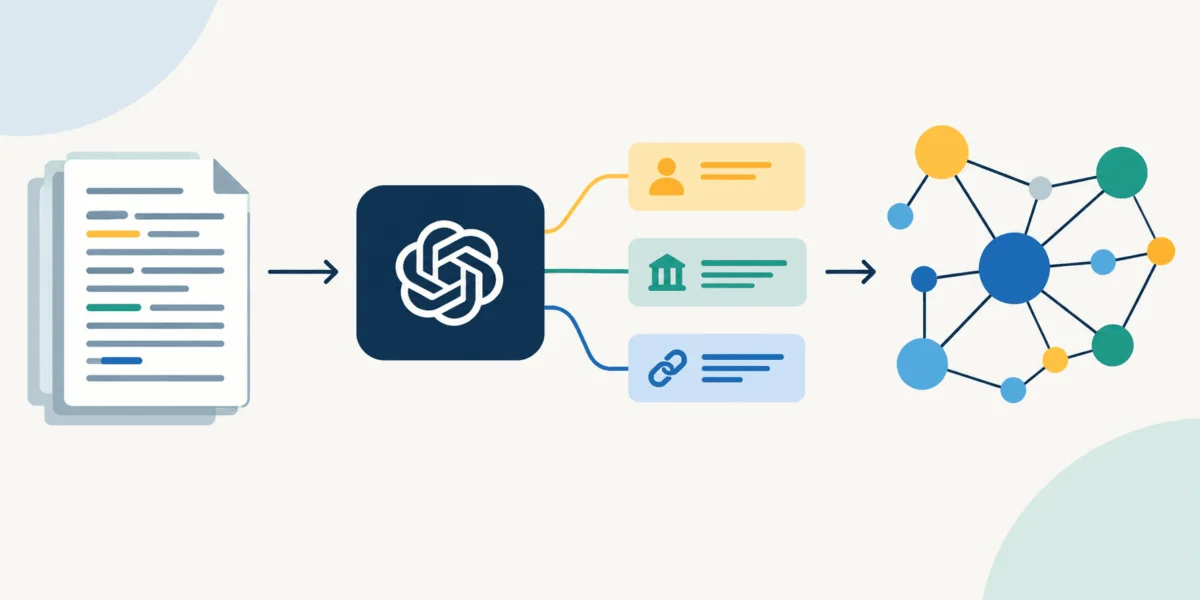
However, a critical bottleneck has persisted in the knowledge engineering lifecycle: the acquisition phase. While utilizing a graph database ensures rigorous query resolution and conflict management, the foundational knowledge graph must first be populated. Historically, this required complex, manual ontology design, brittle regular expression parsers, or expensive commercial extraction pipelines. Today, developers and data architects can leverage localized, open-source Large Language Models (LLMs) via tools like Ollama to automate the ingestion of raw text into structured data. By extracting Subject-Predicate-Object-Context (SPOC) quads from unstructured sources such as Wikipedia, organizations can rapidly build domain-specific knowledge graphs at zero marginal API cost.
The Mechanics of SPOC Quads in Modern Knowledge Graphs
To understand the necessity of automated knowledge graph population, one must first examine the data structures powering modern deterministic RAG engines. Traditional Resource Description Framework (RDF) triples consist of a Subject, a Predicate, and an Object—for example, ("LeBron James", "plays_for", "Lakers"). While functional for static datasets, standard triples lack provenance. In real-world enterprise applications, data is dynamic, contradictory, and source-dependent. A fact that is true in one document may be outdated or false in another.
To solve this, advanced graph architectures utilize SPOC quads, which append a fourth dimension: the Context. A SPOC quad takes the form (Subject, Predicate, Object, Context). Expanding our previous example, the quad becomes ("LeBron James", "plays_for", "Lakers", "NBA_2023_Roster").
The Context parameter serves multiple critical functions within an information retrieval pipeline. First, it establishes immediate provenance, allowing the system to trace precisely which document, database table, or web page yielded a specific assertion. Second, it enables temporal and spatial scoping, ensuring that contradictory facts originating from different epochs or viewpoints do not corrupt the foundational knowledge base. Finally, it provides a deterministic filtering mechanism during graph traversal queries, allowing developers to restrict retrieval strictly to verified, highly authoritative contexts.
Prerequisites and Environment Setup
Implementing a local, automated knowledge graph extraction pipeline requires configuring a lightweight runtime environment. The workflow can be deployed seamlessly across cloud-hosted development environments like Google Colab or local Python Integrated Development Environments (IDEs).
For local deployments, administrators must first install the Ollama runtime on their host machine and pull a performant, lightweight model optimized for structured extraction. Llama 3.2 has emerged as a premier choice for these tasks due to its efficient parameter scale, rapid inference speeds, and native support for strict JSON input/output enforcement.
In a cloud notebook environment such as Google Colab, initialization requires updating system packages and installing the necessary binary distributions:
!apt-get update -qq && apt-get install -y -qq zstd
!curl -fsSL https://ollama.com/install.sh | sh
Following the installation of the core server framework, developers must install foundational Python libraries for web retrieval and HTTP communication:
!pip install wikipedia requestsBecause structured extraction demands rigid adherence to schema constraints, the pipeline relies on Ollama’s native JSON formatting capabilities. Using Python’s subprocess module, developers can instantiate the Ollama background daemon and load the target model programmatically:
import subprocess
import time

print("Starting Ollama server...")
process = subprocess.Popen(["ollama", "serve"], stdout=subprocess.DEVNULL, stderr=subprocess.DEVNULL)
time.sleep(3)

print("Pulling Llama 3.2...")
subprocess.run(["ollama", "pull", "llama3.2"])
print("Model ready!")
Constructing the Simulated Quadstore Engine
Before extracting facts from unstructured narratives, developers must establish a data receptacle capable of housing and querying SPOC quads. While enterprise implementations utilize production graph databases, a lightweight, object-oriented mock engine serves as an ideal foundation for prototyping and notebook-based execution.
The following Python script defines a QuadStore class, which can be generated dynamically within a workspace:
class QuadStore:
    def __init__(self):
        self.quads = []

    def add(self, subject, predicate, obj, context):
        """Adds a new SPOC quad to the knowledge graph."""
        quad = (subject, predicate, obj, context)
        if quad not in self.quads:
            self.quads.append(quad)

    def query(self, subject=None, predicate=None, obj=None, context=None):
        """Queries the graph. Returns a list of matching quads."""
        results = []
        for q_sub, q_pred, q_obj, q_ctx in self.quads:
            if (subject is None or subject == q_sub) and
               (predicate is None or predicate == q_pred) and
               (obj is None or obj == q_obj) and
               (context is None or context == q_ctx):
                results.append((q_sub, q_pred, q_obj, q_ctx))
        return results
This class mirrors the fundamental interface of relational quadstores, supporting atomic insertions and multi-parameter filtering. By encapsulating these operations, developers can seamlessly swap out the mock implementation for a persistent graph database once the pipeline moves to production.
Ingesting Raw Text from Unstructured Sources
The primary input for knowledge graph population is unstructured natural language text. To demonstrate automated ingestion, developers can interface directly with public repositories such as Wikipedia using the Python wikipedia library.
To prevent runtime errors caused by automated string normalization (e.g., mistaking proper nouns for common terms), developers should disable auto-suggestions when querying article metadata:
import wikipedia

print("Fetching Wikipedia summary...")
wiki_page = wikipedia.page("Alan Turing", auto_suggest=False)
text_content = wiki_page.summary

paragraphs = text_content.split('n')[:2]
short_text = " " .join(paragraphs)
print(f"Extracted len(short_text) characters of text ready for processing.")
Executing this snippet yields an initial corpus of raw text detailing the life and contributions of historical figures. This text serves as the direct payload for the local LLM extraction engine.
Designing the LLM Extraction Pipeline
Extracting structured triples from free-form prose requires careful prompt engineering and strict programmatic validation. Large Language Models are prone to conversational filler, markdown formatting wrappers, and schema drift. To ensure reliable data ingestion, the extraction function must enforce a zero-temperature generation setting, a deterministic JSON output format, and robust error-handling fallbacks.
The core extraction function communicates directly with the local Ollama API endpoint, instructing Llama 3.2 to parse the source text and return an array of atomic facts:
import json
import requests

def extract_spoc_quads_final(text, context_label, model="llama3.2"):
    prompt = f"""
    You are an expert data extraction algorithm. Extract atomic facts from the text.
    You must output a valid JSON object containing a single key called "facts".
    The value of "facts" must be an array of objects.
    Example output format:

      "facts": [
        "subject": "LeBron James", "predicate": "plays_for", "object": "Lakers",
        "subject": "Lakers", "predicate": "based_in", "object": "Los Angeles"
      ]

    Text to process:
    text
    """

    payload =
        "model": model,
        "prompt": prompt,
        "format": "json",
        "stream": False,
        "temperature": 0.0


    try:
        response = requests.post('http://localhost:11434/api/generate', json=payload)
        response.raise_for_status()
        raw_llm_text = response.json()['response']
        parsed_json = json.loads(raw_llm_text)

        triples = parsed_json.get("facts", [])
        if not triples and isinstance(parsed_json, dict):
            for key, value in parsed_json.items():
                if isinstance(value, list):
                    triples = value
                    break

        quads = []
        for t in triples:
            if not isinstance(t, dict):
                continue
            normalized_t = str(k).lower().strip(): str(v).strip() for k, v in t.items()
            if all(k in normalized_t for k in ('subject', 'predicate', 'object')):
                quads.append(
                    "subject": normalized_t['subject'],
                    "predicate": normalized_t['predicate'],
                    "object": normalized_t['object'],
                    "context": context_label
                )
        return quads
    except Exception as e:
        print(f"Extraction failed: e")
        return []
Executing the Extraction Pipeline
With the extraction function defined, developers can initiate the parsing workflow over the previously fetched Wikipedia corpus.
print("Beginning extraction...n")
extracted_quads = extract_spoc_quads_final(
    text=short_text,
    context_label="Wikipedia_Alan_Turing"
)

for quad in extracted_quads:
    print(f"S: quad['subject']:<20 | P: quad['predicate']:<15 | O: quad['object']:<25 | C: quad['context']")
When processing biographical text concerning Alan Turing, the local LLM systematically decomposes narrative prose into structured assertions. Typical outputs include relationships mapping the subject to professional titles, academic institutions, and historical achievements:
- Subject: Alan Mathison Turing | Predicate: was | Object: an English mathematician, computer scientist, logician, cryptanalyst, philosopher and theoretical biologist | Context: Wikipedia_Alan_Turing
- Subject: Alan Mathison Turing | Predicate: was born | Object: in London | Context: Wikipedia_Alan_Turing
- Subject: Alan Mathison Turing | Predicate: graduated from | Object: King’s College, Cambridge | Context: Wikipedia_Alan_Turing
- Subject: Alan Mathison Turing | Predicate: worked for | Object: the Government Code and Cypher School at Bletchley Park | Context: Wikipedia_Alan_Turing
- Subject: Alan Mathison Turing | Predicate: played a crucial role in | Object: cracking intercepted messages that enabled the Allies to defeat the Axis powers | Context: Wikipedia_Alan_Turing
Loading Extracted Facts into the Quadstore
Once the extraction phase successfully structures raw text into validated SPOC quads, populating the graph database requires a straightforward iterative insertion loop. Developers can import the QuadStore module, instantiate the graph engine, and commit the extracted dataset:
from quadstore import QuadStore

facts_qs = QuadStore()
for quad in extracted_quads:
    facts_qs.add(
        quad["subject"],
        quad["predicate"],
        quad["object"],
        quad["context"]
    )

print(f"Successfully loaded len(extracted_quads) automated facts into the Graph RAG system!")
Broader Implications and Enterprise Impact
The capability to automate knowledge graph population using local, open-source LLMs addresses a foundational limitation in modern artificial intelligence engineering. Historically, organizations seeking to deploy deterministic, graph-augmented retrieval systems faced prohibitive labor costs associated with manual data curation and ontology mapping. By leveraging local runtimes like Ollama paired with models such as Llama 3.2, engineering teams can ingest thousands of pages of internal documentation, regulatory filings, and academic literature with zero external API expenses.
Furthermore, running extraction pipelines locally ensures absolute data privacy. Enterprises operating under strict compliance frameworks—such as healthcare providers governed by HIPAA or financial institutions subject to strict data residency laws—can extract structured knowledge from sensitive documents without exposing proprietary text to third-party cloud vendors.
As the industry continues to move away from purely probabilistic information retrieval toward hybrid architectures that combine vector search with deterministic graph reasoning, automated quad extraction will become a standard component of data ingestion pipelines. By bridging the gap between unstructured text and structured ontological quads, developers can construct robust, hallucination-free AI systems capable of transparently citing their sources and reasoning over verifiable ground-truth facts.