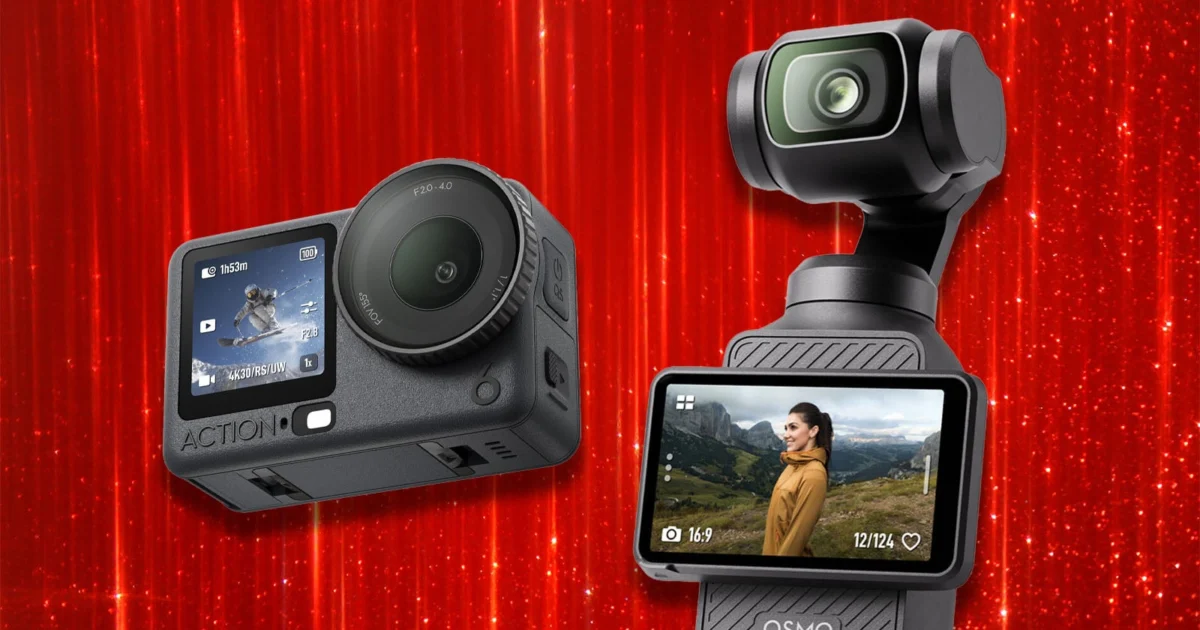
New market intelligence data published by IDC reveals a profound shift in the consumer imaging landscape, highlighting that the global handheld "smart camera" market—comprised of action cameras, 360-degree cameras, and gimbal-integrated devices—has reached a scale that dwarfs the traditional digital camera sector. According to the report, this category, dominated by Chinese technology firms, saw a staggering 83% year-over-year growth in 2025, reaching a total of 16.65 million units shipped. In contrast, the traditional digital camera market, governed by established Japanese manufacturers, remains stable but significantly smaller in volume.
The divergence between these two sectors suggests a fundamental change in how consumers document their lives, shifting from high-end, interchangeable-lens systems toward compact, AI-integrated, and highly portable recording devices.
A Chronology of Market Divergence
To understand the current state of the industry, one must look at the recent trajectory of both markets. For decades, the Camera & Imaging Products Association (CIPA), which tracks the output of major Japanese camera manufacturers such as Canon, Nikon, Sony, Fujifilm, and Olympus, served as the definitive barometer for the photography industry. Following the disruptive rise of the smartphone, the digital camera market hit a critical nadir in 2023. Since then, the industry has seen a modest but consistent recovery, with 2025 marking the fourth consecutive year of growth, yielding 9.44 million units.
Simultaneously, the "smart camera" category—a term encompassing devices like the DJI Osmo Pocket series and the Insta360 Luna lineup—has experienced exponential growth. While the traditional industry struggled to find its footing post-smartphone ubiquity, the smart camera market identified a unique value proposition: automated stabilization, ease of use, and specialized form factors designed for the creator economy. By 2025, market leader DJI alone eclipsed the total unit output of all CIPA-member companies combined, marking a historic turning point in manufacturing volume.
Comparative Data and Market Dominance
The scale of this shift is best illustrated by the raw shipment figures. In 2025, the total value of the handheld smart camera market reached approximately 46 billion yuan (roughly $6.875 trillion, according to historical exchange rate modeling). This represents an 86% increase in revenue compared to 2024. IDC analysts project that this momentum is far from exhausted, with forecasts suggesting the market will reach 40 million units annually by 2030.
When analyzing the competitive landscape, the concentration of power is striking. DJI shipped 10.4 million handheld units in 2025, a landmark achievement for the company. Meanwhile, Insta360 captured a significant portion of the remaining market, shipping 3.4 million units. Together, these two Chinese manufacturers moved roughly 13.8 million devices. To put this in perspective, the entire global mirrorless camera industry—the current gold standard for professional photography—shipped only 6.1 million units during the same period.
While GoPro, a pioneer of the action camera format, continues to operate, it has faced consistent headwinds, losing market share as it struggles to compete with the aggressive pricing and rapid innovation cycles of its competitors. Recent financial reports from GoPro indicate a loss of $51 million in the most recent quarter, underscoring the volatility inherent in this fast-moving sector.
Economic and Strategic Implications
The economic models underpinning these two markets are fundamentally different, which explains why they can coexist despite their disparity in volume. The traditional camera market functions on a high-margin, hardware-focused model. A professional-grade interchangeable-lens camera, when paired with high-quality optics, often commands a price point ranging from $3,000 to $10,000. In this sector, performance, build quality, and sensor size are the primary drivers of value.
Conversely, the smart camera market operates on thinner margins with high sensitivity to price volatility. In this segment, a price delta of just $50 can determine a consumer’s purchasing decision. The value proposition here is not centered on raw image quality or optical versatility, but rather on convenience, software integration, and the ability to capture footage in environments where a traditional DSLR or mirrorless camera would be cumbersome or fragile.
Regulatory and Geopolitical Headwinds
The rise of DJI and Insta360 is occurring against a backdrop of complex geopolitical challenges. DJI, in particular, has faced intense scrutiny from regulators in the United States, with ongoing debates regarding data security and potential restrictions on its operations. As the company continues to dominate the handheld market, its ability to navigate these regulatory environments will likely be the most significant variable in its future growth. If access to the North American market were to be restricted, the resulting vacuum could create a significant opening for competitors, though the technological and manufacturing lead held by the current incumbents remains a formidable barrier.
Analysis: A Shift in Utility, Not Replacement
It is a common misconception to view the growth of handheld smart cameras as a death knell for traditional photography. Market analysts emphasize that these two sectors serve distinct, albeit occasionally overlapping, user bases. The individual who purchases an Insta360 camera for a skiing trip or a vlogging session is not necessarily the same individual who invests in a high-end mirrorless system for portraiture, wildlife, or commercial studio work.
The success of smart cameras is rooted in the "creator economy." As social media platforms prioritize short-form, high-motion video content, the demand for stabilization technology—once the domain of expensive rigs and professional cinematographers—has filtered down to the average consumer. Smart cameras provide this functionality in a "point-and-shoot" format, effectively democratizing professional-grade video production techniques.
Traditional camera manufacturers have responded to this by focusing on high-value, niche markets. The recent resurgence in CIPA-reported shipments is largely driven by the demand for enthusiast and professional-grade gear, where the experience of photography—the tactile nature of lenses, the color science, and the creative control—remains a primary draw.
Future Outlook
As we look toward the remainder of the decade, the question is not whether one market will replace the other, but rather how they will continue to influence each other. We are already seeing traditional camera manufacturers integrate more "smart" features into their hardware, such as advanced autofocus tracking, internal stabilization, and simplified connectivity for social media streaming.

Simultaneously, companies like DJI and Insta360 are moving up-market, introducing sensors and processing capabilities that are slowly narrowing the gap between "smart" devices and professional gear. Whether there will eventually be a point of convergence—a device that satisfies both the casual creator and the working professional—remains the subject of intense industry debate.
For now, the data is clear: the handheld smart camera has moved from a novelty accessory to a primary tool of visual communication. With a projected doubling of the market by 2030, these devices are poised to remain a dominant force in the global tech economy, challenging established industry leaders to either adapt to this new era of hyper-accessible imaging or risk further isolation in an increasingly specialized niche. The trajectory of the next five years will be defined by how effectively these two distinct worlds—the traditional camera industry and the smart-device juggernauts—navigate the inevitable overlap of their respective technologies and consumer bases.