Less than two weeks following the public release of Google’s comprehensive digital mapping of the complete brain and central nervous system of an adult male fruit fly, technology enthusiasts, programmers, and artificial intelligence hobbyists have wasted no time pushing the boundaries of what this biological dataset can achieve. The open-source connectome, comprising an unprecedented 166,000 neurons and millions of synaptic connections, has rapidly transformed from a monumental milestone in neurobiology into an unconventional sandbox for software engineering experiments. Following a bizarre series of community-led adaptations that saw the simulated neural network run the classic first-person shooter Doom, navigate the mechanics of Super Mario 64, execute cryptocurrency day-trading strategies by reading candlestick charts, and even attempt the practical spatial mechanics of parallel parking, a new digital frontier has been breached. A dedicated fan of the hit rogue-like deck-building game Balatro has successfully adapted and trained the simulated fruit fly brain to play the title, achieving a surprisingly viable baseline win rate of 20%.
The rapid iteration of these projects underscores a fascinating intersection between biological mapping, computational neuroscience, and modern machine learning frameworks. While the original scientific undertaking was designed to decode the intricate wiring of Drosophila melanogaster to understand basic behavioral instincts and sensory processing, the tech community has recontextualized the digital connectome as an exotic neural architecture. By translating the complex synaptic weights of a living organism into executable code, engineers are discovering that nature’s compact biological blueprints possess an inherent adaptability that can be repurposed to process modern digital logic.
Background Context and the Google Connectome Breakthrough
To understand the magnitude of these hobbyist experiments, one must examine the monumental scientific achievement that preceded them. The journey toward mapping the adult fruit fly brain—officially designated by researchers as the "FlyWire" project—was a collaborative international effort involving thousands of hours of advanced electron microscopy and machine learning image segmentation. Google, in partnership with various academic institutions, reconstructed the complete connectome of Drosophila melanogaster, cataloging more than 139,000 neurons and over 50 million synaptic connections in unprecedented 3D detail.
For neuroscientists, this dataset represents the holy grail of brain mapping. It provides a complete wiring diagram of an organism capable of complex behaviors such as flight navigation, courtship rituals, food foraging, and threat avoidance, all within a brain roughly the size of a poppy seed. However, the decision by the research consortium to make this massive dataset publicly available immediately triggered a secondary wave of innovation outside traditional laboratories. Software engineers and AI developers realized that the structural layout of the fly brain could be treated as a fixed neural network architecture. By initializing the thousands of simulated neurons with the specific connection topologies found in the biological data, programmers could build reward-based learning algorithms on top of the framework, effectively allowing the simulated brain to learn modern software applications through trial and error.
The Chronology of Connectome Adaptation
The timeline of what the tech community has managed to accomplish with the fruit fly brain connectome in just over a fortnight is nothing short of astonishing. The progression highlights both the ingenuity of independent programmers and the flexibility of modern emulation environments.
The sequence of events began immediately upon the public release of the dataset:
- Days 1 through 3: Software engineers downloaded the massive neural map and began converting the structural data into readable tensor formats. Within 72 hours of the release, the first major breakthrough occurred: developers mapped the sensory inputs and motor outputs of the simulated 166,000-neuron model to execute basic execution loops, successfully booting up and running the 1993 classic video game Doom.
- Days 4 through 7: Encouraged by the initial success with Doom, programmers expanded the behavioral repertoire. The simulated brain was interfaced with the platforming mechanics of Super Mario 64, demonstrating an ability to process multi-variable visual states and output directional control commands. Simultaneously, a separate developer converted the virtual neurons into a rudimentary financial trading agent, training the 167,000 virtual neurons to parse crypto market candlestick charts in exchange for simulated dopamine hits.
- Days 8 through 11: The experiments veered into both physical and logistical simulations. Engineers attempted to wire the connectome to solve spatial navigation problems, resulting in a simulated fruit fly brain trying—with mixed success—to parallel park a virtual vehicle.
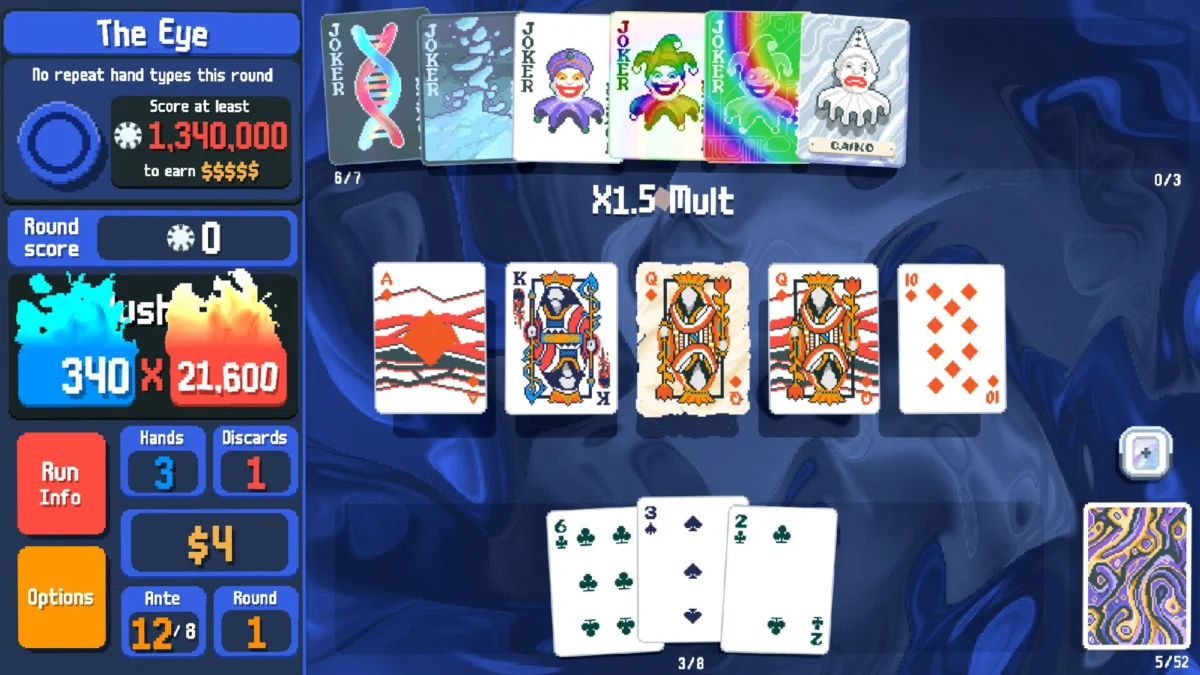
- Day 12 to Present: The latest milestone bridges neurobiology with strategic card gaming. A user within the digital community announced that the simulated structure had been successfully trained using a specialized reinforcement learning algorithm to play the critically acclaimed indie poker rogue-like game, Balatro.
Mechanics of the Balatro Experiment
Balatro, a game centered around illegal poker hands, strategic card manipulation, and exponential score scaling via Jokers, requires a high degree of forward planning, risk assessment, and resource management. Training a biological neural network model derived from a fruit fly to master such a complex, rules-based strategy game is a monumental challenge, given that a real insect’s cognitive capabilities are typically geared toward immediate environmental stimuli rather than long-term numerical optimization.
To bridge this gap, the developer utilized a customized algorithmic wrapper around the simulated fruit fly brain. The game’s current state—including available cards in hand, hand types, chip values, multipliers, and active Joker abilities—was parsed into a numerical vector that served as the artificial sensory input for the virtual neurons. Conversely, the output layer of the connectome was mapped to specific game actions: selecting cards to discard, playing a specific hand, or purchasing enhancements from the shop.
Through thousands of automated iterations, the algorithm utilized reinforcement learning, rewarding the simulated brain with positive feedback loops for successful rounds and negative feedback for losing hands. Over time, the structural pathways of the fly brain adapted within the simulation, finding patterns in card combinations that yielded optimal scores. According to the creator’s documentation shared online, the trained model has stabilized at an impressive 20% win rate across standard runs—a statistical achievement that proves even a simplified insect connectome can learn rudimentary probabilistic logic when guided by effective reward mechanisms.
Expert Reactions and Industry Perspectives
While the gaming community has largely celebrated these experiments as clever feats of engineering and internet humor, the scientific and AI research communities are viewing these developments with a mixture of amusement and analytical curiosity.
Dr. Elena Vance, a computational neuroscientist specializing in connectomics, noted that while these projects are unorthodox, they shed light on the fundamental universality of neural computation. "What we are seeing is not necessarily the fruit fly brain ‘playing’ these games in a conscious or biological sense, but rather the demonstration that a biologically evolved wiring diagram possesses robust information-processing capabilities," Vance explained. "The brain of Drosophila evolved to optimize survival under complex environmental constraints. When you force those same parallel processing pathways to evaluate game states or financial charts, you are essentially testing the generalized efficiency of nature’s network architecture."
Meanwhile, artificial intelligence researchers point out that these experiments highlight both the promise and the limitations of bio-inspired computing. Traditional artificial neural networks are designed from scratch with uniform architectures, whereas biological connectomes feature heterogeneous connections, specialized clusters, and feedback loops that differ significantly from standard deep learning models. By analyzing how a biological blueprint handles non-biological tasks, engineers may glean insights into designing more energy-efficient and adaptable AI accelerators in the future.
Broader Impact and Future Implications
The viral success of turning a fruit fly brain into a gamer, day trader, and driver raises broader questions about the future of open-source biological data and public access to advanced scientific datasets. The swift democratization of the FlyWire project demonstrates that modern computing power, combined with open-source ethos, allows everyday developers to interact with cutting-edge biological research in ways that were previously restricted to heavily funded academic institutions.
As these experiments continue to evolve, the community has begun discussing more ambitious projects. Discussions are already underway on GitHub and various developer forums regarding whether the connectome can be scaled, optimized, or merged with larger language models to create hybrid bio-digital intelligence agents. While practical applications for a fruit fly brain playing Balatro or trading cryptocurrency remain largely experimental and satirical, the underlying technical achievements are paving the way for serious advancements in neuromorphic computing.
For now, the digital fruit fly rests comfortably in its virtual ecosystem, having conquered low-resolution demons, platforming plumbers, financial markets, and now, the intricate statistical depths of illegal poker hands—proving once and for all that intelligence, whether biological or artificial, finds a way to play.