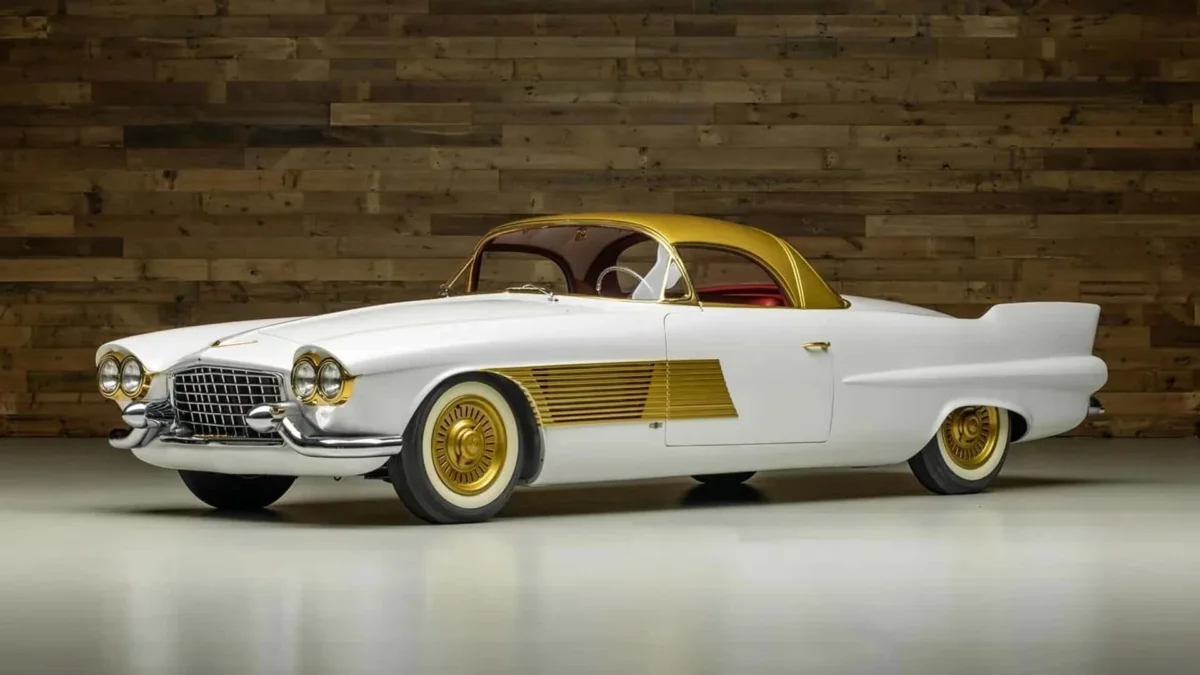
The automotive world witnessed a historic moment at the recent Kruse Auctions event in Auburn, Indiana, as a singular, gold-plated masterpiece—the 1953 Cadillac Elegante—commanded a final bid of $1,275,000. This staggering result establishes a new high-water mark for the Cadillac brand at public auction, surpassing the previous record of $940,000, which was set in 2023 by a 1934 V16 Fleetwood Aerodynamic Coupe. The sale of the Elegante, a one-off grand tourer that had largely remained shielded from the public eye for over seven decades, underscores a growing collector appetite for bespoke, coachbuilt American luxury vehicles that possess both impeccable provenance and unique historical significance.
A Masterpiece of Mid-Century Coachbuilding
The Elegante is not a product of mass-market assembly lines or standard factory trim packages. Built upon the robust foundation of a Cadillac Series 62 chassis, the vehicle represents an ambitious collaboration between American engineering and Italian artistry. The bodywork was masterfully executed by Carrozzeria Motto in Turin, Italy, a firm renowned for its work with some of the most exotic chassis of the era.
The design was penned by Albrecht von Goertz, a visionary who would later gain international acclaim for shaping the iconic BMW 507. During the early 1950s, however, the Elegante served as a critical project that helped establish his reputation in the high-end automotive design world. The fabrication process was a monumental undertaking, requiring 30 months of labor. In the currency of the 1950s, the development cost was estimated at approximately $30,000—a figure that, when adjusted for inflation, would represent a multi-million-dollar investment today. This astronomical cost for a single unit essentially precluded the possibility of a production run, cementing the Elegante’s status as a true one-off prototype.
Design, Detailing, and Theatrics
The aesthetic philosophy behind the Elegante was one of restrained, sophisticated opulence. The exterior features a pearlescent white finish complemented by a gold-painted roof, creating a striking visual contrast. The luxury extends to the smallest details: the door handles, the windshield frame, and various custom bronze components throughout the vehicle are plated in 24-karat gold.
Inside the cabin, the craftsmanship is equally meticulous. The interior is swathed in deep, rich burgundy Italian leather, framing a bespoke Lucite steering wheel that features an illuminated Saint Christopher medallion—a hallmark of period-correct luxury. Beneath the hood lies a 5.4-liter overhead-valve V8 engine, producing approximately 210 horsepower, which provides the performance to match the vehicle’s grand touring aspirations. The car also features an advanced electro-hydraulic retractable hardtop mechanism, a feature that was significantly ahead of its time when the vehicle debuted at the 1955 New York International Auto Show.
A Tumultuous History and Restoration
The journey of the Elegante from its debut to the auction block is a narrative of resilience. After its initial appearance on the international show circuit, the vehicle faced an uncertain future, as plans to manufacture a limited run of ten units failed to materialize. Over the subsequent decades, the car faded into obscurity, hidden away from the public gaze.
The vehicle eventually suffered significant damage during the destructive path of Hurricane Andrew in 1992. This disaster, while unfortunate, sparked a comprehensive, 16-year restoration effort that sought to return the vehicle to its original, showroom-floor glory. The project, which was finalized in 2014, was documented with such precision that it provided future bidders with the necessary confidence to invest at a seven-figure level. At the time of its sale, the Elegante possessed an odometer reading of just 4,331 miles, a testament to its status as a collector’s item rather than a daily driver.

Market Implications and Collector Trends
The $1.275 million sale price is more than just a headline; it serves as a bellwether for the evolving valuation of American coachbuilt classics. Historically, the premium tier of the auction market has been dominated by European exotics—Ferraris, Bugattis, and Jaguars—that benefit from a long-standing prestige associated with European coachbuilders. The success of the Elegante suggests that the collector market is increasingly recognizing the historical importance of American-based concepts and bespoke projects that integrate European craftsmanship.
Industry analysts note that the gap of more than $300,000 between this record and the previous Cadillac record indicates that "inconspicuous luxury" is gaining traction. Unlike the flashy, tail-finned customs that defined the late 1950s, the Elegante represents a more subtle, European-influenced elegance. This shift in collector taste—valuing technical provenance and designer pedigree over sheer size or chrome—is reshaping the hierarchy of the classic car market.
The Role of Provenance in Modern Auctions
For high-end collectors, the price paid for the Elegante was justified by its clean ownership history and its status as an unrepeatable artifact. Kruse Auctions marketed the vehicle as a unique opportunity to own a piece of automotive history that had never before been offered in a public forum. The importance of such provenance cannot be overstated; in a market where replicas and re-bodied cars are common, the ability to trace a vehicle’s lineage back to its 1950s inception is the primary driver of value.
The auction house characterized the vehicle as a perfect storm of "inconspicuous luxury, exclusivity, and theatrics," noting that it stands in a class of its own. For the buyer, the acquisition is likely viewed as an investment in art as much as an investment in machinery. By acquiring a vehicle with a documented restoration history and a lineage linked to a legendary designer like von Goertz, the purchaser has secured an asset that is effectively immune to the volatility of mass-produced vintage cars.
Future Outlook for Bespoke Cadillacs
The record-breaking sale of the Elegante serves as a reminder that the market for "oddball" projects and factory-sanctioned customs is maturing. Owners of such vehicles, or those considering acquisitions, are encouraged to conduct deep research into the historical archives of American manufacturers. Often, cars labeled as "shop customs" or "prototypes" possess deeper stories that, when properly verified, elevate them to the status of museum-grade artifacts.
As the industry moves forward, it is likely that other rare Cadillac concepts—many of which remain in private collections or forgotten in specialized garages—will see renewed interest. The success of the Elegante provides a template for how these vehicles should be presented to the market: with rigorous historical documentation, high-quality restoration, and a clear narrative that connects the car’s design to the broader cultural context of the mid-20th century.
While the vast majority of enthusiasts will never have the opportunity to participate in bidding for a seven-figure vehicle, the broader impact of this sale will be felt across the entire collector community. It validates the efforts of restorers, historians, and archivists who work to preserve these unique chapters of automotive history. As the dust settles on the Auburn auction floor, the Elegante remains a shining, gold-plated example of what happens when vision, investment, and preservation converge at the highest level of automotive excellence. Whether this record will stand for another seventy years remains to be seen, but for now, the 1953 Cadillac Elegante stands alone at the pinnacle of its brand’s history.