










The evolution of artistic photography in the United Kingdom has long been defined by a monochromatic palette. For decades, the high-art establishment viewed black-and-white imagery as the sole legitimate medium for documentary and gallery exhibitions, dismissing color photography as the domain of commercial advertising, family holiday albums, and amateur snapshots. However, a quiet revolution was taking place in the industrial heartlands of northern England during the 1970s. Peter Mitchell, a delivery truck driver navigating the soot-stained streets of Leeds, began documenting a disappearing urban landscape using a medium format camera and a bold, vibrant spectrum of color.
Decades after his pioneering work initially baffled contemporary art critics, Mitchell’s seminal photographic collection is returning to the public eye. RRB Photobooks, in collaboration with AB Editions, has announced the upcoming December 2026 publication of On Strange and Familiar Ground. This remastered, expanded edition revives a legendary, out-of-print collector’s item originally curated by renowned British photographer Martin Parr. Featuring newly discovered images spanning from the early 1970s into the 2000s, the forthcoming release offers a timely reevaluation of a visionary artist who captured the profound social and architectural shifts of post-war Britain.
The Delivery Driver Turned Avant-Garde Chronicler
During the early 1970s, Peter Mitchell’s daily routine involved operating a delivery truck across Leeds, a major industrial hub in West Yorkshire characterized by red-brick factories, terraced housing, and dense manufacturing districts. As he traversed the city, Mitchell maintained a meticulous notebook, jotting down street corners, storefronts, and local characters that caught his analytical eye.
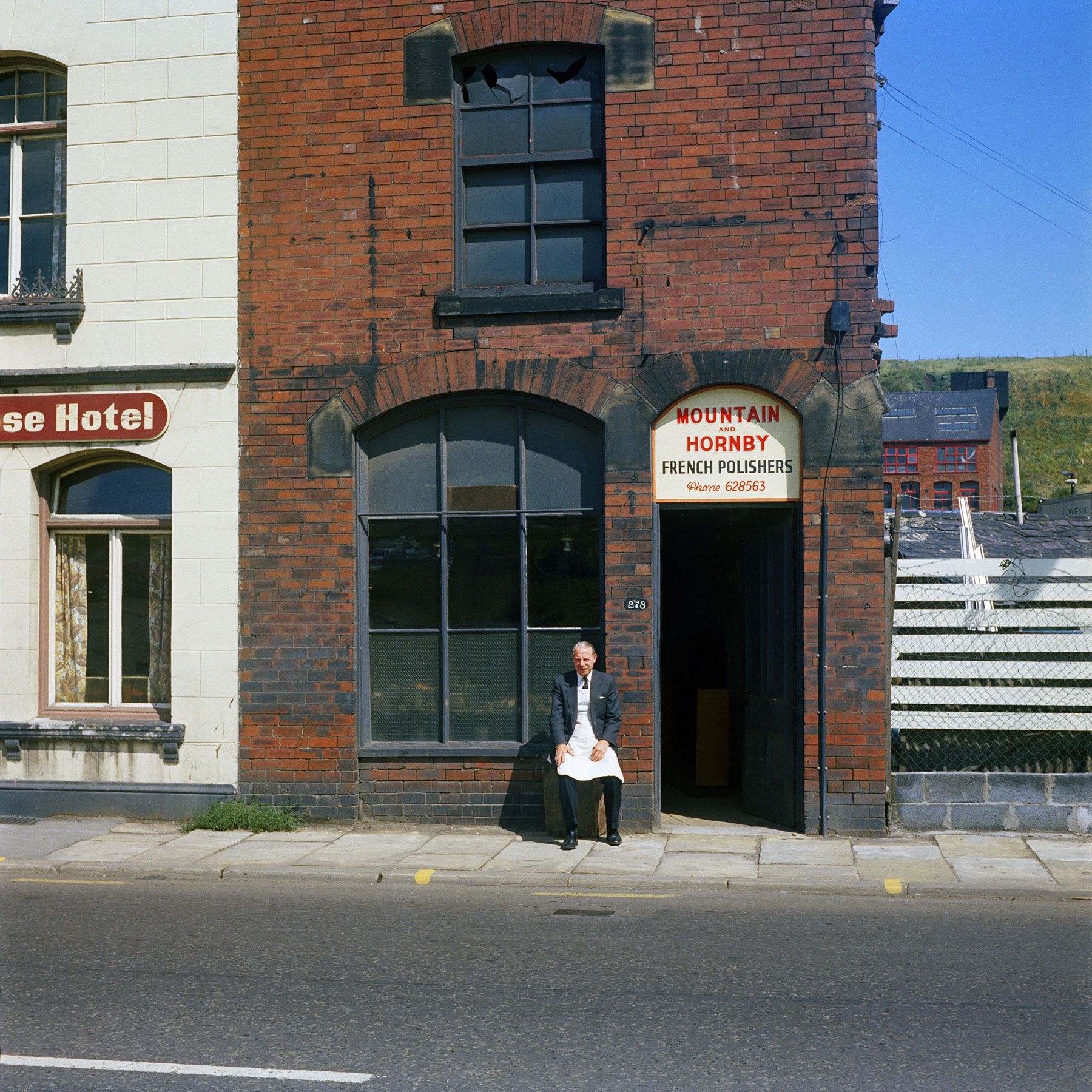
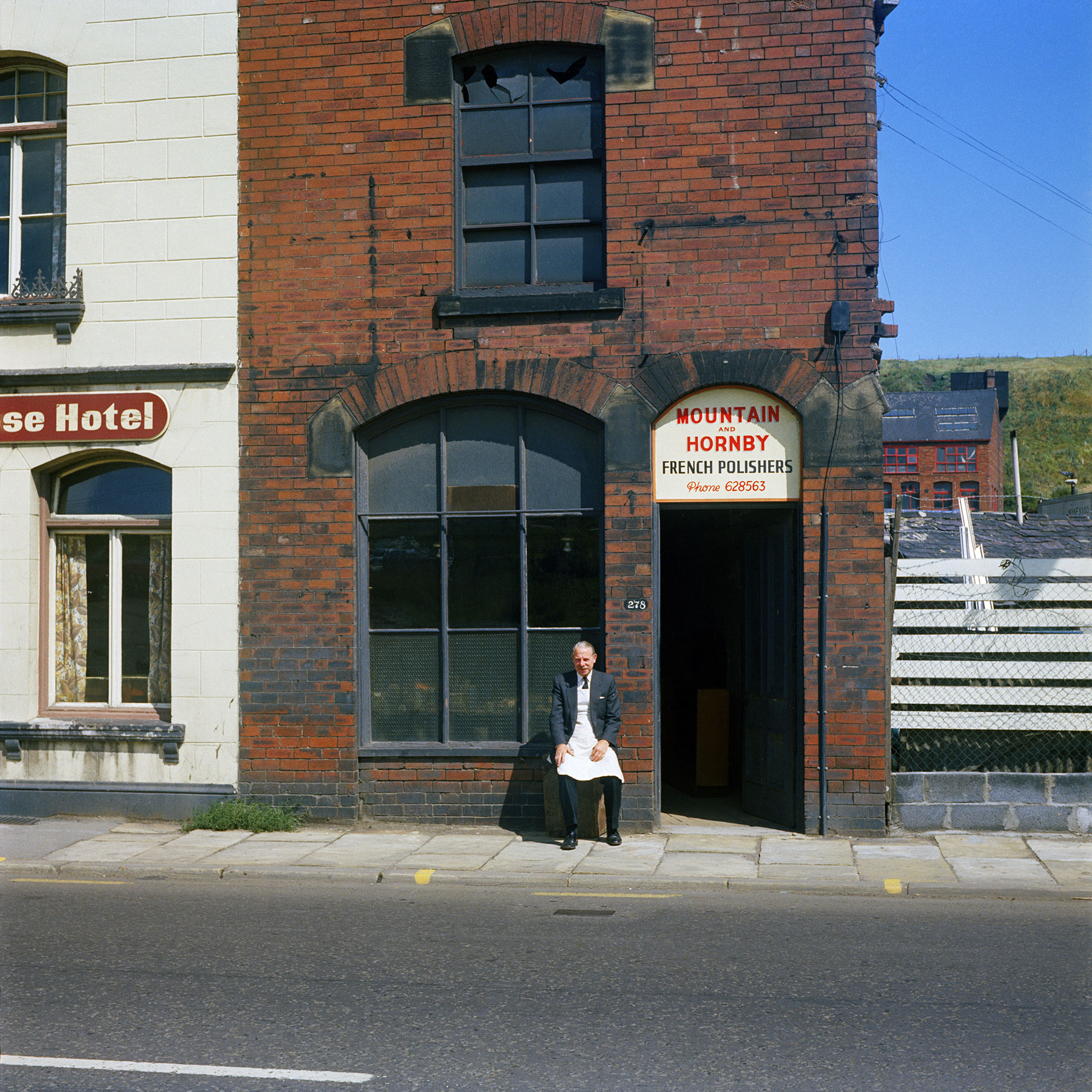
Unlike spontaneous street photographers who relied on 35mm compact cameras for candid snapshots, Mitchell adopted a deliberate, methodical approach. He would scout locations during his workday and return on Sunday mornings—when the bustling industrial city paused its operations—equipped with a heavy medium format camera and a stepladder. By positioning his camera directly across the street, he achieved a formal, frontal perspective. These compositions featured local shopkeepers standing proudly in their doorways, factory workers gathered at gates, and traditional neighborhoods undergoing sweeping clearance and demolition.
What set Mitchell apart from his British contemporaries was his steadfast commitment to color stock. While artists working within the British gallery system strictly adhered to monochrome aesthetics to signal artistic seriousness, Mitchell viewed his immediate environment through a chromatic lens. As he frequently noted, Leeds may have carried a reputation for industrial drabness, but its working-class communities, painted signage, and peeling storefronts were never devoid of vivid color.
A Confounding Debut: The 1979 York Exhibition
The culmination of Mitchell’s early fieldwork materialized in 1979 with a solo exhibition at the Impressions Gallery in York. Titled with ironic science-fiction detachment as A New Refutation of the Viking 4 Space Mission, the exhibition achieved a historic milestone: it marked the first-ever color photography exhibition held by a British photographer at a dedicated British photography gallery.
To contextualize the radical nature of this presentation, exhibition visitors were greeted by a conceptual framework suggesting that an extraterrestrial visitor from Mars had landed in Yorkshire and was wandering through Leeds in a state of profound puzzlement. Mitchell mounted his color prints onto astronomical space charts, merging cosmic scale with hyper-local, mundane reality.
The art establishment’s reaction, however, was not immediate critical acclaim, but rather widespread disorientation. Martin Parr, who later became one of Britain’s most celebrated documentary photographers, reflected on the historic exhibition by recalling that it was so profoundly ahead of its time that gallery attendees simply did not know how to react, save for experiencing total bewilderment. The British art world was not yet equipped to process color documentary photography as high art, causing Mitchell’s groundbreaking contribution to slip into relative obscurity for over three decades.

Rediscovery and the Legacy of Strangely Familiar
Mitchell’s journey from an overlooked regional photographer to a recognized pillar of British documentary history gained significant momentum in 2013. Martin Parr, recognizing the historical and aesthetic value of Mitchell’s archive, selected 47 iconic images for the publication Strangely Familiar.
The book struck a chord with contemporary photography enthusiasts, quickly selling out and transitioning into a highly sought-after collector’s item traded at steep prices among connoisseurs. The acclaim validated Mitchell’s insistence on the cultural importance of ordinary urban spaces. However, because Strangely Familiar had long been out of print, access to Mitchell’s comprehensive body of work remained severely limited.
The upcoming December 2026 release of On Strange and Familiar Ground addresses this gap by expanding significantly upon the 2013 selection. The 96-page volume features meticulously rescanned and remastered images from Mitchell’s extensive archive, incorporating previously unseen photographs that extend the timeline from the 1970s into the 2000s.
Documenting the Anatomy of Deindustrialization and Loss
Beneath the jovial warmth and deadpan humor of Mitchell’s photography lies a profound undertone of social and historical loss. The Leeds captured in his lens was a city undergoing radical municipal transformation. Traditional manufacturing industries, family-owned retail shops, and Victorian terraced neighborhoods were systematically cleared to make way for modern urban planning initiatives, many of which would later face their own structural failures.
Among Mitchell’s recurring subjects was the demolition of the expansive Quarry Hill Flats—a massive municipal housing estate that once stood as a modernist utopia before succumbing to decay. The photographer documented the final stages of its destruction, capturing the demolition crew posing triumphantly atop the last remaining architectural arch.
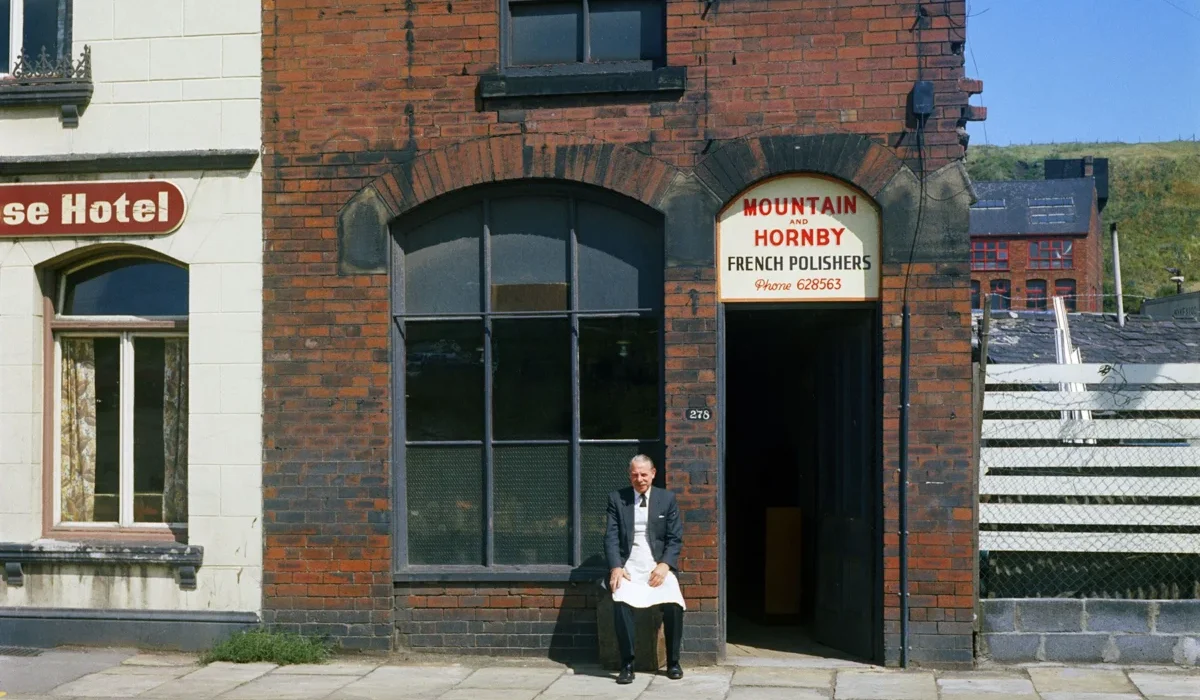
Other images preserve fleeting trades and micro-economies that have since vanished entirely from the British high street. In his captions, which serve as an integral narrative layer to the book, Mitchell reflects on this erasure. Writing about a local French polisher photographed sitting on a wooden crate outside his workshop, Mitchell observed the fading nature of human labor: it is not merely the people and buildings that become ghosts, but entire professions that disappear, noting that contemporary society rarely requires the services of a traditional French polisher.

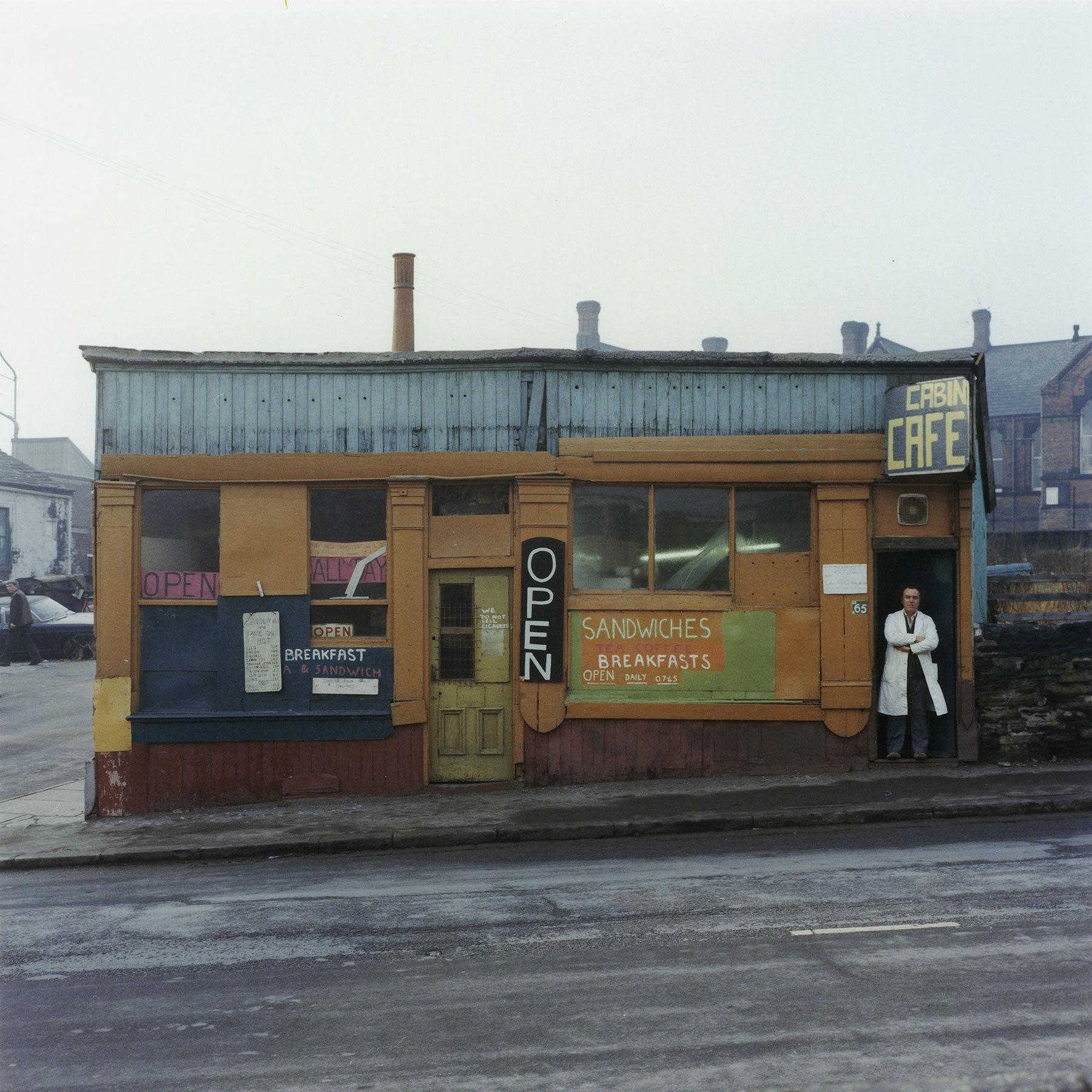
Other iconic figures featured in the collection include Mr. Gower, standing with folded arms in his white coat outside the patchwork-clad Cabin Cafe; George Clegg’s East End Tool Stores, described by Mitchell as a former pawnshop that accumulated so many unredeemed pledges it accidentally transformed into a hardware store; and the female workers of the J.W. Plant flag factory holding Union Jacks during celebrations for Queen Elizabeth II’s Silver Jubilee in 1977. Francis Gavan and his broken-down fairground ghost train also recur throughout the archive, serving as a poignant, surreal mascot for a changing working-class landscape.
Broader Impact and Publishing Details
The historical importance of On Strange and Familiar Ground extends far beyond local Yorkshire history; it serves as a crucial missing link in the global narrative of color photography. While American photographers like William Eggleston and Stephen Shore are universally credited with pioneering color fine-art photography during the 1970s, Peter Mitchell was pursuing a parallel, independent trajectory in northern England, operating entirely outside the mainstream art market.
By capturing the twilight of industrial Britain with medium format precision and unpretentious empathy, Mitchell documented a pivotal juncture in modern socioeconomic history. The re-release of his work provides art historians, sociologists, and contemporary photographers with an unvarnished window into a society navigating the painful transition from industrial manufacturing to a post-industrial future.
RRB Photobooks and AB Editions have scheduled the publication of On Strange and Familiar Ground for December 2026. The standard 96-page softcover edition is priced at $48 / £35, with a pre-order rate of $38 / £28. Additionally, a special limited collector’s edition is available for $128 / £95 ($101 / £75 on pre-order), presented in a custom slipcase and accompanied by a 10 x 8-inch archival pigment print of the Red Brick Cafe, 1992.
Through this definitive publication, Peter Mitchell’s pioneering vision is finally secured in its rightful place at the pinnacle of British documentary photography—transforming the ordinary, overlooked corners of working-class England into enduring monuments of visual history.