









The landscape of generative artificial intelligence is undergoing a profound conceptual shift. For years, the undisputed gold standard for text generation has been the autoregressive, GPT-style architecture. Operating on a strict token-by-token basis, these models predict the single most probable next word in a sequence, append it to the context window, and repeat the process until a complete thought or document is formed. While remarkably effective, this paradigm introduces a fundamental computational bottleneck known as serial dependency: a model cannot generate the tenth word until it has fully processed and generated the ninth.
However, recent advancements spearheaded by open-source research and major technology labs are challenging the necessity of sequential text generation. Diffusion language models, long celebrated for their success in transforming random noise into high-fidelity images, have successfully leaped into the realm of natural language processing (NLP). Pioneering projects and model releases such as LLaDA, Mercury, and Gemini Diffusion in 2025, followed closely by Google’s DiffusionGemma in 2026, have ignited a vibrant debate across the machine learning community. By demonstrating that text can be generated through iterative refinement rather than strict sequential prediction, these models are prompting researchers to re-examine the core mechanics of how machines write.
Background and Context: From Continuous Pixels to Discrete Tokens
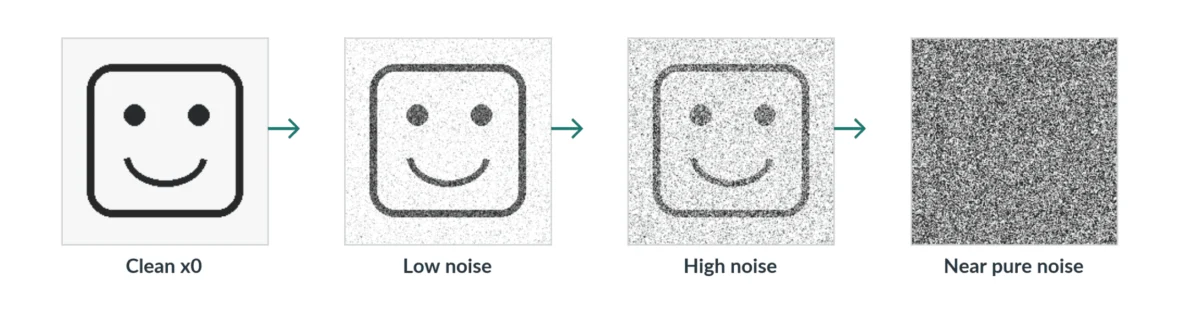
To understand the significance of diffusion language models, one must first examine the historical trajectory of diffusion probabilistic models. The foundational mathematics of diffusion were popularized by seminal machine learning research, notably the 2020 Denoising Diffusion Probabilistic Models paper. In the domain of computer vision, diffusion operates by taking a clean image, progressively corrupting it by adding Gaussian noise over a series of timesteps, and then training a neural network to reverse this corruption process.
This methodology relies heavily on the continuous nature of pixel values. A slight numerical adjustment to a pixel still yields a recognizable, albeit slightly degraded, visual shade. Applying this same framework to human language, however, presented a monumental hurdle for researchers. Text is fundamentally discrete, composed of fixed token identifiers within a massive vocabulary. Adding a standard Gaussian noise vector to a discrete token ID does not yield a "nearby" word; instead, it results in an invalid or nonsensical index.
For years, this mathematical incompatibility relegated diffusion approaches primarily to continuous data modalities like audio and vision. Text generation remained firmly in the domain of autoregressive transformers and masked language models like BERT, which were typically used for understanding rather than open-ended generation. The recent breakthroughs in 2025 and 2026 mark a turning point where researchers successfully bridged the gap between continuous diffusion mathematics and discrete linguistic structures, most notably through masked diffusion techniques.
Mechanics of Diffusion Text Generation: Autoregressive vs. Diffusion
To grasp the operational differences between the two paradigms, it is helpful to analyze their mathematical foundations and execution workflows.
Traditional GPT models are autoregressive, meaning they factorize the joint probability of a sequence ( x = (x_1, dots, x_N) ) as the product of conditional probabilities:
[
p(x) = prod_i=1^N p(x_i mid x1, dots, xi-1)
]
During training, engineers leverage teacher forcing to process multiple token positions in parallel, maximizing computational efficiency on modern hardware accelerators like GPUs and TPUs. Yet, at inference time, this parallelism vanishes. Because each token depends strictly on its predecessors, generation becomes an inherently sequential, unroll-heavy loop.
Masked diffusion language models discard this strict left-to-right restriction. Instead of appending tokens one by one, a diffusion model initiates generation with an empty canvas or a sequence filled entirely with placeholder tokens, designated as [MASK]. Through a series of iterative denoising steps, the model predicts the vocabulary distribution across multiple unresolved positions simultaneously. It then commits high-confidence predictions while keeping ambiguous positions masked for subsequent refinement rounds.
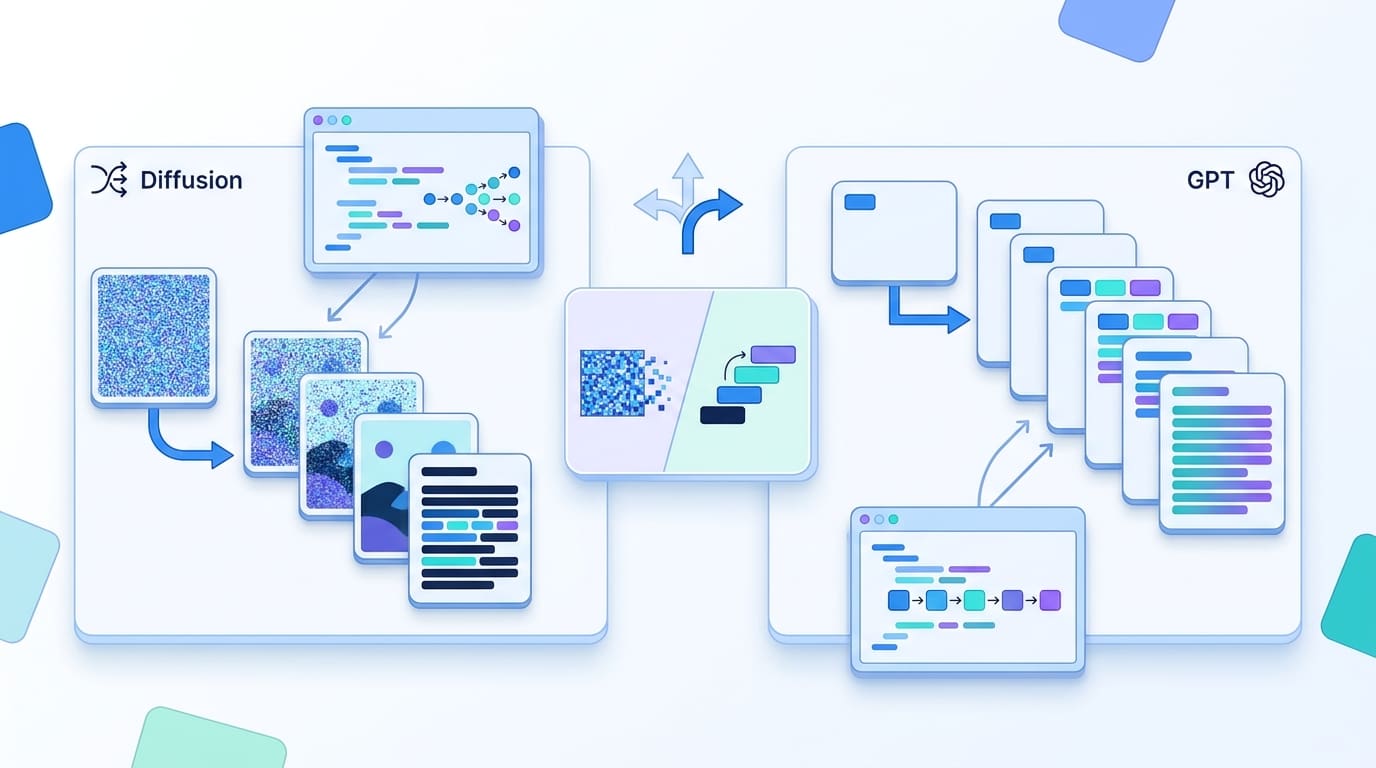
This divergence can be visualized through a comparative progression of a simple sentence:
| Round | Autoregressive Output (GPT-Style) | Masked Diffusion Output |
|---|---|---|
| 1 | The | [MASK] [MASK] [MASK] [MASK] |
| 2 | The cat | The [MASK] sat [MASK] |
| 3 | The cat sat | The cat sat [MASK] |
| 4 | The cat sat down | The cat sat down |
As demonstrated, autoregressive models extend a sequence outward, whereas diffusion models globally refine a sequence inward from generalized structure to specific terminology.
Forward and Reverse Diffusion in Language
The lifecycle of a diffusion language model is divided into two primary phases: training via the forward process and generation via the reverse process.
In the training phase, clean text sequences are subjected to a simulated corruption process. Rather than injecting continuous Gaussian noise, masked diffusion models corrupt training data by randomly replacing tokens with a special [MASK] token. The degree of corruption is governed by a noise schedule or timestep parameter ( t ) ranging from 0 (completely clean) to 1 (completely masked). Each token in a sequence is independently replaced by a mask with a probability corresponding to ( t ).
The neural network is subsequently trained to act as a denoiser, tasked with recovering the original, uncorrupted tokens given the heavily masked input. By training the model across various noise levels simultaneously, the network develops a robust internal representation of syntactic and semantic context, learning how words interrelate regardless of their linear distance in a sentence.
During inference, the reverse process takes over. The model begins with a sequence consisting entirely of [MASK] tokens or a noisy initialization. A specialized sampling algorithm evaluates the probability distribution of the vocabulary for every masked position. Depending on the specific sampler implementation, the model may commit confident predictions early while utilizing subsequent steps to revise, adjust, or completely remask tokens that clash with the newly emerging context. This capability—often referred to as revision or dynamic backtracking—stands in stark contrast to autoregressive models, which generally cannot alter a previously emitted token without restarting the generation sequence from that point.
Industry Adoption and Technological Implications
The emergence of models such as LLaDA, Mercury, Gemini Diffusion, and DiffusionGemma reflects a broader industry quest to overcome the latency and throughput bottlenecks inherent in large-scale autoregressive deployment. As enterprise applications demand real-time responses for complex reasoning, coding, and multimodal interactions, reducing inference latency has become a top priority for AI research laboratories.
The primary allure of diffusion language models lies in their potential for parallel generation. By predicting blocks of tokens or entire passages across a few dozen sampling steps rather than hundreds of sequential token-generation steps, diffusion models open the door to radically faster inference profiles. Furthermore, the ability to globally condition text generation means that a diffusion model can establish the thematic ending or structural backbone of a document early in the generation process and fill in the fine-grained details during subsequent refinement rounds.
However, transitioning from theory to mainstream production is not without significant hurdles. Several technical challenges continue to fuel debate within the machine learning community:
- Sampling Efficiency and Compute Overhead: While diffusion models can theoretically generate multiple tokens in parallel, running multiple reverse-diffusion sampling steps can introduce its own computational overhead. Balancing the number of function evaluations against the speed gains of parallelism remains a delicate optimization problem.
- Evaluation and Alignment: Traditional alignment techniques, such as Reinforcement Learning from Human Feedback (RLHF) and Direct Preference Optimization (DPO), have been heavily optimized for autoregressive architectures. Adapting these reward structures to non-monotonic, iterative text refinement models requires entirely new mathematical formulations.
- Training Stability: Training models to consistently resolve global context from heavily masked inputs requires careful hyperparameter tuning to prevent semantic drift or repetitive token generation loops during the early stages of sampling.
Broader Impact and Future Outlook
Despite these ongoing research challenges, industry analysts and machine learning practitioners view diffusion language models not as an immediate, wholesale replacement for GPT-style architectures, but rather as a complementary paradigm that redefines how computational resources are allocated during inference.
The future of generative AI may well lie in hybrid systems—architectures that combine the precise, locally constrained logic of autoregressive models with the global, non-linear text planning capabilities of diffusion models. As research laboratories continue to refine training algorithms and optimize samplers, the boundary between continuous and discrete generative modeling will continue to blur, ushering in a new era of faster, more flexible, and structurally aware artificial intelligence systems.