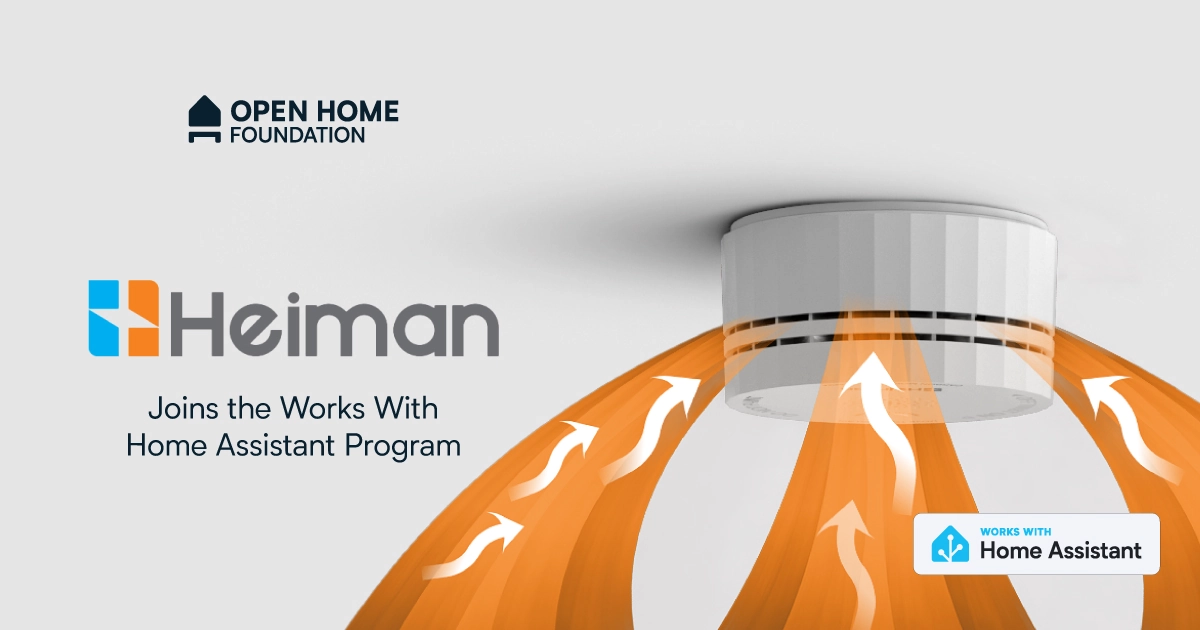
Heiman, a global leader in smart security and fire protection technology, has officially become the first hardware manufacturer to join the Works with Home Assistant program in 2026. This partnership marks a significant milestone for the smart home ecosystem, following a year of rapid expansion in 2025 that saw 12 new partners join the initiative. The collaboration focuses on bringing high-reliability, safety-critical devices—including the world’s first Matter-certified carbon monoxide (CO) alarms—into a local-first control environment. By aligning with the Open Home Foundation’s core principles of privacy, choice, and sustainability, Heiman and Home Assistant aim to redefine how consumers approach domestic safety through interoperable, cloud-independent technology.
Founded in 2005 and headquartered in Shenzhen, Heiman has spent over two decades specializing in the research, development, and manufacturing of smart home security solutions. The company’s entry into the Works with Home Assistant program introduces a suite of sensors designed to meet rigorous international safety standards, including smoke detectors, CO alarms, and leak sensors tailored for markets across the United States, Europe, and Asia. This move is seen as a strategic push to bridge the gap between traditional professional-grade security hardware and the burgeoning DIY smart home market.
The Strategic Importance of Local Control in Life-Safety Systems
The "Works with Home Assistant" certification is not merely a badge of compatibility; it is a verification of a manufacturer’s commitment to local control. In the context of life-safety devices such as smoke and carbon monoxide detectors, the distinction between local and cloud-based control is a matter of critical reliability. Standard smart home devices often rely on manufacturer-hosted cloud servers to process signals and send notifications. If an internet connection fails or a company’s server experiences downtime, the "smart" functionality of these devices can be rendered useless precisely when it is needed most.
By adhering to the Open Home Foundation’s principles, Heiman’s certified devices ensure that all automation and communication occur within the local home network. If a smoke detector identifies a fire, the signal is processed by the Home Assistant hub—such as the Home Assistant Green—without needing to ping a remote server. This allows for instantaneous, fail-safe automations. For example, a detected CO leak can immediately trigger a command to shut off a smart-integrated gas fireplace or HVAC system, while simultaneously turning on all smart lights to a bright white setting to assist in a safe evacuation. This local-first architecture ensures that safety protocols remain operational even during a total internet outage.
Advancing the Matter and Thread Ecosystem
A central pillar of this new partnership is Heiman’s adoption of Matter over Thread. Matter is an industry-unifying connectivity standard designed to eliminate the silos between different smart home platforms. It allows a single device to work seamlessly across Home Assistant, Apple Home, Google Home, and Amazon Alexa. Heiman’s commitment to Matter ensures that consumers are not locked into a proprietary ecosystem, promoting long-term sustainability and device longevity.
The choice of Thread as the underlying transport protocol for these devices is equally significant. Unlike traditional Wi-Fi, which can be power-hungry and prone to congestion, Thread is a low-power wireless mesh network. It is specifically designed for battery-operated devices like sensors and alarms. Because Thread creates a self-healing mesh, every mains-powered device in the network can act as a router, extending the range and reliability of the system. For a homeowner, this means that a smoke alarm in a distant garage or attic can maintain a robust connection to the central hub by hopping through other Thread devices, ensuring no corner of the property is left unmonitored.
Chronology of Development and Certification
The integration of Heiman into the Works with Home Assistant program is the result of a multi-year shift in the smart home industry toward open standards.
- 2005: Heiman is established, focusing on industrial and residential safety sensors.
- 2022: The Matter 1.0 specification is released, promising a new era of interoperability.
- 2024-2025: Home Assistant experiences record growth, certifying 12 new partners and refining the testing protocols for the "Works with" program.
- Late 2025: Heiman begins the rigorous certification process with the Home Assistant in-house testing team.
- January 2026: Heiman’s Matter-certified CO and smoke alarms pass all local-control and interoperability benchmarks.
- February 2026: Official announcement of the partnership, making Heiman the inaugural partner of the year.
The testing process conducted by the Home Assistant team involved the use of the Home Assistant Green hub equipped with the Home Assistant Connect ZBT-2 (Zigbee/Thread/Matter controller). Each device was subjected to scenarios testing its response time, battery efficiency, and "fallback" capabilities, ensuring that the devices continue to function as traditional "dumb" alarms even if the smart network is being reconfigured.
Industry Implications and Market Data
The smart home security market is projected to reach a valuation of over $30 billion by 2030, with a significant portion of that growth driven by environmental sensors. As insurance companies begin to offer discounts for homes equipped with monitored smart leak and fire protection, the demand for reliable, non-proprietary hardware is surging.
Heiman’s entry into the program addresses a specific void in the market. Prior to this partnership, the Works with Home Assistant program featured only one Zigbee-based smoke alarm. The addition of Heiman’s Matter-over-Thread lineup significantly expands consumer choice. Furthermore, Heiman’s global manufacturing scale allows these devices to be positioned at an accessible price point. Historically, smart safety sensors have been viewed as luxury items due to high entry costs and the requirement for expensive monthly subscriptions. Heiman and Home Assistant are challenging this model by offering high-spec hardware that requires no ongoing fees to maintain local smart functionality.
Official Responses and Collaborative Vision
The partnership has been met with enthusiasm from both the engineering and community-engagement sectors of the smart home industry. Leo Xie, Software Engineer Manager at Heiman, emphasized that the company’s core mission is to democratize safe and intelligent living.
"Home Assistant, as a world-leading open-source smart home platform, has an open and inclusive ecological philosophy and strong compatibility with multi-brand and multi-protocol devices," Xie stated. "We deeply understand that only by integrating into an open ecosystem can we break down device barriers and provide users with a truly seamless whole-house smart solution."
Beyond hardware certification, Heiman has committed to an active role within the Home Assistant community. The company intends to participate in developer forums and user discussions to gather real-world feedback. This feedback loop is expected to inform future product development, ensuring that the next generation of Heiman sensors addresses specific user pain points, such as easier battery replacement or more granular sensitivity settings.
Broader Impact on Consumer Privacy and Sustainability
One of the most profound implications of this partnership is the protection of consumer data. In an era where smart home cameras and sensors are frequently scrutinized for data leaks or unauthorized cloud access, the Heiman/Home Assistant integration stands as a model for privacy. Because the devices communicate locally, sensitive data regarding when a home is occupied or the specific layout of a residence never leaves the premises.
Sustainability is also a key factor. By using the Matter standard, Heiman ensures that its devices will remain compatible with future hubs and platforms long after a specific app or server might be discontinued. This reduces electronic waste by preventing "orphaned" hardware—devices that become e-waste simply because a manufacturer decided to shut down a cloud service.
Conclusion and Future Outlook
The addition of Heiman to the Works with Home Assistant program is a clear signal that the industry is moving away from closed "walled gardens" and toward a future defined by the Open Home. For Home Assistant users, the certification of Heiman’s Matter-over-Thread devices provides peace of mind, knowing that their safety infrastructure is built on a foundation of transparency and technical excellence.
As 2026 progresses, the Home Assistant team has indicated that discussions are already underway regarding the certification of additional Heiman products, including water leak detectors and specialized industrial sensors. This partnership not only secures the home but also secures the future of open-source smart home technology as a viable, professional-grade alternative to proprietary ecosystems. By combining Heiman’s manufacturing expertise with Home Assistant’s robust software platform, the two organizations are setting a new benchmark for what a safe, private, and sustainable smart home should look like.