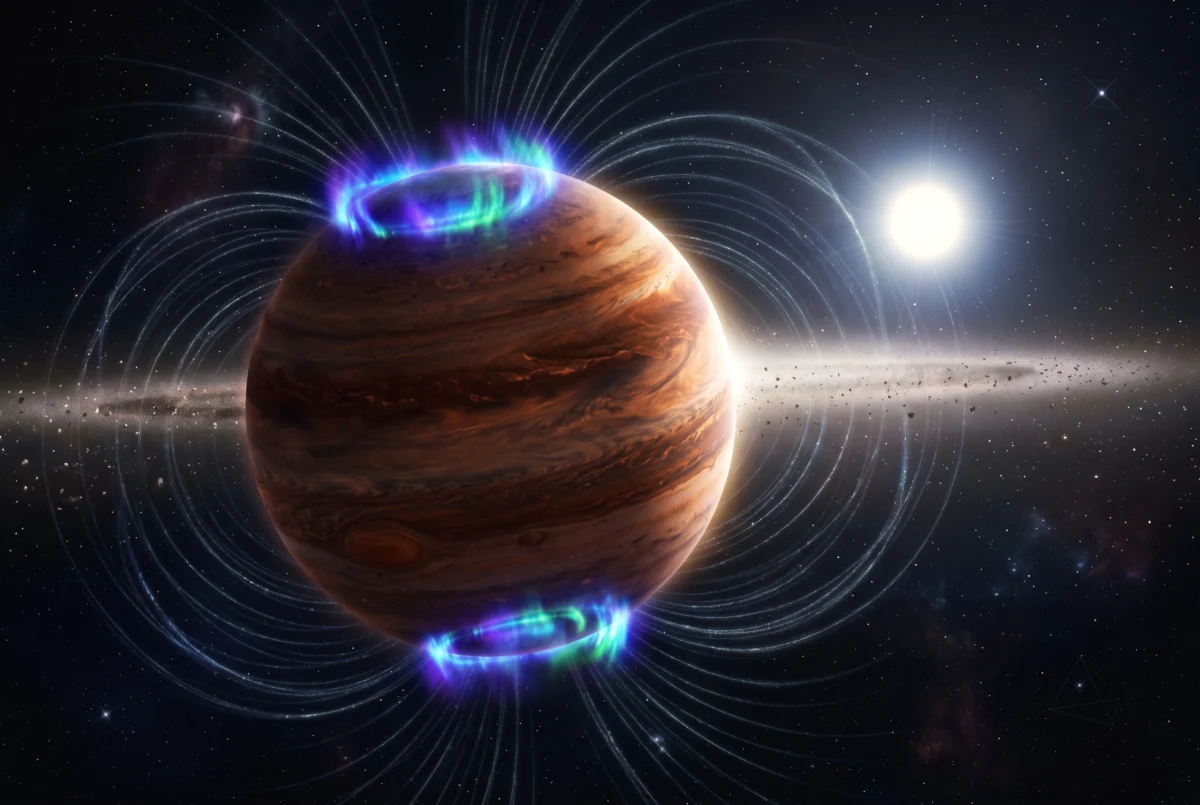
In a landmark achievement that reshapes our understanding of planetary environments beyond our solar system, researchers at the Center for Astrophysics | Harvard & Smithsonian have successfully isolated and confirmed the first direct radio emission originating from an exoplanet. The subject of this study, Beta Pictoris b, is a massive gas giant located approximately 63 light-years from Earth. While astronomers have long hypothesized that exoplanets with strong magnetic fields should produce radio signatures similar to those of our own solar system’s gas giants, this observation marks the first time such a signal has been empirically captured, verified, and analyzed with precision.
The discovery, detailed in recent findings, was made possible through the use of the MeerKAT radio telescope array in South Africa. Over the course of four intensive observational campaigns conducted between 2025 and 2026, the research team identified both steady radiation and intense, episodic bursts characterized by strong circular polarization—a definitive signature of auroral processes. By utilizing distant quasars as geometric reference points to calibrate the array and filter out stellar interference, scientists were able to definitively attribute the signal to the planet itself rather than its parent star, Beta Pictoris.
The Mechanism of the Aurora
While the term "radio signal" might lead to speculation regarding extraterrestrial intelligence, researchers have clarified that the emissions are entirely natural. The phenomenon is a radio aurora, generated through the interaction of high-energy charged particles with the planet’s intense magnetic field. As these particles accelerate along magnetic field lines and plunge into the planet’s upper atmosphere, they emit electromagnetic radiation in the radio spectrum.
On Earth, this process is responsible for the visual beauty of the Northern and Southern Lights. Similarly, Jupiter’s magnetosphere produces powerful radio bursts as it interacts with the solar wind. However, the radio aurora detected at Beta Pictoris b operates on a magnitude that dwarfs anything witnessed within our own solar system. This discovery provides the first direct empirical evidence of a "magnetosphere" around a planet orbiting another star, a crucial variable in determining a planet’s long-term habitability and its interaction with the host star’s radiation environment.
Chronology of the Observation
The road to this discovery began with the initial detection of Beta Pictoris b in 2008, when direct imaging techniques first revealed the massive world orbiting its host star. Because the planet is located at a significant angular distance from the star—a configuration known as a wide-orbit exoplanet—it became an ideal candidate for long-term study.
Between 2025 and 2026, the research team engaged in a series of data collection runs using the MeerKAT array. The timeline of the investigation unfolded as follows:
- Early 2025: Initial planning and selection of quasar calibration points to ensure the integrity of the radio data.
- Mid-2025 to Early 2026: Four dedicated observation sessions focused on capturing the planet at various points in its orbit to monitor for potential variance in signal intensity.
- Spring 2026: Preliminary data processing identified periodic spikes in radio frequency, which were then subjected to rigorous peer-review analysis to rule out noise, terrestrial interference, or stellar flares.
- Late 2026: Final confirmation of the radio aurora and the subsequent calculation of the planet’s magnetic field strength.
Supporting Data and Physical Analysis
The data gathered from the MeerKAT array provided more than just a signal; it acted as a diagnostic tool for the planet’s internal structure. By analyzing the radio frequencies—which reached as high as 3.5 GHz—physicists were able to calculate the strength of the magnetic field in the emission zone.
The results are staggering: the magnetic field at Beta Pictoris b is at least 2,500 times stronger than the surface magnetic field of Earth. This intensity significantly exceeds that of Jupiter, which is the most magnetically active planet in our solar system. Given that Beta Pictoris b is estimated to be between 10 and 12 times the mass of Jupiter and completes a full rotation in just eight to nine hours, the immense magnetic field is likely driven by the rapid convective movement of metallic hydrogen within the planet’s interior.

The rapid rotational period, combined with the planet’s extreme mass and turbulent magnetic environment, creates a hostile, high-energy atmosphere. While the study provides invaluable data for planetary science, it also confirms that Beta Pictoris b is not a candidate for biological life as defined by current astrobiological standards.
Broader Scientific Implications
The successful detection of these radio waves marks the beginning of a new era in exoplanetary research. For decades, the primary methods of detecting exoplanets—the transit method and radial velocity—have focused on gravity and light blockage. Radio astronomy now offers a third, distinct pillar of investigation.
By observing radio emissions, scientists can now map the magnetospheres of distant worlds. A planet’s magnetic field acts as a protective shield, deflecting harmful stellar winds and radiation. Understanding the magnetic properties of exoplanets is therefore essential for characterizing the surface environment of smaller, potentially rocky worlds that might exist in the same systems.
"This is not just about one giant planet," noted an independent astrophysicist familiar with the study. "This is about proving that we have the technical capacity to ‘listen’ to the magnetism of worlds that are tens of light-years away. It opens a window into the internal geophysics of planets that we otherwise would never be able to probe directly."
Expert Responses and Future Outlook
The scientific community has reacted to the news with significant enthusiasm. By validating the use of radio arrays to isolate faint signals from the glare of host stars, this study has paved the way for future missions. The ability to use quasars as "fixed anchors" for calibration is expected to become a standard protocol for future radio-based exoplanet surveys.
Looking ahead, the team behind the discovery intends to expand their observation to other massive gas giants in similar orbits. The goal is to determine whether the powerful auroral displays observed at Beta Pictoris b are a standard feature of high-mass gas giants or if there are significant variations in magnetic field generation that depend on age, composition, or orbital distance.
Furthermore, this breakthrough emphasizes the importance of global collaboration in radio astronomy. The use of the MeerKAT array, a world-class facility in the Karoo region of South Africa, underscores how critical geographical placement and specialized hardware are to resolving the subtle, low-frequency signatures of distant celestial bodies.
As research continues, the focus will likely shift toward refining the models used to interpret these radio signals. With the data from Beta Pictoris b serving as a foundational benchmark, scientists can now construct more accurate simulations of how planetary magnetic fields interact with the high-energy environments of young stars.
In conclusion, while Beta Pictoris b remains a world of extreme conditions and intense, swirling magnetic storms, it has provided humanity with a fundamental lesson in cosmic observation. By tuning into the radio frequencies of the universe, we have moved one step closer to mapping the invisible forces that govern the evolution and stability of planets across our galaxy. The silent, invisible dance of charged particles in the distant atmosphere of this giant world has finally been heard, marking a historic turning point in the field of observational astronomy.